Wills in Qatar for Expats: Nationality, Foreign Wills, Qatar Assets, and Cross-Border Estate Planning
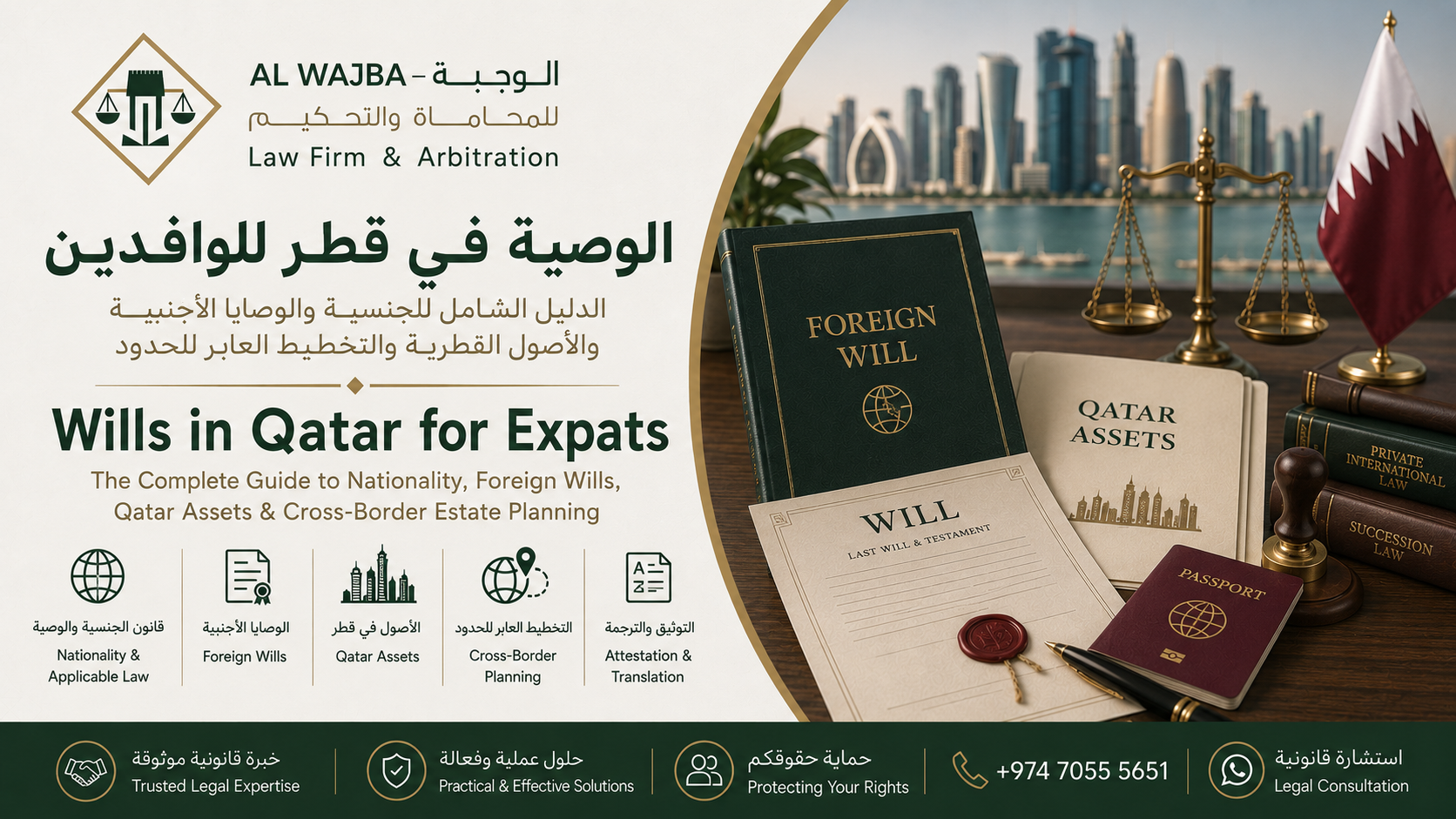
Wills in Qatar for Expats: Nationality, Foreign Wills, Qatar Assets, and Cross-Border Estate Planning
An expat will in Qatar is not simply a standard Qatar will with a foreign passport attached. Nationality can affect the law governing inheritance and testamentary dispositions, a foreign will may have its own execution rules, and Qatar assets can still require local evidence, court and transfer procedures.
This guide focuses on those cross-border questions. For the general rules on making, changing and proving a will where Qatar Family Law applies, see Wills in Qatar. For the wider succession framework, start with Inheritance in Qatar.
Inheritance guides in Qatar
Explore the main inheritance guide, general will rules, estate distribution, inheritance disputes, legal support, and related Family Court resources.
The broad Family Law guide covering divorce, custody, support, marriage documents, inheritance, and Family Court matters in Qatar.
The main guide to inheritance rules, estate distribution, wills, family settlements, and inheritance disputes in Qatar.
Legal support for inheritance disputes, estate distribution, wills, family settlement agreements, and succession issues in Qatar.
A practical guide to Sharia inheritance shares, heirs, estate obligations, assets, debts, wills, valuations, and distribution steps in Qatar.
A guide to disputed heirs, contested estate assets, debts, wills, family disagreements, evidence, settlement, and court options in Qatar.
The general guide to will validity, the one-third rule, wills to heirs, capacity, evidence, revocation, and estate execution in Qatar.
A focused guide for expatriates on nationality rules, foreign wills, Qatar assets, attestation, translation, coordinated wills, and cross-border estate planning.
A guide to settlement between heirs, takharuj, agreed estate division, valuations, documentation, and implementing estate transfers in Qatar.
A related guide to Family Court procedures, required documents, hearings, and case preparation in Qatar.
Legal services for wills, estate distribution, inheritance procedures, and dispute resolution.
The four legal questions an expat will should answer first
A cross-border estate becomes much easier to plan once the governing-law questions are separated from the practical question of how each asset will actually be transferred.
Nationality matters to succession
Qatar Civil Code Article 23 provides that inheritance is governed by the law of the deceased's nationality at the time of death. Residence in Qatar does not, by itself, answer every succession question for a foreign national.
Nationality also matters to the will
Civil Code Article 24 provides that a testament and other dispositions taking effect after death are governed in substance by the testator's national law. The legal effect of an expat will therefore starts with an applicable-law analysis, not simply the place where the person lives.
The form of the will has a separate rule
Article 24 also provides that the form of a testament may follow the testator's national law at the time of the disposition or the law of the country where the disposition is made. This is especially important when a foreign will is signed outside Qatar.
Qatar real estate still engages Qatar property law
Civil Code Article 25 makes the law of the property's location relevant to possession, ownership and other rights in immovable property, including methods of acquisition, transfer and termination. A cross-border will must therefore be coordinated with the local transfer process for Qatar real estate.
Who should get an expat will review in Qatar?
The need is strongest when the family, documents and assets cross more than one legal system.
Will your foreign will work for assets in Qatar?
A foreign will is not automatically useless in Qatar, but it should never be treated as self-executing. Review both legal validity and the evidence and transfer steps that will be needed locally.
Which national law applies?
Identify the testator's nationality and whether the relevant national law recognizes the document and the intended testamentary dispositions. If nationality changed, the timing of the will and the law applicable at death may need separate attention.
Was the will validly executed?
Check the execution place, signatures, witnesses or notarization requirements under the applicable form rule. A document that is valid in one country should not be assumed to satisfy every evidential or procedural requirement in another.
What assets does the will actually cover?
Review the scope clause and asset schedule. A foreign will may be drafted for worldwide assets, only assets in one jurisdiction, or a limited category of property. The wording must be reconciled with any other will or estate-planning document.
Can it be proved and used in Qatar?
Foreign documents may require legalization or attestation, certified Arabic translation, court recognition or other evidential steps before a Qatar authority, bank, company or registry can act on them.
Should an expat make a separate will in Qatar?
Sometimes a Qatar-focused will is useful, but “one will per country” is not a safe universal rule. Multiple wills need deliberate coordination so they do not revoke or contradict each other.
If Qatar Family Law governs the relevant testamentary disposition, the rules on the one-third limit, wills to heirs, capacity, revocation and proof are covered in Wills in Qatar. The expat issue is deciding whether those rules govern the particular person and disposition before applying them.
How different Qatar assets change the planning
The same will can interact differently with property, accounts and business interests. Build the estate plan around ownership and transfer mechanics, not just a list of beneficiary names.
Qatar real estate
Do not stop at the wording of the will. Real-estate transfer is a local registration process, and the Ministry of Justice's current transfer-by-will service requires a decision from the competent court together with property and identity documentation. Ownership structure and any co-ownership should be checked before drafting.
Bank and investment accounts
Record the institution, account ownership and whether the asset is solely or jointly held. After death, the institution may require succession, court, identity, translation or other documents before releasing or transferring funds.
Company shares and business interests
Review the commercial registration, constitutional documents, shareholder arrangements, beneficial ownership, financing and any transfer restrictions. A will cannot safely be drafted around a business asset without confirming what the testator actually owns and how the interest can pass.
Assets outside Qatar
List each material asset by country. Overseas property, accounts, pensions and investments may trigger a separate local succession, probate, tax or registration process. A Qatar plan should be coordinated with advice in the other relevant jurisdictions rather than treating the estate as a single administrative system.
Non-Muslim expats and mixed-religion families
Qatar Family Law Article 4 recognizes that non-Muslim family matters may be subject to their own provisions, while also identifying circumstances in which the Qatar Family Law applies. That sits alongside the Civil Code's nationality-based conflict rules.
For an expat family, religion should not be analysed in isolation from nationality, the national succession law, the identity of the beneficiaries, and the countries where assets are located. A mixed-nationality or mixed-religion family can require more than one legal-system check before the will is drafted.
Do not assume that a non-Muslim expat can freely dispose of every Qatar asset by will, or the opposite—that the Qatar Family Law will rules necessarily control the entire estate. The correct answer depends on the applicable-law analysis and the local rules governing the asset and procedure.
Eight-step cross-border will plan for expats in Qatar
The goal is not merely to sign a document. It is to create a coordinated plan that can be proved and administered across the countries that matter.
Map nationality, family status and applicable law
Record the testator's current nationality, any former nationality that may matter, spouse, children, parents, religion or personal-law background where relevant, and the countries connected to the family and assets. This determines which legal questions need to be answered first.
Build an asset map by country
Create a schedule showing each major asset, its country, registered owner, approximate value, debt or security, and the authority or institution that controls transfer. Separate personal assets from company assets and jointly owned property.
Audit every existing will and estate document
Collect prior wills, codicils, beneficiary designations, family agreements and succession documents. Check whether a new will would revoke an older one worldwide or only in a particular jurisdiction, and remove conflicting language before signing.
Choose a single-will or coordinated-wills strategy
Some families use one will for all assets; others use coordinated wills for different countries. Either approach can fail if scope, revocation and governing-law provisions conflict. The strategy should be designed around the actual jurisdictions and assets, not copied from a generic template.
Draft around the rules that actually apply
If Qatar Family Law governs a testamentary disposition, the one-third and heir-consent rules discussed in the general wills guide may become central. If another national law governs, its substantive succession rules need to be checked instead. Do not mix legal systems by assumption.
Execute, deposit and preserve the evidence
Use an execution method that fits the applicable form rule and consider the available Qatar documentation or deposit process where appropriate. Keep the original, certified copies, translations and attestation trail organized so the family can locate the operative document.
Plan for how Qatar assets will actually move
Anticipate which court order, succession certificate, corporate approval, bank requirement, translation, attestation or registry step may be needed after death. A legally valid gift still needs a workable transfer path.
Review after any major cross-border change
Revisit the plan after relocation, nationality change, marriage, divorce, birth, death of a beneficiary, acquisition or sale of property, business restructuring, or a new will in another country. Cross-border plans become outdated faster than purely domestic ones.
Documents to collect before an expat will review
The lawyer needs enough information to see the full estate and the existing documentary chain. Missing an old will or a major foreign asset can change the advice completely.
What happens after death when an expat leaves a will?
The family may have to prove the will, establish the relevant succession position, identify estate obligations, and complete separate transfer procedures for different assets. A foreign will does not remove the need for local administration.
Prove the operative will
Identify the final document, deal with competing wills, and prepare any required attestation, translation or evidence.
Establish the legal framework
Confirm nationality, governing succession law, and any separate rules affecting Qatar property or local procedure.
Settle estate obligations
Debts, expenses and other estate liabilities can affect what is ultimately available for testamentary gifts and heirs.
Transfer each asset
Banks, companies, courts and property registries may each require a different package before ownership can change.
For the post-death sequence and estate obligations, see Estate Distribution in Qatar. If heirs dispute the will, its validity, ownership of an asset or the applicable distribution, see Inheritance Disputes in Qatar.
Common expat will mistakes in Qatar
Most cross-border failures come from documents that were individually reasonable but never coordinated as one estate plan.
Official sources
These official sources are useful starting points for the nationality, will-form, documentation, attestation and Qatar asset-transfer issues discussed above.
Frequently asked questions about wills in Qatar for expats
These answers are general. Nationality, the national law, religion or personal-law background, asset location, ownership structure and the wording of existing wills can change the result.
Can an expat make a will in Qatar?
Yes. Qatar's Ministry of Justice provides a service for attestation of acceptance and deposit of a will for individuals, including residents who satisfy the service conditions. The more important legal question is what law governs the will and succession, because Qatar's Civil Code uses nationality-based rules for inheritance and testamentary dispositions.
Does Qatar inheritance law automatically apply to every expat resident?
No. Civil Code Article 23 states that inheritance is governed by the law of the deceased's nationality at the time of death. Article 24 similarly addresses the national law governing testamentary dispositions. Qatar law can still be highly relevant to local procedure, property, evidence and transfers, so the analysis is not simply 'foreign law only' either.
Is my foreign will valid in Qatar?
It may be capable of recognition or use, but validity and practical enforceability should be reviewed rather than assumed. Civil Code Article 24 distinguishes the substantive law governing the testament from the law governing its form. A foreign document may also need attestation, Arabic translation, court or registry steps before it can be used for Qatar assets.
Do expats in Qatar have to follow the one-third rule?
Not automatically in every case. The first step is to determine the governing law. Where Qatar Family Law applies, its will rules include the one-third framework and restrictions on wills to heirs. The general Wills in Qatar guide explains those rules; an expat case should not apply them without the applicable-law analysis first.
Should I have a separate Qatar will if I already have a will abroad?
Sometimes, but not as a default rule. A Qatar-focused will can make local asset administration clearer, while multiple wills can also create serious revocation and inconsistency problems. The correct structure depends on the wording of the existing will, the countries involved and the asset mix.
Can a foreign will transfer real estate in Qatar?
The will is only part of the process. Civil Code Article 25 makes the law of the property's location relevant to rights in immovable property, and the Ministry of Justice's transfer-by-will service operates pursuant to a competent court decision. The family should expect local court and registration requirements even where a foreign will is relevant.
Do foreign wills need to be translated into Arabic?
A foreign-language document may need certified Arabic translation when it is used before a Qatar authority or court. The exact requirement depends on the document and procedure. Attestation or legalization may also be required, so translation should be planned as part of the evidence chain rather than treated as the only formality.
Can my will appoint a guardian for my children in Qatar?
Do not assume that a testamentary nomination alone determines guardianship or custody. Civil Code Article 22 points to nationality law for substantive protection arrangements concerning minors, while family-law and court considerations may also be relevant. This issue should be reviewed separately from the asset-distribution clauses of the will.
What happens if I have assets in several countries?
Each country may have its own succession, probate, property, tax, banking and registration rules. Build one coordinated estate map, identify which will covers which assets, and obtain local advice where assets are material. The goal is consistency between documents and jurisdictions, not simply having more documents.
Need an expat or foreign will reviewed for Qatar assets?
A useful cross-border review should connect your nationality, family structure, existing wills, Qatar assets, overseas assets, ownership records, document form, translation and attestation needs, and the practical transfer steps that will be required after death.
Office hours: Saturday–Thursday: 9:00 AM – 5:00 PM. For an expat will review, bring your passport and Qatar ID, every existing will, family-status documents, and a current country-by-country list of major assets and debts.
About the Author
Written by Ms. Lolwa Al-Thani — Founder & CEO — Qatari Lawyer. A pioneering Qatari lawyer with 20+ years of experience in Qatari law and Islamic Sharia, and founder of Al Wajbah Law Firm.
Need Legal Consultation?
Our team of specialized lawyers is ready to assist you with all your legal matters.
Contact Us Now