Estate Distribution in Qatar: Heirs, Sharia Shares, Debts, Wills, and Practical Steps
Estate Distribution in Qatar: Heirs, Sharia Shares, Debts, Wills, and Practical Steps
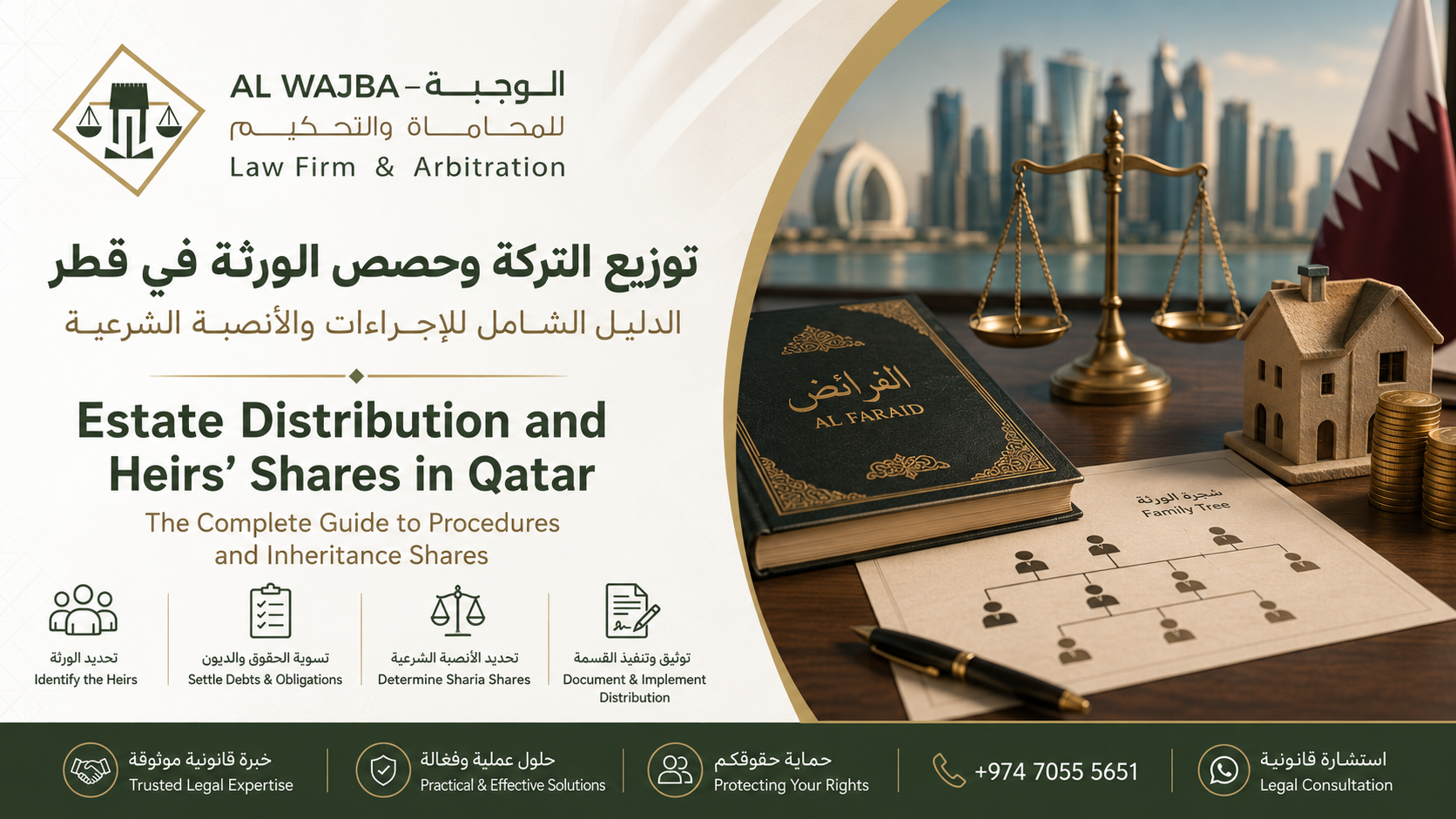
Estate distribution in Qatar is not simply a matter of dividing assets between relatives. The process starts by identifying the estate and the heirs, dealing with estate obligations, then determining each heir's entitlement under Qatar's Sharia-based inheritance rules before property is transferred or divided.
This guide focuses on the distribution stage. For the broader overview, start with our Inheritance in Qatar guide. If the family is already in conflict, see Inheritance Disputes in Qatar.
Inheritance Guides in Qatar
Explore the main inheritance guide, estate distribution, inheritance disputes, legal support, and related Family Court resources.
The broad Family Law guide covering divorce, custody, support, marriage documents, inheritance, and Family Court matters in Qatar.
The main guide to inheritance rules, estate distribution, wills, family settlements, and inheritance disputes in Qatar.
Legal support for inheritance disputes, estate distribution, wills, family settlement agreements, and succession issues in Qatar.
A practical guide to Sharia inheritance shares, heirs, estate obligations, assets, debts, wills, valuations, and distribution steps in Qatar.
A guide to disputed heirs, contested estate assets, debts, wills, family disagreements, evidence, settlement, and court options in Qatar.
The general guide to will validity, the one-third rule, wills to heirs, capacity, evidence, revocation, and estate execution in Qatar.
A focused guide for expatriates on nationality rules, foreign wills, Qatar assets, attestation, translation, coordinated wills, and cross-border estate planning.
A guide to settlement between heirs, takharuj, agreed estate division, valuations, documentation, and implementing estate transfers in Qatar.
A related guide to Family Court procedures, required documents, hearings, and case preparation in Qatar.
Legal services for wills, estate distribution, inheritance procedures, and dispute resolution.
The legal order before heirs receive the estate
Article 242 of Qatar Family Law gives estate obligations a clear priority. This is why calculating inheritance shares is only one part of the distribution process.
Identify the estate
List the deceased's property, benefits, financial rights, bank accounts, real estate, company interests, receivables, vehicles, investments, and other assets that may form part of the estate.
Confirm the heirs
Build the family picture using marriage, birth, identity, and other relationship documents. Inheritance shares cannot be calculated safely until the relevant heirs are identified.
Deal with estate obligations first
Qatar Family Law places burial expenses, the deceased's debts, and execution of a valid will before distribution of the remaining estate to heirs.
Determine Sharia inheritance shares
The remaining estate is allocated according to the applicable inheritance rules, including prescribed shares and residuary inheritance. The exact result depends on the complete combination of heirs.
Value and divide the assets
Cash may be straightforward, but property, company shares, vehicles, rental income, and indivisible assets may require valuation, sale, transfer, or an agreed allocation between heirs.
Document and implement the distribution
Court certificates, settlement documents, transfer papers, bank releases, property registrations, company updates, or enforcement steps may be required depending on the assets and whether heirs agree.
How inheritance shares work under Qatar Family Law
The Law recognizes prescribed shares and residuary inheritance. A correct calculation depends on the full heir configuration because one person's presence can change another person's share or whether that person inherits at all.
| Heir / configuration | Example under the Family Law | Reference |
|---|---|---|
| Husband | One half if the wife leaves no child heir; one quarter if there is a child heir. | Family Law Article 253 |
| Wife | One quarter if the husband leaves no child heir; one eighth if there is a child heir. | Family Law Article 254 |
| One daughter, no son | One half as a prescribed share, subject to the full heir configuration and statutory conditions. | Family Law Article 256 |
| Two or more daughters, no son | Two thirds collectively as a prescribed share, subject to the full heir configuration and statutory conditions. | Family Law Article 256 |
| Son and daughter at the same rank | The daughter inherits by residuary entitlement with the son, with the male receiving twice the female share in that configuration. | Family Law Article 256 |
| Father | His position changes depending on whether there is a male descendant, a female descendant, or no descendant heir. | Family Law Article 257 |
Documents to prepare before distribution
A clean distribution file connects the family tree to the estate inventory. Missing relationship or ownership records are a common reason a straightforward estate becomes disputed.
Assets that need more than a percentage calculation
Even when the inheritance fractions are clear, implementation can be difficult where the estate contains indivisible or income-producing assets.
Real estate
Heirs may inherit fractional interests in property. If physical division is impractical, the realistic options may involve sale, transfer to one or more heirs with compensation, or continued co-ownership under clearly documented terms.
Family companies and shares
A death may affect ownership, voting, management, distributions, and commercial registrations. Company documents should be reviewed alongside inheritance entitlements before anyone assumes control.
Bank accounts and investments
Banks and financial institutions may require succession documents and authority-specific forms before releasing or transferring assets. Keep a clear record of balances and post-death movements.
Debts and guarantees
Distributing assets before checking liabilities can create avoidable disputes. The estate's obligations should be identified and dealt with before heirs treat the remaining property as freely distributable.
What if the heirs agree?
Agreement can make implementation easier, but it should come after the heirs, assets, debts, and legal entitlements are understood. A settlement should say exactly what is being transferred, sold, retained, or paid and by whom.
Confirm every heir
Do not settle around an incomplete family tree or exclude a person whose entitlement has not been resolved.
List every asset and debt
The settlement should be based on a disclosed estate, not assumptions about bank balances, property, or business ownership.
Plan implementation
Set deadlines, valuations, transfer documents, sale mechanics, and responsibility for authority or court steps.
When distribution becomes an inheritance dispute
Stop treating the matter as a simple family calculation when there is disagreement about the heir list, ownership, debts, a will, hidden assets, valuations, or control of estate property.
In those situations, preserve documents and transaction records and review the dispute before signing transfers or settlements. Our Inheritance Disputes in Qatar guide covers the contested-estate side in more detail.
Common estate-distribution mistakes
Avoid shortcuts that can change the legal result or make later implementation harder.
Official sources
Use the legislation itself as the starting point for share and estate-administration questions.
Frequently asked questions about estate distribution in Qatar
These answers are general and should not replace a calculation based on the actual heir list and estate documents.
Does Qatar use Sharia law for inheritance?
Qatar's inheritance framework is expressly tied to Islamic Sharia. Family Law No. 22 of 2006 contains detailed inheritance provisions, and Article 3 provides a Hanbali-based interpretive framework where the Law does not supply the answer. The Civil Code also states that Islamic Sharia and relevant laws apply to heirs and the determination of their shares.
Is a son's share always twice a daughter's share in Qatar?
No. That formula applies in particular heir configurations, such as a son and daughter inheriting together at the same rank. Other heirs may have prescribed shares, equal shares, or different outcomes. The complete family tree must be considered before calculating any distribution.
Are debts paid before inheritance is distributed?
Yes. Qatar Family Law places burial expenses and the deceased's debts before execution of a will and distribution of the remaining estate to heirs. The Civil Code also contains detailed estate-liquidation rules for debts and testamentary obligations.
Can heirs agree on how to deal with a house or company?
Heirs may be able to reach a documented settlement about how estate assets are sold, transferred, valued, or held, but the settlement should be based on a clear heir list, asset inventory, debts, and legal entitlements. Minor heirs or disputed rights require particular care.
What happens if an heir hides estate assets?
The first priority is to preserve records and identify the missing asset or transaction. Estate inventory disputes, control of property, concealed bank movements, and disputed ownership can require formal legal or court steps rather than an informal family calculation.
When should I speak with an inheritance lawyer?
Legal advice is especially useful where the heir list is disputed, there is a will, the estate contains real estate or businesses, debts are unclear, foreign documents are involved, minors inherit, or the family cannot agree on valuation or distribution.
Need help calculating or implementing an estate distribution?
A structured review can connect the family tree, Sharia entitlements, estate obligations, asset records, and the practical transfer steps required in Qatar.
Office hours: Saturday–Thursday: 9:00 AM – 5:00 PM. Bring the death certificate, family relationship documents, a family tree, known asset records, debt records, and any will or probate documents.
About the Author
Written by Ms. Lolwa Al-Thani — Founder & CEO — Qatari Lawyer. A pioneering Qatari lawyer with 20+ years of experience in Qatari law and Islamic Sharia, and founder of Al Wajbah Law Firm.
Need Legal Consultation?
Our team of specialized lawyers is ready to assist you with all your legal matters.
Contact Us Now