Inheritance Disputes in Qatar: Heirs, Estate Assets, Wills, and Family Claims
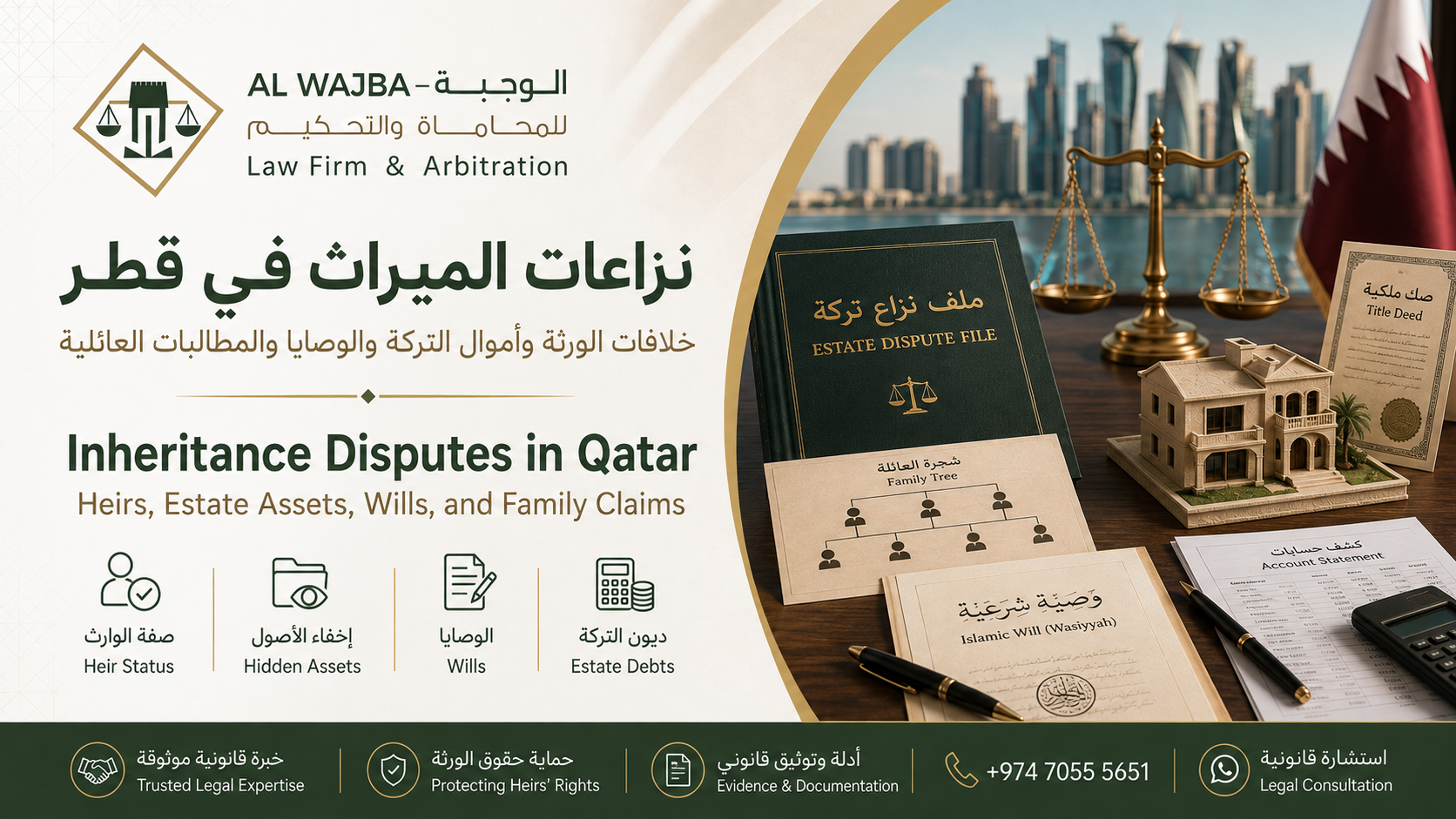
Inheritance Disputes in Qatar: Heirs, Estate Assets, Wills, and Family Claims
An inheritance dispute in Qatar can start with a disagreement over heirs, a missing asset, a contested debt, a will, property valuation, or one family member controlling estate records. The safest approach is to define the disputed legal issue before attempting to divide the estate.
For the non-contentious distribution process, see Estate Distribution in Qatar. For the broader legal overview, see Inheritance in Qatar.
Inheritance Guides in Qatar
Explore inheritance rules, estate distribution, disputes, legal support, and related Family Court resources.
The broad Family Law guide covering divorce, custody, support, marriage documents, inheritance, and Family Court matters in Qatar.
The main guide to inheritance rules, estate distribution, wills, family settlements, and inheritance disputes in Qatar.
Legal support for inheritance disputes, estate distribution, wills, family settlement agreements, and succession issues in Qatar.
A practical guide to Sharia inheritance shares, heirs, estate obligations, assets, debts, wills, valuations, and distribution steps in Qatar.
A guide to disputed heirs, contested estate assets, debts, wills, family disagreements, evidence, settlement, and court options in Qatar.
The general guide to will validity, the one-third rule, wills to heirs, capacity, evidence, revocation, and estate execution in Qatar.
A focused guide for expatriates on nationality rules, foreign wills, Qatar assets, attestation, translation, coordinated wills, and cross-border estate planning.
A guide to settlement between heirs, takharuj, agreed estate division, valuations, documentation, and implementing estate transfers in Qatar.
A related guide to Family Court procedures, required documents, hearings, and case preparation in Qatar.
Legal services for wills, estate distribution, inheritance procedures, and dispute resolution.
Common inheritance disputes between heirs
The label “inheritance dispute” covers several legally different problems. Identifying which one you actually have makes the evidence and next step much clearer.
Who is legally an heir?
Disputes can arise over marriage status, parentage, prior divorce, children, family relationships, or whether an alleged heir is legally entitled to participate in the estate.
What actually belongs to the estate?
Family members may disagree about whether a house, bank balance, company share, vehicle, receivable, gift, or jointly held asset belonged to the deceased or to someone else.
Hidden or controlled assets
One heir may hold title papers, bank information, rent, company records, passwords, or possession of property. The immediate issue may be preservation and disclosure rather than final division.
Debts and creditor claims
Heirs may disagree about whether a loan, guarantee, family debt, business liability, or claimed repayment is genuine and whether it should reduce the estate before distribution.
Will and testament disputes
A dispute may concern whether a will exists, whether the document is authentic or effective, what it covers, or how it interacts with mandatory inheritance rights and estate obligations.
Valuation and distribution
Even where the heir list is accepted, disputes can arise over property values, company shares, sale prices, occupation, rental income, or whether an asset should be sold or transferred to a particular heir.
What to do first when an inheritance dispute starts
Before arguing over percentages, secure the basic evidence and identify any immediate risk to the estate.
Evidence that matters in a contested estate
The useful evidence depends on the exact dispute. Build the file around the question you need to prove rather than collecting documents randomly.
Heir-status evidence
Marriage contracts, birth certificates, identity documents, divorce records, family records, judgments, and other documents proving or disproving a claimed family relationship.
Asset-ownership evidence
Title deeds, bank records, investment statements, vehicle records, company registers, shareholder documents, contracts, invoices, and evidence of beneficial ownership or payment.
Transaction evidence
Statements showing withdrawals or transfers, sale contracts, gifts, powers of attorney, rental receipts, account movements, and correspondence about the deceased's assets.
Debt evidence
Loan contracts, guarantees, judgments, receipts, creditor correspondence, business accounts, and proof of payments said to be owed by or to the deceased.
A practical strategy for resolving the dispute
The goal is not simply to “win an argument” between relatives. It is to establish the correct estate, protect the rights of the heirs, and reach an implementable outcome.
Define the disputed question
Separate the emotional conflict from the legal issue: heir status, asset ownership, debt, will, valuation, management, or distribution.
Protect the estate
Where assets or records are at risk, preservation and evidence steps may be more urgent than negotiating final shares.
Calculate from the correct estate
Inheritance shares should be calculated only after the estate, obligations, and relevant heirs are identified. A percentage applied to the wrong asset pool solves nothing.
Assess settlement realistically
A negotiated settlement can be useful when the facts are sufficiently known and all required parties can participate, but it should not be used to hide an unresolved entitlement problem.
Use court procedure when necessary
If disclosure, heir status, ownership, debt, or implementation cannot be resolved by agreement, formal Family Court or related judicial steps may be necessary.
Document the outcome
A judgment or settlement still needs implementation. Transfers, bank releases, property registration, company changes, and enforcement should be planned clearly.
Settlement versus court action
A family settlement can be valuable, but only where the information needed to settle is sufficiently complete. Court involvement becomes more likely where a material fact or right cannot be resolved voluntarily.
Settlement may be suitable when
The heir list is known, assets and debts are substantially disclosed, valuations can be agreed or obtained, and the disagreement is mainly about implementation rather than a hidden legal entitlement.
Court action may be needed when
Heir status, ownership, debt validity, a will, disclosure, asset control, or enforcement is genuinely disputed and cannot be resolved through documented negotiation.
For procedural context, review the Family Court in Qatar guide.
Official sources
These are useful starting points for the legal inheritance framework, estate obligations, and court context.
Frequently asked questions about inheritance disputes in Qatar
The correct response depends on the family relationships, estate evidence, urgency, and the exact right being disputed.
What are the most common inheritance disputes in Qatar?
Common disputes concern who qualifies as an heir, what property belongs to the estate, hidden or controlled assets, debts, wills, property valuation, rental income, company interests, and how an agreed or judicial distribution should be implemented.
Can one heir distribute or sell estate property alone?
Do not assume that possession or access gives one heir the right to treat estate property as personal property. The answer depends on ownership, authority, the estate process, and the rights of the other heirs. Obtain advice before a disputed sale or transfer proceeds.
What if I think an estate asset has been hidden?
Preserve the records you have, identify the specific asset or transaction, and gather title, bank, company, rental, or correspondence evidence. Where there is a real risk of loss or transfer, the timing of legal action can matter.
Can heirs settle an inheritance dispute without a judgment?
Many disputes can potentially be resolved by a documented family settlement if the heirs, estate, debts, and legal rights are sufficiently clear. A settlement should not be signed simply to end pressure where material assets or entitlements remain unknown.
Does Sharia still matter if the dispute is about property or money?
Yes. Qatar's inheritance entitlements are Sharia-based under the Family Law and Civil Code. At the same time, a dispute may also require evidence and estate-administration rules to determine what belongs to the estate and what obligations must be paid before the Sharia shares are applied.
When should I contact an inheritance lawyer?
Contact a lawyer early if heir status is disputed, assets may be transferred, one person controls the records, there is a contested will or debt, the estate includes companies or valuable property, foreign documents are involved, or negotiations have reached an impasse.
Need help with an inheritance dispute in Qatar?
Bring the family tree, relationship documents, known asset records, disputed transactions, debt records, any will, and a short timeline of what happened.
Office hours: Saturday–Thursday: 9:00 AM – 5:00 PM.
About the Author
Written by Ms. Lolwa Al-Thani — Founder & CEO — Qatari Lawyer. A pioneering Qatari lawyer with 20+ years of experience in Qatari law and Islamic Sharia, and founder of Al Wajbah Law Firm.
Need Legal Consultation?
Our team of specialized lawyers is ready to assist you with all your legal matters.
Contact Us Now