Wills in Qatar: Legal Rules, One-Third Limit, Heirs, and Estate Planning
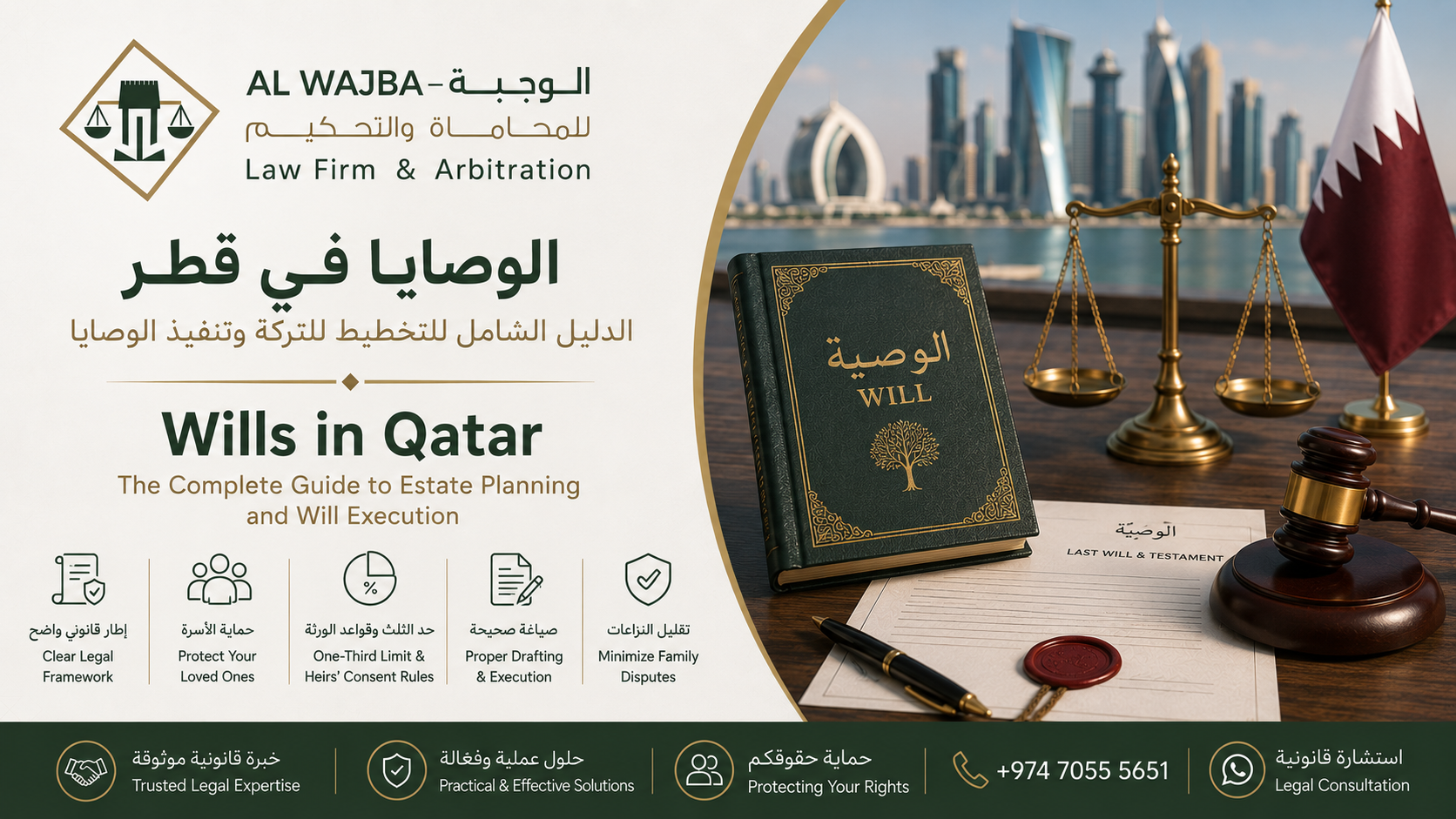
Wills in Qatar: Legal Rules, One-Third Limit, Heirs, and Estate Planning
A will in Qatar is not simply a document naming who should receive property after death. Its effect depends on the applicable legal framework, who the beneficiaries are, how much of the estate is being given, the testator's capacity, the evidence of the will, and—especially in international families—the testator's nationality and the location of assets.
For the broader succession framework, start with our Inheritance in Qatar guide. This page focuses specifically on making, reviewing, changing, and later proving a will, while our Estate Distribution in Qatar guide explains what happens to the estate after death.
Inheritance Guides in Qatar
Explore the main inheritance guide, wills, estate distribution, inheritance disputes, legal support, and related Family Court resources.
The broad Family Law guide covering divorce, custody, support, marriage documents, inheritance, and Family Court matters in Qatar.
The main guide to inheritance rules, estate distribution, wills, family settlements, and inheritance disputes in Qatar.
Legal support for inheritance disputes, estate distribution, wills, family settlement agreements, and succession issues in Qatar.
A practical guide to Sharia inheritance shares, heirs, estate obligations, assets, debts, wills, valuations, and distribution steps in Qatar.
A guide to disputed heirs, contested estate assets, debts, wills, family disagreements, evidence, settlement, and court options in Qatar.
The general guide to will validity, the one-third rule, wills to heirs, capacity, evidence, revocation, and estate execution in Qatar.
A focused guide for expatriates on nationality rules, foreign wills, Qatar assets, attestation, translation, coordinated wills, and cross-border estate planning.
A guide to settlement between heirs, takharuj, agreed estate division, valuations, documentation, and implementing estate transfers in Qatar.
A related guide to Family Court procedures, required documents, hearings, and case preparation in Qatar.
Legal services for wills, estate distribution, inheritance procedures, and dispute resolution.
The key will rules under Qatar Family Law
For estates governed by the Family Law will provisions, these are the rules that most often shape the drafting and later execution of a will.
A will takes effect after death
Qatar Family Law Article 206 defines a will as a gratuitous disposition intended to take effect after the testator's death. It is therefore different from a lifetime gift or an ordinary transfer made while the owner is alive.
The one-third limit matters
Under Article 208, a will to a non-heir can operate within the permitted one-third framework. A disposition to a non-heir above one third requires ratification by adult heirs, within the shares of those who ratify it.
A bequest to an heir needs post-death approval
Article 208 states that there is no will for an heir unless adult heirs ratify it. Article 209 adds that valid ratification must occur after the testator's death and must come from a person legally capable of making a gift.
A will can be changed or revoked
Article 237 allows a testator to amend or revoke a will wholly or partly, expressly or by conduct that legally demonstrates revocation. Keeping one clear current version reduces avoidable disputes over competing documents.
What does the one-third rule mean in practice?
The one-third rule is often discussed too loosely. The legal result depends on whether the beneficiary is an heir and whether adult heirs later ratify the disposition.
Non-heir, within one third
The Family Law framework permits a will to a non-heir within the disposable one-third portion, subject to the other validity requirements.
Non-heir, above one third
The excess requires ratification by adult heirs after death and operates only within the shares of those who validly ratify it.
Beneficiary is an heir
A will in favor of an heir requires adult-heir ratification after the testator's death. Heir status is assessed at the time of death, not merely when the will is signed.
How to prepare a will in Qatar
Good estate planning starts before drafting. The aim is to connect the intended gift to the correct law, family structure, ownership records, and evidence.
Map the family and legal context
Record spouse, children, parents and other potentially relevant relatives, together with nationality, religion, marital status, prior marriages, and any cross-border elements that may affect the applicable law.
Build a reliable asset and debt schedule
A will is easier to draft and later administer when ownership records are organized. Include where each asset is located, how it is registered, approximate value, and whether another person has a legal or beneficial interest.
Choose beneficiaries and objectives
Decide whether the aim is a charitable gift, support for a non-heir, allocation of a particular asset, family protection, or another legitimate objective. Then test that objective against the applicable inheritance and will rules.
Draft for enforceability, not just intention
Clear names, asset descriptions, percentages, alternatives if a beneficiary dies first, and consistent wording can reduce later uncertainty. Qatar Family Law recognizes verbal and written wills, but Article 240 makes evidence critical where a will or revocation is denied.
Execute and preserve the evidence
Use a form and signing process suitable for the governing law and the place of execution. Foreign documents may also require legalization, attestation, certified Arabic translation, or other formal steps before use in Qatar.
Keep the plan current
A will should match the assets and family circumstances that actually exist. Dispose of an asset, change ownership, or create a later inconsistent will and the legal result may change substantially.
Will-planning checklist before you sign
A short planning review can expose problems that are much harder to solve after death.
Documents to gather for a will review
The drafting exercise is only as reliable as the family and ownership information behind it.
What if the testator is an expat?
Foreign nationals need an additional applicable-law review before the general Qatar will rules are applied. Nationality, the place where the will was made, the location of major assets, and any existing foreign will can materially change the analysis.
The dedicated Wills in Qatar for Expats guide covers foreign wills, Civil Code nationality rules, Qatar real estate, document attestation and translation, coordinated wills, and cross-border estate administration.
What happens to the will after death?
A will is only one part of estate administration. The family still needs to identify the estate, obligations, heirs, and the legally effective testamentary disposition before assets can be transferred.
Prove the document
Locate the final will, confirm its authenticity and status, and deal with any evidence, translation, attestation, or foreign-document requirements.
Identify obligations
Burial expenses and estate debts come before will execution under the statutory order of estate rights.
Test legal effect
Check whether a beneficiary is an heir, whether a gift exceeds the permitted amount, and whether any adult-heir ratification is required.
Transfer the assets
Banks, land records, companies, courts, and other authorities may each require their own documents before ownership changes.
For the full post-death sequence, see Estate Distribution in Qatar. If the validity, beneficiary, asset ownership, or effect of the will is contested, the matter may instead need the evidence and strategy discussed in Inheritance Disputes in Qatar.
Common mistakes when making a will in Qatar
Most avoidable problems come from treating the will as an isolated document rather than part of the inheritance and estate-administration framework.
Official sources
These official sources are the starting point for checking Qatar's will, inheritance, applicable-law, attestation, and court framework.
Frequently asked questions about wills in Qatar
These are general answers. The correct result can change with nationality, religion, family structure, beneficiary status, asset ownership, and the place and form of execution.
Can I make a will in Qatar?
Yes, but the legal effect depends on the testator, beneficiaries, applicable personal or national law, the assets involved, and the way the will is made and later proved. For people governed by Qatar Family Law, Articles 206–240 contain detailed will rules.
Can I leave all of my estate to one person?
Do not assume so. Under the Qatar Family Law framework, a bequest to a non-heir above one third requires ratification by adult heirs within their shares, and a bequest to an heir also depends on adult-heir ratification after death. Cross-border cases may require a separate applicable-law analysis.
Can I make a will in favor of one of my heirs?
Under Family Law Article 208, a will to an heir is not enforceable merely because the testator wrote it. It requires ratification by adult heirs, and Article 209 requires that ratification to occur after the testator's death from a person capable of making a gift.
Does a will have to be written in Qatar?
Family Law Article 213 recognizes a will made verbally, in writing, or by understandable gesture where the testator can do neither. In practice, written evidence is far safer because Article 240 requires evidence if a will or revocation is denied. Cross-border wills also need to satisfy the applicable form rules.
Can I change or cancel my will later?
Yes. Family Law Article 237 permits amendment or revocation wholly or partly, expressly or through legally significant conduct. A formal replacement document and clear recordkeeping are usually safer than leaving multiple inconsistent versions.
What happens to debts before a will is paid?
Family Law Article 242 places burial expenses and the deceased's debts before execution of the will, and distribution of the remaining estate to heirs follows after the valid will is dealt with. The practical estate calculation therefore starts with obligations, not the headline value of the assets.
Do expats use exactly the same will rules in Qatar?
Not necessarily. Foreign nationals should first determine the law governing inheritance and testamentary dispositions. The dedicated Wills in Qatar for Expats guide covers nationality, foreign wills, Qatar assets, attestation, translation, and coordinated cross-border planning.
When should I ask a lawyer to review a will?
A review is particularly useful where the estate includes Qatar real estate or companies, the family has mixed nationality or religion, there are children from different relationships, a beneficiary may also be an heir, the intended gift is large, foreign assets are involved, or an old will no longer matches the current family and asset position.
Need a will reviewed or prepared for assets in Qatar?
A useful review should connect your family circumstances, nationality, intended beneficiaries, Qatar and foreign assets, debts, the one-third and heir rules where applicable, execution evidence, and the practical steps that will be required after death.
Office hours: Saturday–Thursday: 9:00 AM – 5:00 PM. For a will review, bring identification and nationality records, family-status documents, any existing will, and a current list of major assets and debts in Qatar and abroad.
About the Author
Written by Ms. Lolwa Al-Thani — Founder & CEO — Qatari Lawyer. A pioneering Qatari lawyer with 20+ years of experience in Qatari law and Islamic Sharia, and founder of Al Wajbah Law Firm.
Need Legal Consultation?
Our team of specialized lawyers is ready to assist you with all your legal matters.
Contact Us Now