A Guide to Cases Before Qatar’s Investment and Trade Court
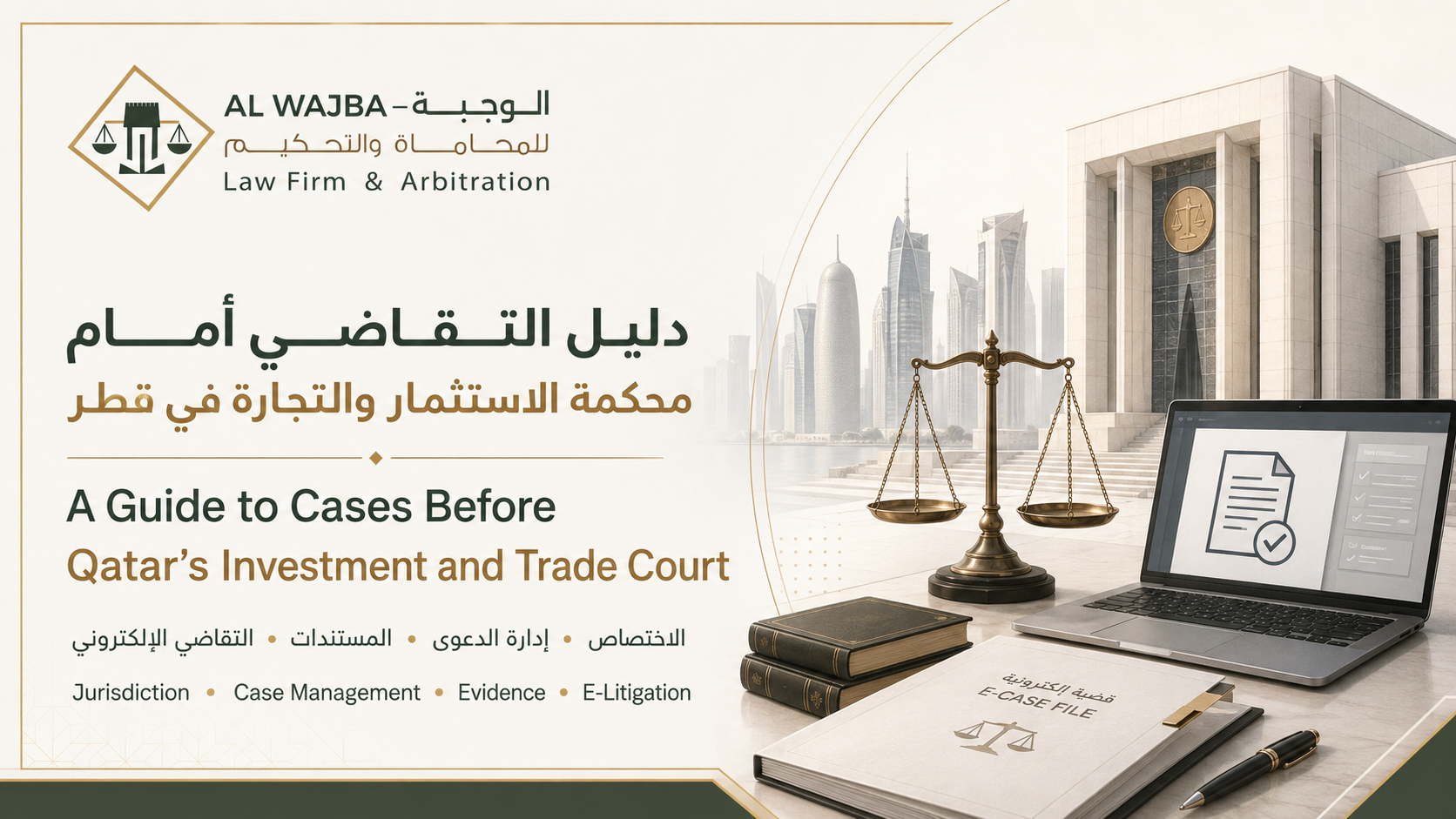
A Guide to Cases Before Qatar’s Investment and Trade Court
Qatar's Investment and Trade Court is a specialized forum for specified commercial and investment disputes. A strong case begins before the first hearing: with the right jurisdiction, correct procedural route, complete party data, organized evidence, and a clear understanding of how the Case Management Office and electronic litigation system shape the file.
Related commercial dispute guides
Explore nearby guides on commercial claims, contracts, debt recovery, litigation procedure, and legal representation.
The main guide covering commercial lawsuits, contract disputes, financial claims, debt recovery, business partner disputes, arbitration, court procedures, and judgment enforcement in Qatar.
Legal support for commercial lawsuits, contract disputes, financial claims, unpaid debts, business partner disputes, arbitration, and judgment enforcement in Qatar.
A practical guide to filing a commercial lawsuit in Qatar, including jurisdiction, legal notices, required documents, court hearings, judgments, and enforcement.
A practical guide to commercial contract breaches, delayed or defective performance, contract termination, compensation claims, and penalty clauses in Qatar.
A guide to commercial financial claims involving unpaid invoices, contractual payments, compensation, account statements, and supporting evidence in Qatar.
A practical guide to recovering commercial debts through payment demands, settlement negotiations, court claims, precautionary measures, and enforcement in Qatar.
Legal support for unpaid invoices, commercial debts, payment demands, settlement negotiations, financial claims, court proceedings, and enforcement in Qatar.
A practical guide to disputes between business partners involving company management, profit distribution, access to records, company shares, withdrawal, and partner agreements.
A guide to the jurisdiction, procedures, required documents, hearings, judgments, and case preparation before the Investment and Trade Court in Qatar.
A practical guide to arbitration agreements, arbitral procedures, interim measures, arbitral awards, challenges, and enforcement in Qatar.
A guide to enforcing commercial judgments, recovering awarded amounts, attachment procedures, debtor assets, and enforcement disputes in Qatar.
Legal services for commercial lawsuits, contract disputes, financial claims, debt recovery, business partner disputes, arbitration, and judgment enforcement.
What is the Investment and Trade Court in Qatar?
The Investment and Trade Court was established by Law No. 21 of 2021 as a specialized court for defined investment and commercial disputes. Its official court overview describes specialized first-instance and appellate chambers, departments in the Court of Cassation for relevant appeals, a Case Management Office, and an electronic system for litigation services.
Specialization does not eliminate the need for careful case preparation. In commercial litigation, jurisdiction can depend on the legal character of the transaction, the parties' status, company relationships, special legislation, and the remedies requested. A dispute should therefore be classified before pleadings are drafted in detail.
The court's current official website also provides filing guides, court information, electronic-service links, and a searchable publication platform for judicial rulings. Those resources are useful operational references, but a live dispute should still be checked against the current law, applicable court decisions, and the facts of the specific file.
Which disputes can fall within the court’s jurisdiction?
Commercial contracts and trader disputes
The court's official jurisdiction materials include disputes arising from commercial contracts and lawsuits between traders connected with their business. Contract language, party status, transaction type, and the remedy requested still need to be reviewed before filing.
Company, partner, and shareholder disputes
Disputes between companies, partners, or shareholders can fall within the court's specialized jurisdiction. These cases often require the company's constitutional documents, resolutions, ownership records, accounts, and evidence showing whether the claimed right belongs to the company or an individual participant.
Banking, finance, insurance, and investment matters
The court's jurisdiction extends to specified disputes involving banking operations, insurance, finance and investment activities, and non-Qatari capital investment in economic activity. The legal basis of the transaction and any sector-specific rules remain important.
Commercial papers, debt, and insolvency-related matters
Commercial papers, qualifying payment disputes, bankruptcy, and preventive composition are among the matters identified in the court's official materials. A monetary claim should also be screened for any special payment-order route before an ordinary lawsuit is filed.
Intellectual property, e-commerce, and specialized commerce
The official jurisdiction description includes intellectual-property disputes and a range of specialized commercial activities. The court's detailed jurisdiction pages also classify matters such as electronic commerce, transportation, commercial agency, brokerage, and other business disputes.
Arbitration-related court applications
The court's official overview also identifies proceedings concerning the invalidity and enforcement of civil and commercial arbitration provisions. The existence and scope of an arbitration agreement should therefore be checked at the start of a commercial dispute, not after substantive court proceedings have already begun.
Six jurisdiction questions to answer before filing
What is the legal nature of the transaction: commercial contract, company dispute, banking matter, commercial paper, investment issue, intellectual-property claim, or another category?
Are the parties acting as traders or companies in relation to the transaction, and how are they identified in the contracts and registrations?
Does the dispute arise from a company, partner, or shareholder relationship, and who owns the right being asserted?
Is there an arbitration clause, forum clause, special statutory procedure, or payment-order route that changes the correct path?
What precise remedies are requested: payment, performance, termination, compensation, declaration, urgent protection, or another order?
Are there connected claims, counterclaims, guarantees, or parties that may affect jurisdiction or how the case should be framed?
How the court is structured and managed
Specialized judicial chambers
The court's official materials describe specialized first-instance and appellate chambers, with Court of Cassation departments handling appeals within the applicable legal framework. The correct level and route depend on the case and the decision being challenged.
Case Management Office
The Case Management Office supervises procedural preparation from registration, including completeness of party data and documents, payment of prescribed fees, notifications, exchange of memoranda, monitoring procedural periods, and preparing the file for referral to the competent chamber.
Electronic litigation system
The court states that its electronic system supports filing lawsuits and certain applications, as well as challenges and grievances. Current user guides should be checked because account type, filing screens, required fields, and supporting-document requirements can change operationally.
Published judicial rulings
The court now maintains a judicial-rulings publication platform with first-instance and appeal search functions. Published judgments can help lawyers and businesses research judicial principles, but each live case still turns on its own evidence, contracts, pleadings, and applicable law.
Preparing a case for the Investment and Trade Court
Define the commercial dispute and the business objective
Start with a short chronology: who contracted with whom, what was promised, what happened, what remains unresolved, and what outcome matters commercially. A case should not begin with a pile of documents and no theory of the dispute.
Confirm jurisdiction and the correct procedural route
Match the parties, transaction, claim, and requested relief to the court's specialized jurisdiction. Then check arbitration clauses, payment-order requirements, urgent applications, limitation issues, and any special-law procedure before selecting an ordinary lawsuit route.
Identify the parties and legal representation correctly
Verify commercial-registration details, company names, authorized representatives, addresses, and relevant powers or authority. Errors in party identity or representation can create avoidable procedural problems before the merits are reached.
Build a document set that proves each element
Organize the signed contracts, amendments, purchase orders, invoices, delivery or completion records, account statements, corporate records, notices, correspondence, expert material, and payment evidence by issue and date. Link each requested remedy to the documents that support it.
Prepare pleadings for electronic case management
The claim should state the facts, legal basis, requests, and supporting evidence in a coherent structure. Documents in another language may require proper Arabic translation for court use. The filed set should be searchable and logically named where the electronic system permits.
Follow Case Management Office directions closely
Respond to requests for missing data or documents, complete notifications, pay required fees, and exchange memoranda within the applicable procedural timetable. Case management is not a formality; it is designed to prepare the dispute before it reaches the trial chamber.
Prepare the technical and accounting issues early
If the dispute turns on accounts, valuation, construction quantities, delay analysis, technical performance, software, intellectual property, or another specialist issue, identify the questions and source documents before an expert is appointed or a technical report is requested.
Plan for judgment, challenge, and enforcement from the start
A litigation strategy should consider what a successful judgment must actually achieve, whether the other side can satisfy a monetary award, what parts may be appealable, and which records must be preserved for later enforcement or challenge.
Documents to organize before registration
Party and company records
Commercial registrations, licenses, incorporation documents, authorized-signatory evidence, powers of attorney, identification records, and reliable address information for each relevant party.
Contracts and amendments
Signed agreements, general conditions, schedules, variations, purchase orders, acceptance documents, guarantees, security, and any arbitration or jurisdiction clauses.
Financial evidence
Invoices, statements of account, payment records, bank documents, ledgers, reconciliations, damages calculations, profit records, and documents explaining credits, deductions, or set-off positions.
Performance evidence
Delivery notes, completion certificates, inspection records, timesheets, project reports, correspondence accepting or rejecting work, defect notices, and records of delay or non-performance.
Notices and correspondence
Demand letters, termination notices, emails, messages, meeting minutes, admissions, settlement exchanges, objections, and communications showing when a dispute crystallized.
Technical and expert material
Existing accounting, engineering, valuation, forensic, IT, or other specialist reports, together with the raw source material on which those reports rely.
What the Case Management Office changes in practice
The court describes case management as early procedural control of the lawsuit. That means parties should treat registration, document completeness, notifications, memoranda, and procedural directions as part of the litigation strategy—not as administrative steps that can be fixed later without consequence.
Completeness before referral
The office is intended to identify missing party data and documents, verify procedural requirements, and prepare the case file before it reaches the competent judicial chamber.
Exchange of memoranda
The official description expressly includes giving parties the opportunity to exchange memoranda and monitoring the relevant periods. A response strategy should therefore be prepared as soon as a claim is received.
Notifications and fees
Proper notification and payment of prescribed fees are part of the procedural preparation. Current electronic instructions should be followed rather than assuming a filing is complete merely because documents were uploaded.
Procedural preparation is separate from deciding the merits
The court describes case management as separating the procedural function from the judicial function. The office prepares and supervises the file; the competent chamber decides the substantive dispute.
Electronic filing through the court system
The court's website links to the Taqadi electronic system and publishes separate user guides for individual litigants, lawyers, Qatari company accounts, and non-Qatari company accounts. The court also describes electronic mechanisms for lawsuits, certain petitions and orders, appeals, and grievances.
For a business, the practical preparation goes beyond having PDF copies. Confirm the account and authority used to file, use consistent party names, prepare a clear claim narrative, index supporting documents, and check current fee and filing instructions. If a document is in a foreign language, obtain the translation required for court use rather than relying on an informal internal translation.
Screens, service categories, fees, and operational requirements can change. For that reason, the current court guides and electronic portal should be checked at the time of filing even where a business has used the system previously.
Expert evidence in commercial cases
Commercial disputes often contain questions that are partly legal and partly technical. The court's official materials recognize the use of experts, including specialist accounting and engineering expertise. A party should prepare the technical record before expert work begins so the expert question does not become a substitute for proving the underlying facts.
| Issue | Useful source material | Preparation point |
|---|---|---|
| Accounting and financial claims | Ledgers, bank statements, invoices, reconciliations, supporting vouchers, audited accounts, partner/current accounts, and a clear schedule of the amounts in dispute. | Separate agreed figures from disputed entries and identify exactly which accounting conclusion is required. |
| Construction and engineering disputes | Contract drawings, specifications, variations, programs, site records, completion data, measurements, delay records, notices, and payment certificates. | Create a chronology and connect each delay, defect, variation, or valuation issue to contemporaneous project records. |
| Valuation and company disputes | Financial statements, asset records, ownership documents, shareholder agreements, management accounts, projections, and evidence of related-party transactions. | Define the valuation date, the interest being valued, and the assumptions or disputed transactions that may affect the result. |
| Technical, digital, or intellectual-property disputes | Source files, system logs, licenses, registrations, designs, specifications, access records, version histories, and evidence of creation, use, or alleged infringement. | Preserve original digital evidence and avoid altering source material before technical review. |
Urgent measures, payment orders, and ordinary claims are different paths
Urgent or protective applications
Where time-sensitive protection is needed, the legal team should identify the specific measure, evidence of urgency, relationship to the substantive right, and the correct procedural application.
Payment-order route
Certain qualifying monetary rights may follow the payment-order procedure rather than an ordinary lawsuit. The debt documents, certainty, due status, and current statutory requirements should be checked before registration.
Ordinary commercial claim
Disputed facts, defenses, counterclaims, complex contractual issues, or other substantive questions may require a full claim with pleadings, evidence, memoranda, and potentially expert work.
For the recovery side of commercial claims, see our guide to commercial debt collection in Qatar. For service-focused guidance, see how a debt collection lawyer in Qatar can assess evidence, settlement, court proceedings, and enforcement.
Hearings, judgments, and preparing for challenge
By the time a case reaches the competent chamber, the core issues should already be identifiable from the pleadings, documents, and Case Management Office process. Counsel should be able to state the contractual or statutory basis of the claim, the evidence supporting each request, the opposing party's main defenses, and any issue that genuinely requires expert determination.
A judgment should be reviewed promptly and as a whole: operative orders, reasoning, amounts awarded or rejected, interest or expenses where applicable, expert findings, procedural findings, and any part that may affect later enforcement. If a challenge is contemplated, the applicable route and deadline must be checked for that specific judgment or order rather than assumed from another type of case.
The court's Judicial Rulings Publication Platform provides access to published first-instance and appeal judgments for legal research. It can help identify judicial principles and recurring issues, but published cases should not be treated as a substitute for analyzing the current contract, evidence, and procedural posture.
Common mistakes that weaken commercial court cases
Filing before checking jurisdiction or arbitration
A commercially strong claim can still be procedurally misdirected. Review the forum, arbitration agreement, special statutory route, and the identity of the parties before drafting the merits in detail.
Treating invoices as self-proving
An invoice may show what was charged, but the case may still require proof of the contract, delivery or performance, acceptance, due date, calculation, and response to any genuine defense or set-off.
Uploading documents without an evidence structure
Large commercial cases become harder when the file is merely chronological or unsorted. Organize evidence by legal issue, amount, transaction, and requested remedy, with a master chronology and document index.
Waiting too long to preserve evidence or seek protection
Digital records, project documents, accounts, or assets can change while parties negotiate. Urgent legal review may be needed where evidence or the practical value of a future judgment is at risk.
Using correspondence as argument instead of evidence
Emotional or repetitive messages rarely improve a court file. Written communications should identify the obligation, facts, supporting documents, amount or remedy, and a reasonable legal position without unnecessary admissions.
Assuming every deadline is the same
Ordinary claims, payment orders, urgent applications, grievances, appeals, and other procedures may have different requirements and time limits. The applicable rule should be checked for the specific decision and procedural path.
A practical way to prepare your file before speaking with counsel
Write a one-page chronology with dates, parties, key events, and the current commercial problem.
Identify the exact amount or non-monetary remedy you want and how you calculate it.
Collect the signed contract and every amendment, order, acceptance, notice, and guarantee.
Separate evidence proving performance from documents that merely show billing or internal accounting.
Flag any arbitration, jurisdiction, governing-law, notice, limitation, or dispute-escalation clause.
List the other side's strongest defenses honestly and attach the documents relevant to each one.
Preserve original electronic records and avoid editing files that may later need technical verification.
Note whether assets, evidence, ongoing projects, customer relationships, or deadlines create urgency.
How a commercial litigation lawyer can help with an Investment and Trade Court case
Jurisdiction and route analysis
Assess the parties, transaction, arbitration clauses, special procedures, payment-order possibilities, urgent measures, and remedies before filing.
Evidence architecture
Turn contracts, financial records, correspondence, corporate documents, and technical records into a coherent evidentiary file tied to each legal request.
Pleadings and case management
Prepare claims or defenses, respond to Case Management Office requirements, manage memoranda, and keep procedural steps aligned with the litigation strategy.
Expert preparation
Frame accounting, engineering, valuation, or technical issues precisely and prepare the source material needed for reliable expert analysis.
Settlement strategy
Assess commercial settlement options against the strength of the evidence, litigation cost, timing, enforceability, and business relationship.
Judgment and next steps
Review the judgment, advise on challenge options where available, preserve deadlines, and prepare for enforcement or compliance.
Our guide to working with a commercial litigation lawyer in Qatar explains the service side of evidence review, procedural strategy, negotiation, and court representation.
Official court and legal sources
Court portals, user guides, fees, forms, chamber allocations, and procedural directions can be updated. Check the current official source when preparing or filing an actual case.
Related commercial dispute guidance
Contract disputes
Prepare breach, termination, performance, compensation, and contractual evidence issues.
Breach of commercial contract guideFinancial claims
Organize invoices, account statements, contractual payments, calculations, and financial evidence.
Commercial financial claims guideCommercial litigation overview
See how contracts, financial claims, debt recovery, partner disputes, procedure, and enforcement fit together.
Commercial litigation in QatarFrequently asked questions about the Investment and Trade Court in Qatar
What is Qatar's Investment and Trade Court?
It is a specialized Qatar court established under Law No. 21 of 2021 for specified investment and commercial disputes. Its official materials describe specialized first-instance and appellate chambers, a Case Management Office, and an electronic litigation system.
Does every business dispute go to the Investment and Trade Court?
No. The court has specialized statutory jurisdiction. The parties, transaction, legal basis, requested remedies, arbitration clauses, and any special procedure should be reviewed before deciding where and how to file.
Can disputes between business partners or shareholders be heard there?
Specified disputes between companies, partners, and shareholders fall within the court's stated jurisdiction. The company type, ownership documents, resolutions, relief sought, and any arbitration agreement remain important to the analysis.
Are cases filed electronically?
The court operates an electronic litigation system and publishes user guides for individuals, lawyers, Qatari company accounts, and non-Qatari company accounts. Current instructions should be checked when preparing an actual filing.
What does the Case Management Office do?
The court describes it as early procedural control of the case. It checks completeness of data and documents, fees and notifications, manages exchange of memoranda and procedural periods, prepares a report, and refers the file to the competent court chamber.
Will the court appoint an expert in a commercial case?
Expert evidence may be used where accounting, engineering, valuation, or other technical issues require specialist analysis. Whether expertise is needed, its scope, and how evidence should be presented depend on the dispute and the court's directions.
Can I use a normal lawsuit for an unpaid commercial debt?
Not always. Some monetary claims may need to be screened for the payment-order procedure or another special route. The documents, certainty of the debt, due status, defenses, and requested measures should be reviewed before filing.
Does the court publish judgments?
Yes. The court operates a Judicial Rulings Publication Platform with search functions for first-instance and appeal rulings. Published decisions can assist legal research but do not replace advice on the facts and evidence of a particular case.
What should I bring to a lawyer before an Investment and Trade Court case?
Bring the main contract, company and party records, invoices or financial schedules, performance evidence, notices, correspondence, any expert material, information about arbitration or jurisdiction clauses, and a concise chronology identifying the result you want.
Can a commercial dispute still settle after a case is prepared?
Often yes. Litigation preparation can clarify the evidence, amount, defenses, and risks, which may improve settlement discussions. Any settlement should be documented carefully, particularly where payments, releases, guarantees, transfers, or pending proceedings are involved.
Preparing for a case before Qatar’s Investment and Trade Court?
Bring the main contract, company and party records, financial schedule, performance evidence, key correspondence, any expert material, and a concise chronology. A focused legal review can help identify jurisdiction, the correct procedural route, evidentiary gaps, settlement options, and the steps needed to prepare the file for electronic registration and case management.
About the Author
Written by Mr. Yasser Asaad — Egyptian Lawyer in Qatar. A legal director with 33+ years of experience in Egyptian and Qatari law, specializing in international civil and commercial arbitration.
Need Legal Consultation?
Our team of specialized lawyers is ready to assist you with all your legal matters.
Contact Us Now