How to File and Pursue a Commercial Claim in Qatar
How to File and Pursue a Commercial Claim in Qatar
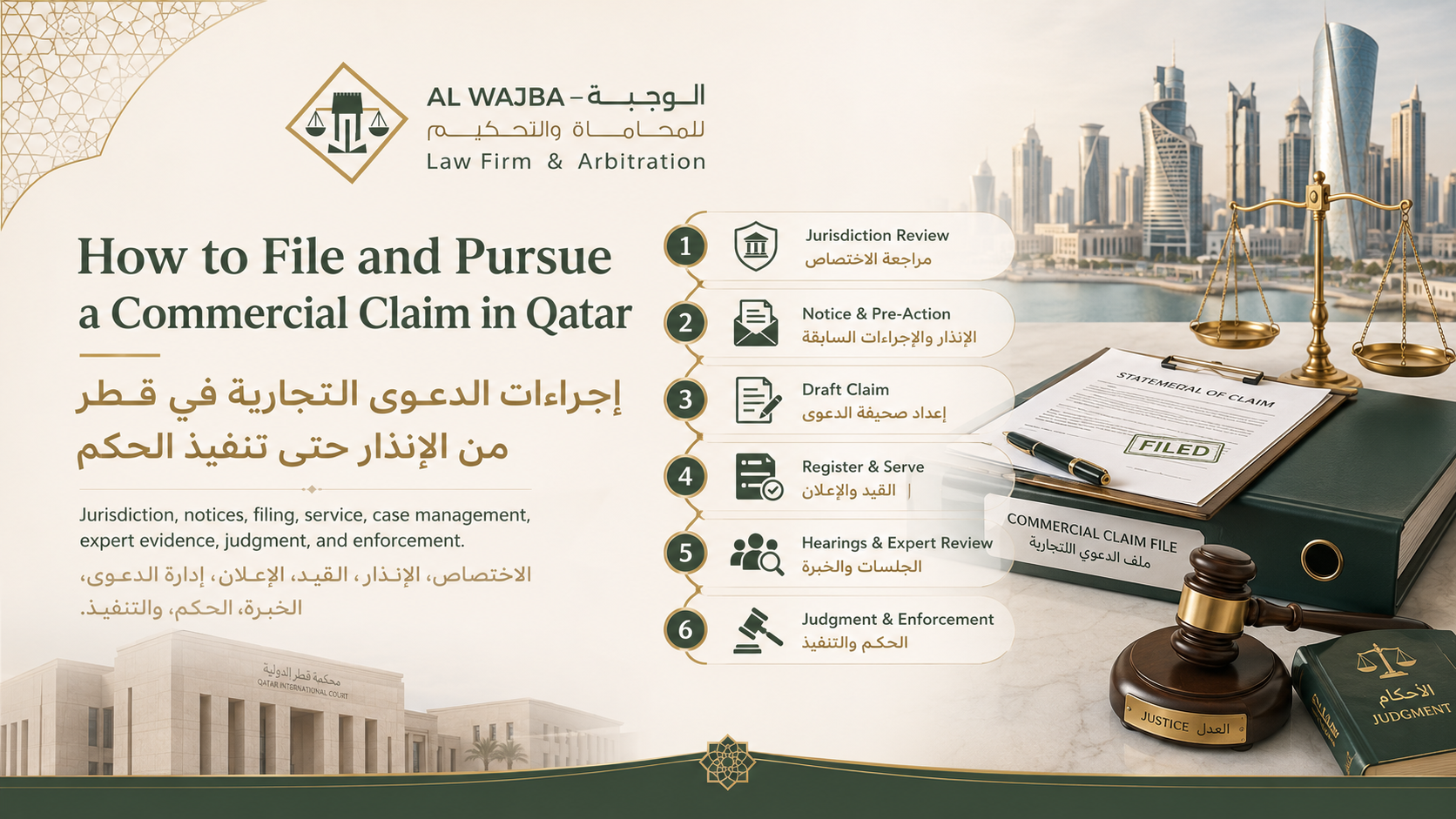
This guide explains commercial lawsuit procedures in Qatar, from reviewing jurisdiction, notices, parties, and evidence to registering the claim, completing service, managing pleadings and expert evidence, obtaining judgment, and pursuing enforcement.
Related Commercial Litigation Guides and Services
Explore related guides and legal services covering commercial court claims, contract disputes, financial claims, arbitration, debt recovery, and judgment enforcement in Qatar.
The main guide covering commercial lawsuits, contract disputes, financial claims, debt recovery, business partner disputes, arbitration, court procedures, and judgment enforcement in Qatar.
Legal support for commercial lawsuits, contract disputes, financial claims, unpaid debts, business partner disputes, arbitration, and judgment enforcement in Qatar.
A practical guide to filing a commercial lawsuit in Qatar, including jurisdiction, legal notices, required documents, court hearings, judgments, and enforcement.
A practical guide to commercial contract breaches, delayed or defective performance, contract termination, compensation claims, and penalty clauses in Qatar.
A guide to commercial financial claims involving unpaid invoices, contractual payments, compensation, account statements, and supporting evidence in Qatar.
A practical guide to recovering commercial debts through payment demands, settlement negotiations, court claims, precautionary measures, and enforcement in Qatar.
Legal support for unpaid invoices, commercial debts, payment demands, settlement negotiations, financial claims, court proceedings, and enforcement in Qatar.
A practical guide to disputes between business partners involving company management, profit distribution, access to records, company shares, withdrawal, and partner agreements.
A guide to the jurisdiction, procedures, required documents, hearings, judgments, and case preparation before the Investment and Trade Court in Qatar.
A practical guide to arbitration agreements, arbitral procedures, interim measures, arbitral awards, challenges, and enforcement in Qatar.
A guide to enforcing commercial judgments, recovering awarded amounts, attachment procedures, debtor assets, and enforcement disputes in Qatar.
Legal services for commercial lawsuits, contract disputes, financial claims, debt recovery, business partner disputes, arbitration, and judgment enforcement.
Quick answer: what are the steps in a commercial lawsuit?
Confirm jurisdiction, identify the correct parties and remedies, organize the evidence and calculations, register the case, complete service and case management, and then manage hearings, expert evidence, judgment, and enforcement.
- Review the competent court, governing law, and any arbitration or pre-action clause.
- Use the correct legal name and a reliable registered address for the defendant.
- Connect every allegation and claimed amount to a clear exhibit and calculation.
- Prepare Arabic translations and any required authentication for foreign documents.
- Complete Case Management Office, memorandum-exchange, and expert requirements promptly.
- Review the judgment, appeal position, and enforcement plan immediately after issuance.
Preparing a commercial case that is clear, organized, and capable of proof
Jurisdiction, parties, pleadings, evidence, expert review, judgment, and enforcement
A commercial claim is not strong merely because a contract or invoice exists. The claimant must identify the correct party, prove the obligation and performance, establish the breach or unpaid amount, and present the record in a way that the court, opposing party, and expert can understand and test.
An error in the defendant's legal name, registered address, arbitration clause, translation, or claim calculation can create substantial delay even where the underlying commercial right appears strong.
Procedural stages
Evidence groups
Filing through enforcement
Before registering the claim
Which cases may fall within the Investment and Trade Court's jurisdiction?
The Court publishes several categories within its jurisdiction. The correct forum must nevertheless be assessed against the transaction, party status, requested remedies, special laws, and any arbitration agreement.
| Dispute category | Examples | What to review before filing |
|---|---|---|
| Commercial contract disputes | Supply, service, distribution, agency, transport, sale, construction, and other business contracts | The parties, transaction, requested remedies, governing law, and any jurisdiction or arbitration clause |
| Claims arising between traders | Unpaid invoices, outstanding account balances, contractual payments, and commercial compensation claims | The source of the debt, due date, proof of delivery or performance, and the debtor’s objections |
| Company and shareholder disputes | Management control, profit distributions, ownership interests, company resolutions, and access to records | Articles of Association, shareholder agreements, legal standing, corporate resolutions, and whether the right belongs to the company or an individual shareholder |
| Commercial papers and banking disputes | Cheques, negotiable instruments, financing arrangements, guarantees, banking transactions, and account disputes | The nature of the instrument or transaction, original records, maturity, payment history, and available defenses |
| E-commerce and intellectual-property disputes | Electronic transactions, online sales, trademarks, patents, trade names, designs, and trade secrets | The protected right, electronic record, data source, applicable special law, and evidence of ownership or infringement |
| Investment and economic-activity disputes | Certain disputes involving non-Qatari capital investment and regulated investment or commercial activities | The investment structure, licenses, parties, contract, requested remedies, and any special statutory framework |
Commercial lawsuit pre-filing checklist
- Confirm the correct legal names of the claimant and defendant
- Review commercial-registration records and authority to represent each company
- Check the jurisdiction, governing-law, and arbitration provisions
- Review any notice, cure-period, negotiation, or escalation requirement
- Define the primary and alternative remedies clearly
- Calculate principal debt, damages, deductions, and other amounts separately
- Identify the evidence proving the contract, performance, breach, and loss
- Preserve original emails, messages, attachments, and electronic records
- Prepare clear Arabic translations of foreign-language documents where required
- Assess whether interim or precautionary relief may be necessary
- Review whether an order for payment or another procedure may be available
- Consider the defendant’s solvency and practical enforceability
Commercial lawsuit procedures in Qatar: step by step
The exact details differ by case, but a commercial claim commonly moves through these practical stages from initial assessment to enforcement.
Assess the facts and commercial objective
Identify what happened, which obligation was breached, who is legally responsible, and what result is required. The objective may be payment, performance, termination, damages, urgent protection, or another commercial remedy.
Confirm jurisdiction and review the arbitration clause
Examine the transaction, party status, legal claims, requested remedies, governing law, and dispute-resolution clause. Confirm whether the matter belongs before the Investment and Trade Court, arbitration, or another competent forum.
Review notices and pre-action requirements
Check whether the contract or applicable law requires a demand, default notice, cure period, negotiation, or another step before proceedings. Also assess whether an order for payment or another procedure may be more suitable than an ordinary lawsuit.
Identify the correct parties and service details
Use the correct legal name of each company or person. Confirm commercial-registration details, legal capacity, registered address, notification information, and the authority of any representative acting for a party.
Draft the claim and define the remedies
Present the facts in chronological order, identify the legal basis, and state the remedies clearly. Separate principal debt, contractual payments, damages, costs, and any interim or precautionary applications.
Organize exhibits, translations, and calculations
Create an indexed exhibit file, connect each document to a specific allegation or amount, and prepare clear Arabic translations and any required certification or legalization for foreign documents.
Register the case and complete filing requirements
Submit party details, pleadings, exhibits, powers of attorney, translations, and claim schedules through the applicable filing route. Complete the required fees and procedural information for the selected case type.
Complete service and Case Management Office procedures
Monitor service or notification of the defendant, correct incomplete details, and complete document and memorandum exchange. The Case Management Office supervises procedural completion before referral to the competent circuit.
Manage pleadings, hearings, and applications
Each party presents its factual and legal position through submissions and supporting evidence. Counterclaims, jurisdiction objections, interim requests, and other procedural applications may also arise.
Prepare for technical or accounting expertise
The court may refer financial, engineering, delay, defect, valuation, or performance issues to an expert. The expert file should be organized, traceable, and responsive to the exact scope of the appointment.
Review the judgment and available appeal routes
Examine the operative part and reasoning, identify what was granted or rejected, and review finality, enforceability, available challenge or appeal grounds, and the applicable procedural deadlines.
Open enforcement proceedings and pursue recovery
Once the judgment is enforceable, a separate process may be required to notify the debtor and pursue payment or performance. Available information about accounts, receivables, assets, and guarantees can become important.
What should a commercial statement of claim contain?
The pleading should explain who is claiming, against whom, on what factual and legal basis, which remedy is requested, how each amount is calculated, and which exhibit proves each material allegation.
| Element | Purpose | Risk if omitted |
|---|---|---|
| Party details | Identify each party, its legal capacity, address, and connection to the transaction | Naming the wrong defendant, defective service, or an objection concerning legal standing |
| Jurisdiction | Explain why the selected court has authority to determine the dispute and requested remedies | Starting proceedings in the wrong forum or overlooking a valid arbitration agreement |
| Statement of facts | Present a concise chronology of the contract, performance, breach, notices, and resulting loss | A lengthy or inconsistent narrative that does not identify the legally relevant events |
| Legal basis | Connect the facts, obligations, and requested remedies to the applicable legal rules | Seeking relief that does not match the contract or the claimant’s legal position |
| Remedies requested | State precisely what the court is asked to order, whether financial or non-financial | Ambiguous or inconsistent relief that does not follow from the pleaded facts |
| Claim schedule | Explain each claimed amount, the calculation method, and the supporting document | Referral to an expert or rejection of amounts because the calculation is unclear or duplicated |
| Exhibit list | Allow the court, opposing party, and expert to find the relevant evidence efficiently | Important evidence becoming difficult to identify inside an unstructured document bundle |
| Interim applications | Request urgent protection where a legally recognized risk and remedy can be established | An unsupported application that does not identify the asset, evidence, or risk concerned |
Documents for a commercial lawsuit
Not every case requires every document below. The checklist helps identify what is available and what may need to be obtained from management, accounting, project teams, banks, or other record holders.
Party identification documents
Commercial-registration records, identification documents where relevant, registered addresses, contact details, service information, and evidence of legal capacity.
Authority and representation documents
Powers of attorney, corporate resolutions, authorized-signatory documents, and records showing who approved or is entitled to commence the claim.
The contract and amendments
The signed contract, scope of work, general and special conditions, schedules, purchase orders, variation orders, and later amendments.
Invoices and account statements
Invoices, detailed account statements, transfers, partial payments, credits, deductions, reconciliations, and due dates.
Performance and delivery evidence
Delivery notes, completion certificates, service records, acceptance documents, work reports, and evidence that performance was rejected or disputed.
Correspondence and notices
Emails, letters, messages, meeting minutes, payment demands, default notices, objections, responses, and admissions.
Technical records
Delay reports, defect reports, inspection records, drawings, photographs, project logs, and reports prepared by engineers or other specialists.
Corporate and shareholder records
Articles of Association, shareholder agreements, resolutions, ownership records, accounts, registers, and manager-authority documents.
Claim calculation
A separate schedule explaining principal amounts, invoices, payments, deductions, damages, and the method used to calculate each financial remedy.
Foreign-issued documents
Certified, legalized, or otherwise authenticated copies and Arabic translations, depending on the document’s source and intended use.
Enforcement information
Available information about the debtor’s bank relationships, assets, contracts, receivables, guarantees, or amounts owed by third parties.
Chronology and exhibit index
A dated summary of the facts and an index showing the date, source, and purpose of every document in the case file.
Evidence used in commercial court cases
Contract and obligations
The agreement, appendices, scope of work, payment terms, deadlines, notice provisions, termination clauses, and dispute-resolution provisions define what the parties agreed.
Performance and delivery
Delivery notes, work reports, acceptance certificates, completion records, and service evidence show what was performed, received, accepted, or rejected.
Accounts and financial records
Invoices, account statements, transfers, credits, deductions, and partial payments explain the financial history and amount claimed.
Correspondence and admissions
Emails, notices, letters, messages, and meeting records may prove instructions, objections, acknowledgments, requests for time, or agreed variations.
Technical evidence
Reports, drawings, photographs, inspection records, schedules, and specialist material may establish delay, defects, completion, or the cause of loss.
Corporate status and authority
Company records establish ownership, management powers, signing authority, shareholder status, and the capacity of each person acting for the business.
What does the Case Management Office do?
The Case Management Office focuses on completing and managing the early procedural record before the case is referred to the competent circuit for determination of the merits.
Checking party information
Reviewing the completeness of party names, legal capacities, registered addresses, notification details, and supporting identification records.
Completing documents and fees
Following up on missing exhibits, powers of attorney, translations, procedural documents, court fees, and guarantees where applicable.
Monitoring service or notification
Checking whether the opposing party has been properly notified and addressing incomplete or inaccurate service information.
Managing memorandum exchange
Facilitating submission of pleadings and exhibits and monitoring procedural periods associated with the exchange.
Preparing the procedural file
Ensuring that the procedural record is sufficiently complete before the claim moves to the adjudicating circuit.
Referral to the competent circuit
Referring the completed file to the appropriate court circuit for hearings and determination of the merits.
Court-appointed experts in commercial disputes
Many commercial disputes involve accounting, construction, engineering, valuation, delay, defect, completion, payment, or deduction issues. Expert proceedings can therefore become one of the most important stages of the case.
Identify the technical questions
Define the issues requiring specialist review, such as account balances, completion percentages, delay, defects, valuation, deductions, or payment certification.
Organize the expert file
Arrange contracts, financial schedules, correspondence, and technical records in clearly labelled folders, with a short explanation of each document’s relevance.
Use traceable calculations
Present financial schedules that can be followed from the source document to the claimed amount, separating disputed and undisputed items.
Attend meetings and respond to requests
Follow expert meetings and document requests carefully, submit responses within the required period, and maintain a record of everything provided.
Review the expert report
Examine the methodology, calculations, evidence relied upon, assumptions, and any issue that was omitted or addressed outside the assigned scope.
Prepare specific comments or objections
A useful objection identifies a particular error and supports the alternative position with a document, calculation, or technical explanation.
What should the claimant and defendant do at each stage?
| Stage | Claimant | Defendant |
|---|---|---|
| Before filing | Preserve evidence, define the remedies, review jurisdiction, and prepare the claim calculation | Preserve records, review the allegations, avoid unconsidered admissions, and identify potential defenses |
| Registration and service | Provide accurate party details, complete exhibits and fees, and supply usable service information | Monitor notification, do not ignore the claim, and identify the applicable response deadline and procedure |
| Pleadings | Prove the elements of the claim, address defenses, and submit supporting evidence and calculations | Define admissions, denials, defenses, counterclaims, and the documents supporting each position |
| Expert proceedings | Explain the technical or accounting claim and provide a file that can be verified | Test the calculations and assumptions and provide supporting records and alternative analysis |
| Settlement | Evaluate the amount, timing, enforceability, security, and risk of continuing the proceedings | Evaluate exposure, payment structure, guarantees, releases, and consequences of settlement default |
| Judgment and enforcement | Review the judgment, consider appeal where necessary, and pursue enforcement with available asset information | Review appeal options, consider voluntary compliance, and respond lawfully to enforcement measures |
Legal demands and default notices
A demand should identify the obligation, default, amount or action required, response period, and potential consequences. The need for notice and its legal effect depend on the contract and applicable rules.
Orders for payment
An order-for-payment procedure may be relevant to certain qualifying debts. Where liability, performance, entitlement, or the account balance is substantially disputed, an ordinary claim may be the more appropriate route.
Settlement during proceedings
Settlement discussions can continue during the case. Any offer should be compared with evidence strength, time, cost, and enforceability, with security and default consequences documented clearly.
From commercial judgment to enforcement
Reviewing the judgment
Review the operative part, reasoning, awarded amounts, costs, rejected requests, and whether the judgment is final or presently enforceable.
Appeals and challenges
Appeal grounds, procedure, and deadlines should be assessed promptly. Disagreement with the result alone is not a substitute for identifying a material legal, procedural, or factual error.
Enforcement
Enforcement may involve notifying the judgment debtor, pursuing payment or performance, using available asset information, and responding to objections or disputes raised during execution.
What affects the duration of a commercial case?
- Completeness of party information and ease of service or notification
- Number of parties, contracts, claims, defenses, and counterclaims
- Volume of documents and the need for translation or authentication
- Whether technical or accounting expertise is required
- Number of pleading rounds and interim or procedural applications
- A jurisdiction dispute or disagreement concerning an arbitration clause
- Appeals and the number of judicial stages reached
- The debtor’s solvency and complexity of enforcement
What affects the cost of a commercial case?
- Court-registration fees, application fees, and guarantees where applicable
- Volume of contract, correspondence, and evidence review
- Preparation of the claim, defenses, pleadings, and financial schedules
- Arabic translation and authentication of foreign documents
- Technical, engineering, valuation, or accounting expert work
- Number of hearings, applications, and appeal stages
- Enforcement work and investigation of debtor assets
- Arbitration-institution and tribunal fees where arbitration applies
Common mistakes when filing a commercial lawsuit
- Filing before confirming jurisdiction or reviewing the arbitration clause
- Naming a trade name instead of the correct legal person or company
- Using an outdated or inaccurate address that delays service
- Presenting facts without a clear chronology or connection to the exhibits
- Claiming one total amount without explaining invoices, payments, deductions, and calculations
- Relying on an invoice without proving the underlying order, contract, delivery, or service
- Failing to provide complete and accurate Arabic translations where required
- Overloading the file with repetitive documents that do not support a specific allegation
- Ignoring contractual notice, cure-period, negotiation, or escalation requirements
- Holding back important evidence until a late stage without a proper reason
- Failing to prepare for expert proceedings or review the expert report carefully
- Failing to assess appeal deadlines immediately after judgment
- Focusing on judgment without evaluating the debtor’s assets and recoverability
- Accepting an unclear settlement without security or defined default consequences
How this guide was prepared
Official court resources
The procedural framework is based on official Investment and Trade Court, Supreme Judicial Council, filing-guide, and legislation sources.
Practical case-file focus
The guide focuses on what litigants actually need: jurisdiction, standing, service, documents, calculations, experts, judgment, and enforcement.
No fixed-result promises
The guide does not promise a fixed duration or outcome because each case depends on its parties, evidence, expert issues, appeals, and enforceability.
Official court and legal sources
These official English resources provide information on court jurisdiction, registration, the Case Management Office, electronic services, orders for payment, judicial decisions, and relevant legislation. Current procedures should be checked when handling a live case.
Investment and Trade Court – Official Website
Investment and Trade Court – Court Overview and Jurisdiction
Investment and Trade Court – Case Management Office
Investment and Trade Court – Filing Guidelines
Investment and Trade Court – Judicial Rulings
Supreme Judicial Council – Electronic Services
Investment and Trade Court – Individual Case Registration Guide
Investment and Trade Court – Orders on Payment Guide
Al Meezan – Civil and Commercial Procedure Law
Al Meezan – Civil Code, Law No. 22 of 2004
Al Meezan – Trading Regulation Law, Law No. 27 of 2006
Taqadi – Investment and Trade Court E-Services
Commercial lawsuit procedures in Qatar FAQ
How do I file a commercial lawsuit in Qatar?
The process generally begins with reviewing jurisdiction, the contract, the parties, the evidence, and the requested remedies. The claimant then prepares the pleading, claim calculation, exhibits, translations, and authority documents, registers the case, pays the applicable fees, and follows service and Case Management Office procedures before the matter reaches the competent circuit.
Which court has jurisdiction over a commercial lawsuit?
The Investment and Trade Court has jurisdiction over broad categories of commercial and investment disputes, including commercial-contract claims, lawsuits between traders, and certain company, shareholder, banking, commercial-paper, intellectual-property, and investment disputes. The contract, parties, remedies, special laws, and any arbitration agreement must still be reviewed.
Can a commercial case be filed electronically?
The Investment and Trade Court provides electronic mechanisms and registration guides for individuals, lawyers, Qatari companies, and non-Qatari company accounts. The current guide and filing route should be reviewed for the user type and case being submitted.
What documents are required for a commercial lawsuit?
The documents depend on the dispute, but commonly include the contract and amendments, invoices and statements of account, delivery or service evidence, correspondence and notices, technical or accounting reports, party and authority documents, a claim schedule, and Arabic translations where required.
Must I send a legal notice before filing a commercial claim?
The answer depends on the contract, the obligation, and the applicable legal rules. A notice may be legally or contractually required, may help establish default, or may clarify the claim and support settlement discussions. A standard template is not appropriate for every dispute.
What is the difference between a lawsuit and an order for payment?
An ordinary lawsuit is generally used where liability, performance, facts, or the account balance require substantive determination. An order for payment is a separate procedure that may be available where its legal requirements are satisfied. The debt and supporting document should be reviewed before selecting the route.
What does the Case Management Office do?
The Case Management Office supervises early procedural completion of the file. Its role includes checking party information, supporting documents, fees, service or notification, and the exchange of memoranda before referring the completed file to the competent circuit.
When does the court appoint an expert in a commercial case?
The court may use an expert where the dispute requires technical, engineering, accounting, valuation, delay, defect, or performance analysis. The court remains responsible for evaluating the expert report together with the other evidence.
Can emails and electronic messages be used as evidence?
Electronic communications may be relevant to instructions, orders, objections, admissions, delivery, payment, or agreed changes. Their weight depends on authenticity, completeness, context, preservation, and the applicable evidentiary rules. Original files and complete message chains are preferable to isolated screenshots.
How long does a commercial lawsuit take in Qatar?
There is no single duration for every case. Timing may be affected by jurisdiction, service, the number of parties, document volume, translations, memorandum exchange, expert appointment, interim applications, appeals, and later enforcement.
Can the parties settle after the commercial case has been filed?
The parties may explore settlement before or during proceedings where appropriate. The agreement should address the amount, payment dates, security, releases, confidentiality, enforcement, and consequences of default clearly.
What should I do if a commercial lawsuit is filed against my company?
Do not ignore the claim or notification. Review the pleading, applicable deadlines, contract, calculations, and exhibits; preserve all relevant evidence; identify defenses and possible counterclaims; and avoid making unconsidered admissions in communications.
What happens after a commercial judgment is issued?
The parties should review the operative part, reasoning, finality, enforceability, and available appeal routes. If the judgment is enforceable, separate enforcement proceedings may be required to obtain payment or performance and address any enforcement dispute.
Does winning a commercial judgment guarantee payment?
A favorable judgment does not by itself guarantee recovery. Actual payment depends on enforceability, the correct identity and legal status of the debtor, the existence of reachable assets or receivables, and the enforcement measures legally available.
Need to file or defend a commercial claim in Qatar?
We can review jurisdiction, the contract, the claim, and supporting evidence; prepare pleadings, calculations, and translations; and assist through filing, service, expert proceedings, judgment, and enforcement.
About the Author
Written by Mr. Yasser Asaad — Egyptian Lawyer in Qatar. A legal director with 33+ years of experience in Egyptian and Qatari law, specializing in international civil and commercial arbitration.
Need Legal Consultation?
Our team of specialized lawyers is ready to assist you with all your legal matters.
Contact Us Now