Commercial Financial Claims in Qatar: Proving and Recovering Amounts Due
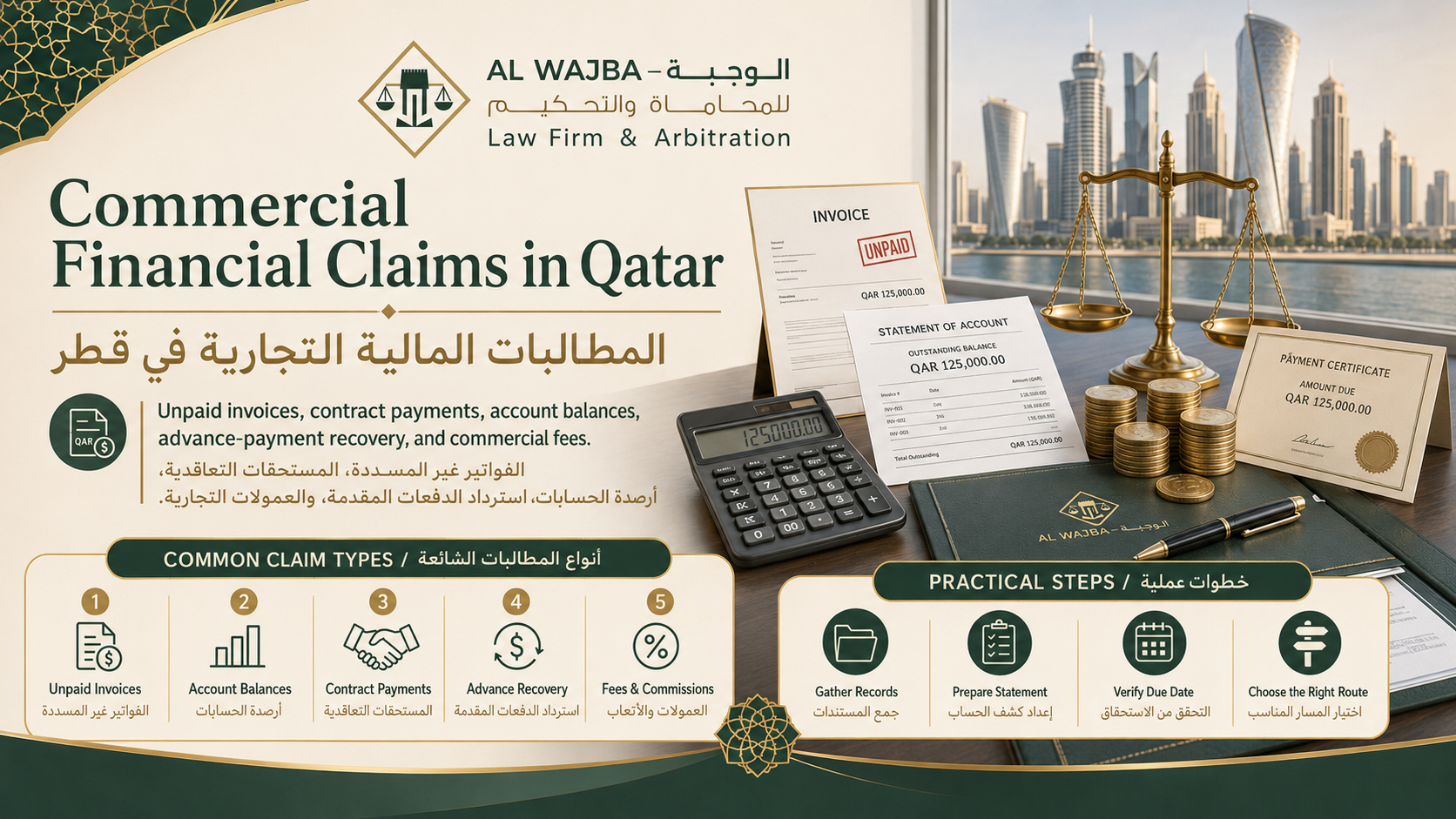
Commercial Financial Claims in Qatar: Proving and Recovering Amounts Due
This guide explains commercial financial claims in Qatar, including unpaid invoices, statements of account, proof of delivery or services, acknowledgments of debt, orders for payment, ordinary commercial claims, accounting experts, settlements, judgments, and enforcement.
Related Commercial Litigation Guides and Services
Explore related guides and legal services covering financial claims, debt recovery, contract disputes, commercial lawsuits, and judgment enforcement in Qatar.
The main guide covering commercial lawsuits, contract disputes, financial claims, debt recovery, business partner disputes, arbitration, court procedures, and judgment enforcement in Qatar.
Legal support for commercial lawsuits, contract disputes, financial claims, unpaid debts, business partner disputes, arbitration, and judgment enforcement in Qatar.
A practical guide to filing a commercial lawsuit in Qatar, including jurisdiction, legal notices, required documents, court hearings, judgments, and enforcement.
A practical guide to commercial contract breaches, delayed or defective performance, contract termination, compensation claims, and penalty clauses in Qatar.
A guide to commercial financial claims involving unpaid invoices, contractual payments, compensation, account statements, and supporting evidence in Qatar.
A practical guide to recovering commercial debts through payment demands, settlement negotiations, court claims, precautionary measures, and enforcement in Qatar.
Legal support for unpaid invoices, commercial debts, payment demands, settlement negotiations, financial claims, court proceedings, and enforcement in Qatar.
A practical guide to disputes between business partners involving company management, profit distribution, access to records, company shares, withdrawal, and partner agreements.
A guide to the jurisdiction, procedures, required documents, hearings, judgments, and case preparation before the Investment and Trade Court in Qatar.
A practical guide to arbitration agreements, arbitral procedures, interim measures, arbitral awards, challenges, and enforcement in Qatar.
A guide to enforcing commercial judgments, recovering awarded amounts, attachment procedures, debtor assets, and enforcement disputes in Qatar.
Legal services for commercial lawsuits, contract disputes, financial claims, debt recovery, business partner disputes, arbitration, and judgment enforcement.
Quick answer: how do you prove a commercial financial claim?
Prove the legal source, payment maturity, and reciprocal performance, then provide a detailed reconciliation connecting every invoice, payment, credit, and deduction to a source document or reliable acknowledgment.
- Identify the contract or transaction creating the amount claimed.
- Prove delivery of the goods, completion of the work, or performance of the service.
- Confirm the due date and any certification, acceptance, or approval required before payment.
- Prepare a detailed account reconciliation rather than relying on one total figure.
- Separate admitted amounts from invoices or deductions that remain disputed.
- Choose settlement, a payment order, ordinary litigation, or arbitration according to the documents and defenses.
From invoice and account statement to an enforceable result
Entitlement, reconciliation, acknowledgment, payment orders, expert accounting, and enforcement
Saying that a business has unpaid invoices is not, by itself, a complete claim. The file should explain why each invoice was issued, what was delivered or performed, when payment became due, what was paid, what the debtor disputed, and how the final balance was calculated.
The strategy may differ significantly between a clear written and acknowledged debt suitable for settlement or a payment order and a disputed running account requiring an ordinary lawsuit and accounting expert to examine numerous invoices, payments, credits, and counterclaims.
The entitlement
The account balance
The final result
A strong financial-claim file answers
Types of commercial financial claims
The required evidence depends on the source of the amount. A supply invoice is proved differently from a commission, retention payment, reconciled account, advance-payment refund, or contractual damages claim.
| Claim type | Examples | What may prove it |
|---|---|---|
| Unpaid commercial invoices | Invoices for supplied goods, services, maintenance, consultancy, software, or completed commercial work | The agreement or purchase order, invoice, proof of delivery or performance, due date, and any objection or acknowledgment |
| Supply and service contract payments | Milestone payments, final payments, recurring service fees, additional quantities, and approved variations | Scope of work, variations, delivery records, completion certificates, accepted quantities, and approved calculations |
| Payment certificates and retention amounts | Certified work amounts, retention, deposits, guarantees, and payments linked to acceptance or expiry of a stated period | The contract, certificates, completion percentages, acceptance documents, and release conditions |
| Commercial account balances | A running customer or supplier account containing multiple invoices, payments, credits, deductions, and set-off entries | A detailed statement of account, source documents, transfers, reconciliations, and the debtor's recorded objections |
| Commercial fees and commissions | Agency, brokerage, sales, success, management, referral, or professional commercial fees | The fee agreement, transaction or result creating entitlement, calculation method, and payment trigger |
| Recovery of advance payments | Deposits or advance payments made for goods, services, or work that were not provided or were only partly completed | Payment evidence, purpose of payment, completed value, repayment terms, and any valid deductions or set-off |
| Acknowledged or reconciled balances | Signed account reconciliation, acknowledgment of debt, repayment schedule, or settlement agreement that was not performed | The signed or electronic record, authority of the signatory, amount, maturity, conditions, and later payments |
| Financial claims involving damages | Repair, replacement, or completion costs, delay-related losses, third-party exposure, or agreed compensation | The breach, loss, causal connection, calculation, supporting documents, and reasonable mitigation measures |
Initial steps before demanding payment
Reconstruct the transaction file
Collect the agreement, purchase orders, invoices, delivery or service records, transfers, and correspondence in one indexed file.
Prepare a traceable account statement
List each invoice, payment, credit, deduction, and set-off entry and show the running balance after every transaction.
Confirm when payment became due
Review the payment clause and any required invoice, certificate, acceptance, delivery, or approval that triggers maturity.
Preserve admissions and objections
Retain requests for time, balance confirmations, partial-payment messages, and objections concerning quality, quantity, or calculation.
Verify the debtor's legal identity
Confirm the registered entity, commercial-registration details, address, and authority of the persons who ordered, accepted, or acknowledged the transaction.
Assess recovery risk
Consider the debtor's continuing operations, guarantees, assets, receivables, and other known liabilities before committing to a lengthy process.
Choose the correct claim route
Compare demand and settlement, an order for payment, ordinary litigation, and arbitration against the documents and likely defenses.
Avoid unnecessary delay
Monitor contractual and procedural deadlines and preserve records before staff changes, system migrations, or account complexity make proof more difficult.
How do you assess the strength of a financial claim?
Source of the entitlement
Identify whether the amount arises from a contract, purchase order, settlement, acknowledgment, commission arrangement, repayment obligation, or damages claim.
Payment maturity
Confirm the due date and any preceding requirement such as delivery, certification, inspection, invoice acceptance, or another approval.
Proof of reciprocal performance
Show that the claimant supplied the goods, performed the service, completed the work, or establish the legal basis for repayment.
Certainty of amount
Separate principal amounts, earlier payments, credits, deductions, set-off, damages, and agreed compensation in a reviewable schedule.
The debtor's position
Determine whether the debtor admits the balance or disputes liability, delivery, quality, quantity, pricing, calculation, or the claimant's identity.
Strength of the records
Assess the contract, invoices, acknowledgments, account statements, commercial books, and electronic records as one evidential chain.
Forum and procedure
Review the Investment and Trade Court's jurisdiction, any arbitration clause, and whether the payment-order conditions may be satisfied.
Practical enforceability
Include likely recovery, assets, security, and enforcement cost in the decision to litigate or settle.
Is an invoice alone enough?
An invoice identifies an amount requested by the creditor, but it may not prove the underlying order, delivery, performance, acceptance, or maturity on its own. Connect it to the following records where available.
- The contract, purchase order, or service request creating the obligation
- A compliant invoice stating the amount, date, parties, and relevant transaction
- Evidence that the invoice was delivered through the agreed channel
- A delivery note, completion certificate, service record, or acceptance document
- The payment due date and any certification or approval required before payment
- Any debtor objection, including its date, subject, and supporting records
- The claimant's response and technical or financial material addressing the objection
- Any partial payment, request for additional time, balance confirmation, or acknowledgment
- A statement of account showing the position before and after the invoice
- The debtor company's identity and the authority of the person ordering or accepting performance
- Variations, quantity changes, additions, or deductions affecting the amount
- Arabic translations of foreign-language documents where required
Which procedure fits the financial claim?
The route depends on the clarity of the debt, strength of the written records, any acknowledgment or objection, complexity of the account, arbitration clause, settlement prospects, and enforceability.
| Route | When it may fit | Core requirements | Key risk |
|---|---|---|---|
| Payment demand and legal notice | Where the balance is documented and there is a realistic prospect of payment or serious negotiation without immediate filing | A clear explanation of the source, invoices, maturity, amount, payment period, and reserved rights | An unverified demand or inaccurate total can expose weaknesses and create inconsistencies in later proceedings |
| Settlement and repayment schedule | Where the debtor admits all or part of the amount but requires time, restructuring, or agreed security | A clear acknowledgment, payment schedule, security, default consequences, releases, and treatment of existing proceedings | A poorly drafted settlement can replace a well-documented claim with a less secure and harder-to-enforce promise |
| Order for payment | Where the claim is for a due cash debt of a certain amount established in writing and the statutory conditions are satisfied | A demand allowing at least five days for payment, the written debt instrument, evidence of demand, and a compliant application | Where liability or amount requires substantial investigation, an ordinary commercial claim may be more appropriate |
| Ordinary commercial lawsuit | Where the contract, performance, calculation, damages, set-off, or counterclaim is disputed or expert review is needed | A clear statement of claim, defined remedies, indexed exhibits, account schedule, Arabic translations, and responses to defenses | An unstructured account file can prolong expert proceedings and weaken parts of the claim |
| Commercial arbitration | Where a valid arbitration agreement covers the financial claim or the underlying commercial dispute | Review of scope, seat, rules, language, tribunal appointment, cost, interim relief, and award enforcement | Starting court proceedings despite an applicable arbitration clause may cause a jurisdiction objection and duplicated cost |
When may an order for payment be available?
The payment-order route is an exceptional procedure for qualifying written monetary debts. The existence of an invoice, cheque, contract, or acknowledgment does not automatically establish every requirement; the instrument, maturity, certainty of amount, and defenses must be reviewed.
A cash debt
The requested relief should be payment of money rather than an amount that first requires valuation of work or unquantified damages.
A certain amount
The amount should be determinable from the written instrument and connected documents without a substantial accounting dispute.
Payment has become due
The maturity date must have passed and any contractual condition preceding payment should have been satisfied.
Established in writing
The debt must be supported by the legally required written record, with signatures, acknowledgments, and connected documents reviewed carefully.
Prior demand for payment
The payment-order procedure requires a prior demand giving the debtor at least five days to pay before the application is submitted.
A compliant application and attachments
The application should include the debt instrument, proof of demand, debtor details, service address, and other required records.
Documents for a commercial financial claim
Contract and purchase orders
The signed agreement, general and special terms, purchase orders, scope, pricing, schedules, amendments, and variations.
Invoices and financial notices
Invoices, debit and credit notes, payment certificates, applications for payment, retention, deductions, and certified amounts.
Delivery and performance evidence
Delivery receipts, completion certificates, service logs, acceptance records, work reports, approvals, and inspection documents.
Detailed statement of account
A schedule showing the opening balance, invoices, payments, credits, deductions, set-off entries, and final balance.
Transfers and partial payments
Bank-transfer records, cheques, receipts, remittance descriptions, and allocation of each payment to the correct invoice or account.
Correspondence and acknowledgments
Emails, letters, messages, meeting minutes, requests for time, reconciliations, admissions, and payment promises.
Objections and counterclaims
Quality, quantity, delay, pricing, deduction, or set-off arguments and the records supporting or answering those positions.
Commercial books and accounting records
Ledger entries, journals, reports, reconciliations, and the source documents supporting each recorded transaction.
Electronic records and data messages
Emails, system records, electronic invoices, exports, attachments, and information showing source, integrity, creation, and preservation.
Party and authority documents
Commercial-registration records, registered addresses, powers of attorney, corporate resolutions, and signing authority.
Documents supporting damages
Repair or replacement invoices, additional costs, linked financial statements, expert reports, and mitigation records.
Chronology and exhibit index
A dated summary of the transaction and a numbered index explaining the fact or amount supported by each document.
Evidence supporting a commercial financial claim
Contract and legal source
These establish why payment is due, the payment mechanism, timing, acceptance requirements, credits, set-off, and dispute forum.
Invoices and payment certificates
They identify the amount claimed but are stronger when connected to a contract, delivery, performance, and maturity.
Delivery or service performance
Delivery notes, completion certificates, service logs, approvals, and acceptance records show that the financial entitlement arose.
Acknowledgments and correspondence
Messages may record a request for time, balance confirmation, admission of an invoice, or the reason for non-payment.
Commercial books and ledgers
Properly maintained commercial books may have evidential value in business disputes, while remaining open to challenge and contrary proof.
Accounting analysis and expertise
Schedules, source records, and expert review can separate invoices, payments, credits, disputed items, and the final balance.
How should the financial-claim schedule be prepared?
The court, expert, and debtor should be able to move from the final balance back to the relevant invoice, payment, credit, and source record without reconstructing the entire account from the beginning.
| Calculation component | Examples | Supporting evidence |
|---|---|---|
| Principal or outstanding balance | Invoices, payment certificates, instalments, or contractual amounts that became due | Agreement, invoice, performance evidence, account statement, and maturity date |
| Earlier payments | Bank transfers, cheques, cash receipts, or other amounts paid on account | Payment record, remittance description, and allocation to the correct invoice or transaction |
| Credits and agreed deductions | Returns, price reductions, credits, rebates, or corrections accepted by the claimant | Credit note, agreement, correspondence, or another record explaining the adjustment |
| Set-off or counterclaim | An amount the debtor says should be deducted because of defects, delay, or another transaction | Legal and contractual basis, maturity, calculation, connection between claims, and supporting documents |
| Repair or replacement costs | Expenses resulting from defective work, non-delivery, or failure to complete an obligation | Reports, quotations, invoices, necessity, causation, and reasonableness of cost |
| Agreed compensation | A stated amount or rate addressing a specified delay or contractual breach | Clause wording, covered breach, duration, formula, cap, and partial performance |
| Reconciled or settled amount | A balance agreed through an account confirmation, acknowledgment, settlement, or repayment plan | Signed or electronic acknowledgment, authority, later payments, and maturity conditions |
| Final amount claimed | The result after adding supported entitlements and deducting payments, credits, and accepted set-off | One consolidated schedule linking every line to a numbered source document and avoiding duplication |
Accounting experts in financial-claim disputes
Expert accounting may be important where the case involves many invoices, payments, deductions, credits, reciprocal accounts, or disputed allocations. The quality of the source file can be as important as the final claimed number.
Define the accounting scope
Identify the period, agreements, invoices, accounts, and related transactions included in the review and those that should be excluded.
Create one master schedule
Use one table for invoices, payments, credits, deductions, and set-off, with a document reference for every entry.
Match ledger entries to source documents
Each accounting entry should connect to an invoice, transfer, credit note, contract, or other source record rather than an unsupported internal summary.
Separate admitted and disputed items
Identify uncontested amounts, disputed amounts, the reason for each objection, and the evidence supporting each party's position.
Respond to expert requests promptly
Provide answers and records within the required period and maintain a complete log of what was submitted and when.
Test the expert report
Review calculations, assumptions, omitted records, duplicate entries, and allocations, identifying each alleged error with a document and alternative calculation.
Common defenses to commercial financial claims
| Defense | What it means | How it should be reviewed |
|---|---|---|
| Payment is not yet due | The debtor says a condition such as certification, acceptance, delivery, or expiry of a period has not occurred | Show that the condition was satisfied, waived, accepted, or prevented by the debtor's own conduct |
| Goods or services were not provided | The debtor denies that the agreed commercial performance occurred | Produce purchase orders, delivery records, work logs, completion certificates, communications, and acceptance evidence |
| Defects, shortage, or incomplete performance | The debtor seeks rejection or reduction because the supplied performance was allegedly non-compliant | Review the timing and detail of the objection, inspection evidence, acceptance, repair, and usable partial performance |
| Full or partial payment | The debtor says the balance has already been paid or reduced | Reconcile transfers and cheques against invoices and identify payments allocated to another account or transaction |
| Set-off | The debtor relies on a separate claim that it wants deducted from the financial demand | Examine the legal basis, amount, maturity, connection, notices, and documentary proof of the alleged counterclaim |
| The statement of account is inaccurate | The debtor disputes duplicated entries, opening balances, credits, deductions, or payment allocation | Provide a traceable schedule and source document for each line and reconcile uncontested differences |
| Wrong claimant or debtor | The responding party says another company or person entered the transaction or owns the alleged right | Use the agreement, registrations, purchase orders, invoices, delivery, and authority records to identify the correct parties |
| Arbitration or lack of jurisdiction | The debtor argues that the selected court should not determine the claim | Review the validity, scope, parties, and application of the arbitration or jurisdiction clause before filing |
Safeguards for settlement and instalment plans
Settlement may be preferable to a lengthy dispute, particularly where the amount is substantially acknowledged and the debtor needs time. The agreement should not convert a strong documented claim into an unsecured and ambiguous promise.
- Separate the admitted balance from any amount that remains disputed
- Include a clear acknowledgment of the amount or obligation forming the settlement
- State each instalment, due date, payment method, and account details
- Obtain appropriate lawful security where the circumstances justify it
- State whether default on one instalment accelerates the remaining balance
- Define the consequences of late, partial, rejected, or insufficient payment
- Address the status of any existing lawsuit, payment order, arbitration, or enforcement file
- Define whether release occurs on signature, partial payment, or only after full performance
- Do not surrender original security or core documents before receiving the agreed consideration
- Specify the law, forum, and procedure for a dispute arising from the settlement itself
- Confirm corporate authority and any resolutions required for signature
- Retain originals and documentary proof of every payment under the settlement
Investment and Trade Court proceedings
The Court's published jurisdiction covers commercial contract disputes and lawsuits between traders related to their businesses. The specific forum must still be checked against the parties, transaction, requested remedies, special laws, and arbitration provisions.
- • Identify the correct claimant and debtor
- • Prepare the claim and financial remedies
- • File the account schedule and source records
- • Address set-off, defects, and other defenses
- • Manage case procedures, expertise, and hearings
Enforcing the judgment and recovering payment
Once the entitlement is established and the judgment becomes enforceable, separate enforcement steps may be required to pursue payment or legally reachable assets and to address objections arising during execution.
- • Review finality and enforceability
- • Confirm the identity of the judgment debtor
- • Provide available asset information
- • Pursue legally available recovery measures
- • Address enforcement objections and disputes
Mistakes that weaken a commercial financial claim
- Relying on an invoice without the contract, purchase order, or proof of performance
- Claiming one total that cannot be linked to specific invoices, payments, and credits
- Using a trade name instead of the debtor's correct legal identity
- Ignoring the debtor's objections rather than answering them with records
- Combining principal debt, damages, and other remedies without separating the calculations
- Omitting partial payments or allocating them to the wrong invoice
- Submitting an internal statement of account without the underlying source documents
- Failing to distinguish admitted amounts from genuinely disputed items
- Seeking an order for payment where liability or amount requires substantive determination
- Failing to make the prior payment demand in the manner required for the payment-order route
- Starting proceedings without reviewing the arbitration or jurisdiction clause
- Failing to preserve original emails, attachments, electronic invoices, and system exports
- Submitting foreign-language records without clear Arabic translations where required
- Accepting a repayment plan without acknowledgment, security, or defined default consequences
- Failing to prepare for accounting expertise or objecting to the report only in general terms
- Obtaining judgment without a realistic enforcement and asset-recovery plan
How can a commercial financial claims lawyer help?
Assess entitlement and evidence
Review the agreement, maturity, performance, objections, and evidential gaps.
Audit the account schedule
Separate invoices, payments, credits, set-off, damages, and the final balance.
Demand payment and negotiate
Prepare an evidence-based demand and negotiate payment or secured settlement.
Assess a payment order
Review the statutory conditions and prepare the demand, application, debt instrument, and attachments.
Manage litigation and expertise
Prepare pleadings and calculations and respond to the debtor and accounting expert.
Pursue judgment and enforcement
Review the decision, consider appeal where appropriate, and assist with recovery steps.
How this guide was prepared
Official court and legislative sources
The framework uses official Investment and Trade Court materials and published procedure, commercial-books, and electronic-transactions legislation.
Source-document and accounting focus
The guide emphasizes source records, account reconciliation, acknowledgments, entries, payments, credits, and objections rather than the final claimed number alone.
No guarantee of recovery
The result depends on entitlement, calculation, defenses, expert findings, and the court's decision, followed by the debtor's financial position and practical enforceability.
Official court and legal sources
These English-language sources provide information on court jurisdiction, payment orders, procedure, commercial books, electronic records, case registration, and published judgments. Current texts and filing requirements should be reviewed when handling a live claim.
Investment and Trade Court – Official Website
Investment and Trade Court – Court Overview and Jurisdiction
Investment and Trade Court – Case Management Office
Investment and Trade Court – Filing Guidelines
Investment and Trade Court – Judicial Rulings
Al Meezan – Civil and Commercial Procedure Law
Civil and Commercial Procedure Law – Order for Payment, Article 147
Civil and Commercial Procedure Law – Payment-Order Application, Article 148
Al Meezan – Trading Regulation Law, Law No. 27 of 2006
Trading Regulation Law – Commercial Books and Evidence
Al Meezan – Electronic Transactions and Commerce Law
Electronic Transactions Law – Evidence in Data-Message Form
Electronic Transactions Law – Preservation of Electronic Records
Taqadi – Investment and Trade Court E-Services
Commercial financial claims in Qatar FAQ
What is a commercial financial claim in Qatar?
It is a claim for money arising from a commercial transaction or business relationship, such as unpaid invoices, supplied goods, services, payment certificates, commissions, account balances, advance payments, acknowledged debt, or contractual damages. The claimant should prove the source, maturity, amount, and correct debtor.
Is an unpaid invoice enough to prove a commercial debt?
An invoice may be important evidence, but the claim is usually stronger when the invoice is connected to the agreement or purchase order, delivery or service performance, payment due date, account statement, and any acceptance, acknowledgment, or objection by the debtor.
What documents support an unpaid invoice claim?
Common documents include the contract or purchase order, invoice, proof that it was delivered, delivery or completion records, statement of account, transfers, correspondence, payment demands, objections, acknowledgments, and partial-payment evidence.
What is the difference between a financial claim and debt collection?
A financial-claim analysis focuses on proving legal entitlement, calculating the amount, addressing defenses, and selecting court or arbitration procedure. Debt collection focuses more broadly on payment contact, settlement, recovery strategy, debtor assets, and enforcement after the right is acknowledged or established.
When can an order for payment be requested in Qatar?
The Civil and Commercial Procedure Law provides a payment-order route for a cash debt of a certain amount that is due and established in writing, following a demand allowing the debtor at least five days to pay. The documents and any substantive dispute should be reviewed before using this route.
When is an ordinary lawsuit better than an order for payment?
An ordinary commercial claim may be more appropriate where the debtor disputes the underlying obligation, performance, amount, defects, credits, set-off, or damages, or where accounting or technical expertise is required to determine the balance.
Can an email acknowledging the debt be used as evidence?
An email, request for additional time, account confirmation, or payment promise may be relevant. Its value depends on source, authority, context, completeness, integrity, preservation, and its connection to the contract and other transaction records.
Does a statement of account prove the amount due?
A detailed statement supported by invoices, payments, reconciliations, and acknowledgments can be important evidence. A debtor may still challenge unsupported ledger entries, duplication, allocation, opening balances, credits, or missing source documents.
Can commercial books be used as evidence?
The Trading Regulation Law addresses the evidential use of commercial books in certain business disputes. Their value may depend on proper maintenance, the parties' commercial status, source documents, and any contrary evidence produced in the case.
What happens if the debtor disputes only some invoices?
Separate the uncontested and disputed amounts, identify the exact reason and evidence for each objection, and prepare a technical or accounting response for every item. This may permit partial payment or settlement while the remaining difference is addressed.
Can the debtor set off a counterclaim against the amount due?
A debtor may raise set-off or a counterclaim, but its legal basis, maturity, amount, connection to the original claim, and supporting evidence must be examined. An unsupported allegation of loss does not automatically change the account balance.
When is an accounting expert appointed?
Accounting expertise may be used where the dispute involves many invoices, payments, ledger entries, deductions, reconciliations, or reciprocal accounts. The parties should prepare one master schedule and a source document for every entry.
Can a commercial financial claim be settled in instalments?
Yes, where settlement is commercially appropriate. The agreement should state the acknowledged amount, instalments, dates, security, acceleration, default consequences, status of existing proceedings, and when any release becomes effective.
Which court handles commercial financial claims in Qatar?
The Investment and Trade Court has jurisdiction over broad categories of commercial-contract and trader disputes. The correct forum should still be assessed against the parties, transaction, requested remedies, special laws, and any arbitration agreement.
Does a commercial judgment guarantee recovery?
No. Practical recovery depends on the judgment's enforceability, the correct identity and status of the debtor, available accounts, assets, receivables, guarantees, and the enforcement measures legally available.
When should a business consult a commercial financial claims lawyer?
Legal assistance is particularly important where the value is significant, the account contains many entries, the debtor raises defects or set-off, an arbitration clause applies, or the claim may require a payment order, lawsuit, accounting expert, interim protection, or enforcement.
Have a commercial financial claim in Qatar?
We can review the contract, invoices, account statement, and performance evidence; assess a payment order, lawsuit, arbitration, or settlement; and assist with accounting expertise, judgment, and enforcement.
About the Author
Written by Mr. Yasser Asaad — Egyptian Lawyer in Qatar. A legal director with 33+ years of experience in Egyptian and Qatari law, specializing in international civil and commercial arbitration.
Need Legal Consultation?
Our team of specialized lawyers is ready to assist you with all your legal matters.
Contact Us Now