A Practical Guide to Recovering Business Debts in Qatar
A Practical Guide to Recovering Business Debts in Qatar
Commercial debt collection in Qatar is not only about sending repeated reminders. Effective recovery starts with proving the correct debtor, the legal source of the amount, the due date, and the exact balance. It then moves through a deliberate sequence of payment demand, negotiation, settlement, court or arbitration proceedings where needed, and enforcement under Qatar's current judicial enforcement framework.
This guide focuses on business-to-business debts such as unpaid invoices, contractual payments, account balances, acknowledged debts, and amounts arising from commercial transactions. It is designed to help creditors decide what to do next while also recognizing that a debtor may have a genuine defense that must be addressed before recovery can succeed.
Related Commercial Litigation Guides and Services
Explore nearby guides on commercial financial claims, contract disputes, lawsuit procedure, business debt recovery, and commercial litigation in Qatar.
The main guide covering commercial lawsuits, contract disputes, financial claims, debt recovery, business partner disputes, arbitration, court procedures, and judgment enforcement in Qatar.
Legal support for commercial lawsuits, contract disputes, financial claims, unpaid debts, business partner disputes, arbitration, and judgment enforcement in Qatar.
A practical guide to filing a commercial lawsuit in Qatar, including jurisdiction, legal notices, required documents, court hearings, judgments, and enforcement.
A practical guide to commercial contract breaches, delayed or defective performance, contract termination, compensation claims, and penalty clauses in Qatar.
A guide to commercial financial claims involving unpaid invoices, contractual payments, compensation, account statements, and supporting evidence in Qatar.
A practical guide to recovering commercial debts through payment demands, settlement negotiations, court claims, precautionary measures, and enforcement in Qatar.
Legal support for unpaid invoices, commercial debts, payment demands, settlement negotiations, financial claims, court proceedings, and enforcement in Qatar.
A practical guide to disputes between business partners involving company management, profit distribution, access to records, company shares, withdrawal, and partner agreements.
A guide to the jurisdiction, procedures, required documents, hearings, judgments, and case preparation before the Investment and Trade Court in Qatar.
A practical guide to arbitration agreements, arbitral procedures, interim measures, arbitral awards, challenges, and enforcement in Qatar.
A guide to enforcing commercial judgments, recovering awarded amounts, attachment procedures, debtor assets, and enforcement disputes in Qatar.
Legal services for commercial lawsuits, contract disputes, financial claims, debt recovery, business partner disputes, arbitration, and judgment enforcement.
Quick answer: what is the best way to recover a business debt?
Build a claim that can survive scrutiny before escalating it. Confirm who owes the money, why it is due, the exact amount, the documents proving performance, and the debtor's actual objections. Then choose the least costly route that still protects recoverability.
Debt collection, financial claims, and commercial disputes are related but not identical
A collection file may begin as a straightforward unpaid account and later become a contested legal dispute. The practical difference matters because the appropriate procedure depends on whether the debtor accepts the obligation or disputes liability, performance, calculation, or forum.
Commercial debt collection
Focuses on recovering an amount through contact, negotiation, settlement, legal escalation, and enforcement strategy.
Commercial financial claim
Focuses on proving the legal entitlement and exact amount, especially where invoices, accounts, credits, or defenses require analysis.
Read the financial claims guideCommercial litigation
Becomes central when liability, contractual performance, damages, evidence, jurisdiction, or defenses must be decided judicially.
See the commercial litigation guideCommon commercial debts businesses seek to recover in Qatar
The label "debt" can cover very different legal and evidential situations. The first task is to classify the amount correctly.
| Debt type | Examples | First legal/evidence check |
|---|---|---|
| Unpaid invoices | Goods, maintenance, consultancy, software, logistics, professional services, or recurring commercial services | Match each invoice to the contract or purchase order, delivery or performance record, due date, and any objection. |
| Certified contractual payments | Milestones, approved variations, payment certificates, retention, final accounts, and completed work | Confirm the certification or acceptance condition and whether the amount has actually matured. |
| Running account balances | Multiple invoices, payments, credits, rebates, returns, deductions, and reciprocal transactions | Prepare a transaction-by-transaction reconciliation instead of relying on a single ledger balance. |
| Acknowledged debts | Signed balance confirmations, repayment schedules, settlement agreements, or written promises to pay | Verify the amount, maturity, authority of the signatory, later payments, and any conditions attached to the acknowledgment. |
| Commercial paper and cheque-related amounts | Cheques, promissory instruments, and other payment instruments connected to a business transaction | Identify the instrument, its status, any presentation or return record, and the enforcement route available under current law. |
| Amounts due after termination or breach | Refunds, advance payments, unpaid completed work, agreed compensation, or final settlement amounts | Separate the debt already due from damages or disputed amounts that still require judicial assessment. |
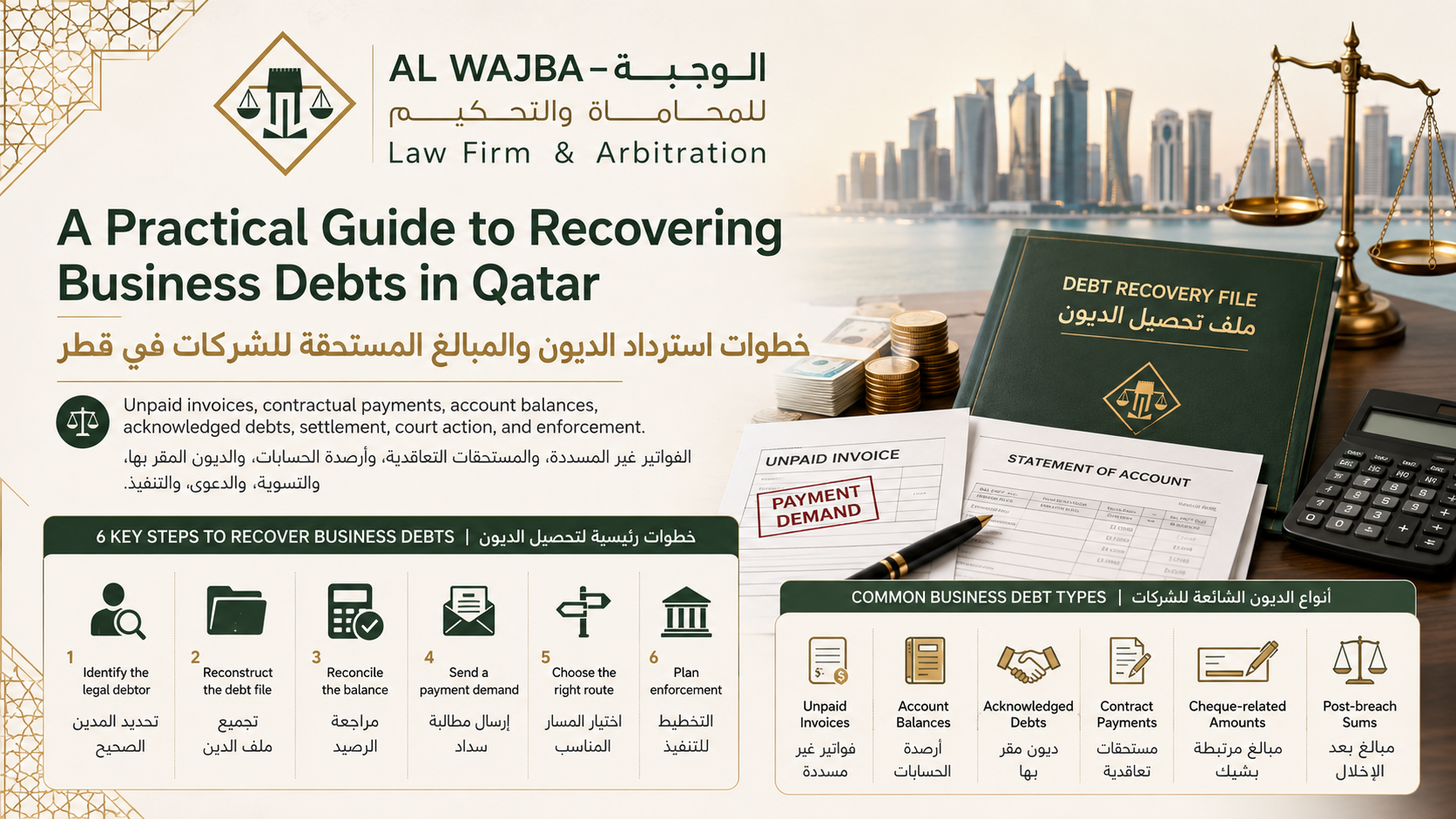
Commercial debt recovery process: an eight-step roadmap
Identify the legal debtor
Confirm the exact company or person that contracted, ordered, received, acknowledged, or guaranteed the payment. Similar trade names, branches, group companies, and personal representatives should not be treated as interchangeable.
Reconstruct the debt file
Collect the agreement, purchase orders, invoices, delivery or service evidence, payment records, account statements, correspondence, notices, acknowledgments, and any security in one indexed chronology.
Calculate the recoverable balance
Show principal, invoices, credits, payments, agreed deductions, set-off items, and any claimed compensation separately. A transparent calculation is easier to negotiate and easier to plead.
Assess the debtor's position
Distinguish inability to pay from a genuine contractual dispute. Record objections about quality, delay, quantities, authority, price, credits, or set-off before choosing the next step.
Send a focused payment demand
State the parties, transaction, amount, due date, supporting documents, payment method, response deadline, and the consequence of continued non-payment without making unsupported threats.
Evaluate settlement
If payment can realistically be achieved through a short settlement or instalment plan, document the admitted amount, dates, default consequences, security, and release terms precisely.
Choose the legal route
Depending on the documents and dispute, the route may involve an order for payment, an ordinary commercial lawsuit, arbitration, or another procedure required by the contract or applicable law.
Plan enforcement early
A judgment is valuable only if it can be enforced. Consider available information about accounts, receivables, movable or immovable assets, guarantees, and other lawful recovery targets before spending heavily on proceedings.
Documents that strengthen a commercial debt recovery file
A collection strategy becomes stronger when the account can be reconstructed from source documents rather than summaries alone. Electronic records can also matter, provided they are preserved and capable of being connected reliably to the transaction and sender.
Contract and purchase records
Signed contracts, terms, purchase orders, quotations accepted by the debtor, variations, and documents identifying the parties and payment trigger.
Invoices and statements
Invoices, account statements, credit notes, payment certificates, and a reconciliation showing how the claimed balance was reached.
Performance and delivery proof
Delivery notes, completion certificates, service reports, timesheets, acceptance records, handover documents, or other evidence that the creditor performed.
Payment history
Bank transfers, cheque records, receipts, remittance advice, partial payments, and the allocation of each payment to the correct invoice or account.
Admissions and objections
Emails, messages, signed reconciliations, requests for time, payment promises, complaints, rejection notices, and explanations for withheld amounts.
Security and guarantees
Guarantees, security documents, collateral arrangements, acknowledgments, or other instruments that may change the recovery route or available enforcement options.
What should a commercial payment demand contain?
A payment demand should make it easy for a reasonable debtor, lawyer, or judge to understand the transaction and the amount in dispute. Its purpose is not to sound aggressive; its purpose is to create clarity, invite payment or a defined response, and preserve the creditor's position.
- Use the debtor's correct registered name and reliable service/contact details.
- Identify the agreement, purchase order, project, invoice series, or transaction giving rise to the debt.
- State a reconciled amount and explain any credits, partial payments, deductions, or disputed items.
- State when the amount became due and attach or reference the strongest supporting records.
- Give a realistic deadline and clear payment instructions.
- Invite a specific written response to any disputed item instead of accepting vague promises.
- Preserve the right to pursue the legally appropriate court, arbitration, interim, or enforcement remedy.
- Keep proof of sending, receipt, and any reply because the communication may later become evidence.
Where a creditor may use the statutory order-for-payment process, the formal demand requirement should be checked specifically against the applicable law and current court guidance rather than assuming that an ordinary collection email satisfies every procedural condition.
Choosing between settlement, a payment order, lawsuit, arbitration, and enforcement
The best route is fact-sensitive. A creditor with a signed written acknowledgment may be in a very different position from a supplier whose invoices are met with allegations of defects and delay.
| Route | Often suitable where | Main advantage | Key caution |
|---|---|---|---|
| Direct payment and negotiation | A debt that is admitted or commercially resolvable and where the debtor remains responsive | Fastest and least procedurally expensive when the parties can agree credible payment terms | Do not allow repeated promises to consume limitation periods or weaken documentary leverage. |
| Structured settlement | A debtor that can pay over time or where both parties want to preserve a commercial relationship | Can convert a disputed or poorly documented account into a clearly acknowledged repayment obligation | Define default, acceleration, security, releases, and the effect on existing claims or proceedings. |
| Order for payment | A cash debt of a certain amount that is due and established in writing, subject to the statutory conditions | A focused route for qualifying written debts without beginning with a fully contested ordinary action | A substantial dispute over entitlement, performance, amount, defects, or set-off can make the ordinary claim route more appropriate. |
| Commercial lawsuit | Disputed invoices, performance issues, complex accounts, counterclaims, damages, or cases requiring accounting or technical expertise | Allows the court to determine liability, defenses, evidence, expert issues, and the final amount | The claim should be organized around a clear chronology, calculation, legal basis, and source documents. |
| Arbitration | A dispute governed by a valid arbitration agreement covering the debt or underlying contract | Respects the parties' agreed dispute-resolution mechanism and may suit specialized commercial disputes | The arbitration clause, seat, institution, scope, interim relief, costs, and enforcement strategy should be checked before filing elsewhere. |
| Enforcement proceedings | A creditor holding an enforceable judgment, order, instrument, or other title recognized under applicable enforcement law | Moves the focus from proving the claim to legally compelling satisfaction from the debtor or reachable assets | Current enforcement requirements and the exact nature of the enforceable title must be verified at the time of filing. |
When an order for payment may be relevant
Qatar's Civil and Commercial Procedure Law contains a payment-order route for qualifying debts. Article 147 addresses a cash debt of a certain amount that has become due and is established in writing, together with a prior demand. Article 148 addresses the application and the debt deed submitted with it. The Investment and Trade Court also publishes guidance on orders for payment and describes them as part of its electronic procedures.
A payment-order file is document-driven
Review the written debt evidence, certainty of the amount, maturity, demand, debtor identity, and whether the debtor's position creates a substantive dispute that requires fuller litigation.
A disputed claim may need ordinary proceedings
Defects, incomplete performance, complex accounting, counterclaims, damages, or factual disputes may require pleadings, evidence, and potentially expert review.
Review commercial lawsuit proceduresInvestment and Trade Court and commercial debt claims
The Investment and Trade Court's official jurisdiction materials expressly include supply and contract disputes and business transaction value claims under invoices, alongside other defined commercial categories. Its case-management system is designed to complete party data and documents, fees, notifications, memorandum exchange, deadlines, and referral to the competent circuit.
Correct party data
Company identity, registration details, addresses, representatives, and authority should be checked before filing.
Complete document set
The claim should be filed with a coherent chronology, legal basis, calculation, and supporting documents rather than an unstructured invoice bundle.
Procedural deadlines
Notices, submissions, responses, appeals, and other procedural steps should be monitored against current court rules and orders.
When non-payment is really a contract dispute
Some debts cannot be collected simply by proving that an invoice exists. If the debtor says the creditor delivered late, supplied defective goods, failed to complete scope, breached specifications, or caused losses, the case may require a full contractual analysis. The debt figure then depends on performance, remedies, deductions, damages, and possibly expert evidence.
Read the breach of commercial contract guideCommon defenses to commercial debt claims
Treat a defense as something to investigate, not something to ignore. A focused response can narrow the dispute, reveal an admitted amount, or show that the collection strategy should be changed before filing.
Defense
The debt is not due
What it means
The debtor says certification, acceptance, completion, a notice period, or another payment condition has not occurred.
What to test
Identify the contractual trigger and prove it occurred, was waived, was accepted, or was prevented by the debtor's own conduct.
Defense
The goods or services were defective
What it means
Payment is withheld because of alleged defects, delay, shortage, non-conformity, or incomplete work.
What to test
Examine the timing and detail of the complaint, inspection records, acceptance, corrective work, usable value, and any contractual notice mechanism.
Defense
The balance is wrong
What it means
The debtor challenges duplicate invoices, missing credits, prior payments, opening balances, or allocation between transactions.
What to test
Use one master reconciliation linking every entry to a source record and clearly separate agreed from disputed amounts.
Defense
There is a set-off or counterclaim
What it means
The debtor says it has its own financial claim that should reduce or extinguish the amount demanded.
What to test
Test the legal basis, maturity, calculation, supporting documents, and connection between the alleged counterclaim and the debt.
Defense
The wrong entity is being pursued
What it means
The debtor says another group company, branch, individual, agent, or project entity entered the transaction.
What to test
Trace the contracting party through registrations, contract signatures, purchase orders, invoices, delivery records, bank details, and authority documents.
Defense
The dispute belongs in arbitration or another forum
What it means
The debtor challenges the selected court or procedure because of an arbitration clause, jurisdiction clause, or special statutory route.
What to test
Review the wording, scope, validity, parties, seat, and applicable law before taking procedural steps that may create delay or cost.
How to structure a commercial debt settlement
A settlement should reduce uncertainty, not create a second dispute. Oral payment promises or vague emails are poor substitutes for a document that makes the obligation and default consequences clear.
Acknowledged balance
State the amount that is admitted, the currency, and how it was calculated, with any disputed amount addressed separately.
Payment schedule
Specify exact instalment amounts, dates, bank details, and when a payment is treated as received.
Default consequences
Define grace periods, acceleration of remaining instalments, agreed consequences, and what happens after a missed payment.
Security
Record any legally valid guarantee, security, cheque, acknowledgment, or other agreed protection and the conditions for using it.
Proceedings and enforcement
Explain whether an existing case is stayed, withdrawn, continued, or capable of being resumed if the settlement is breached.
Release
State whether release is immediate or takes effect only after full cleared payment, and identify the claims it covers.
Precautionary measures and asset risk
In some disputes, a creditor is concerned that assets may disappear before a final decision. Qatar law contains mechanisms for precautionary measures in appropriate cases, but the requirements are technical and fact-specific. The availability of a measure can depend on the nature of the debt, evidence, urgency, requested asset, court jurisdiction, security, and follow-on procedural obligations.
Recovering the money after judgment: the current enforcement framework
Qatar issued Judicial Enforcement Law No. 4 of 2024, which came into force after the period stated in the law and introduced a specialized Enforcement Court. For a current commercial debt file, post-judgment strategy should therefore be based on the new enforcement regime and the Supreme Judicial Council's current procedures rather than older descriptions of the former enforcement department alone.
Identify enforceable targets
Lawfully available information about bank accounts, receivables, vehicles, real estate, business assets, guarantees, or third-party amounts may affect practical recovery strategy.
Use the current enforcement framework
Qatar's Judicial Enforcement Law No. 4 of 2024 introduced a specialized Enforcement Court. Filing and measures should be checked against the current law and SJC procedures rather than relying on older enforcement practice alone.
Distinguish judgment from collection
Winning the merits establishes or confirms the right. Actual payment still depends on a valid enforcement title, procedure, reachable assets, priorities, and any competing claims.
Monitor insolvency risk
Signs of closure, repeated defaults, asset movement, multiple creditor claims, or severe cash-flow problems can change the value of settlement, interim, and enforcement options.
Common commercial debt collection mistakes
Continuing informal chasing for months without fixing the amount, evidence, or next legal deadline.
Demanding a ledger total that cannot be traced back to invoices, delivery records, payments, and credits.
Treating a parent company, branch, shareholder, manager, or related company as automatically liable for another entity's debt.
Ignoring a real defect, delay, set-off, or counterclaim and assuming non-payment is the only issue.
Starting ordinary litigation without checking whether the debt qualifies for a payment order or whether an arbitration clause controls the dispute.
Accepting an instalment plan that does not acknowledge the balance or explain what happens on default.
Obtaining a judgment without considering whether the debtor has identifiable assets or receivables capable of enforcement.
Using outdated enforcement assumptions after the introduction of Judicial Enforcement Law No. 4 of 2024.
How legal support can improve a debt recovery file
Assess recoverability
Review debtor identity, evidence, defenses, contractual forum, account calculation, and practical asset risk before escalation.
Prepare the demand and negotiation record
Present the debt coherently, answer objections, and structure settlement discussions without casually giving up rights.
Select the procedure
Evaluate payment order, ordinary lawsuit, arbitration, interim relief, and any special route that applies to the documents.
Build the evidence file
Create a chronology, reconciliation, source-document index, and clear separation between admitted and disputed amounts.
Manage proceedings
Prepare submissions, respond to defenses, handle expert issues, and track procedural deadlines through judgment.
Plan enforcement
Move from judgment to recovery using the current enforcement framework and lawful information about available recovery targets.
Practical decision guide before escalating a debt
Is the debt admitted and clearly documented?
Prioritize a focused demand and settlement, while checking whether a payment-order or direct enforcement route may be available.
Is only part of the balance disputed?
Separate admitted and disputed amounts and seek payment of the uncontested portion without losing the right to pursue the balance.
Are defects, delays, or counterclaims central?
Treat the matter as a substantive commercial dispute and prepare the contractual and expert evidence needed to address those defenses.
Does the contract contain an arbitration clause?
Review the clause before court filing and plan interim or enforcement steps consistently with the agreed dispute-resolution mechanism.
Is the debtor showing serious financial distress?
Evaluate urgency, settlement security, lawful precautionary options, and likely enforceable assets before delaying further.
Do you already have a judgment or enforceable title?
Shift the analysis to the current Judicial Enforcement Law and the specific SJC enforcement procedure for that title.
How this guide was prepared
Current official court framework
The guide uses current Investment and Trade Court jurisdiction and case-management materials for commercial claims and payment-order procedure.
Primary legislative sources
Payment-order concepts are checked against the Civil and Commercial Procedure Law, with commercial and electronic record issues cross-checked against official legislation.
Updated enforcement context
The article recognizes Judicial Enforcement Law No. 4 of 2024 so post-judgment recovery is not described through an outdated enforcement framework.
Official legal and court sources
These sources are useful starting points for jurisdiction, procedure, payment orders, evidence, electronic court services, and the current enforcement framework. Live filing requirements and the latest legislation should always be checked for an active case.
Investment and Trade Court – Court Jurisdictions
Investment and Trade Court – Court Overview
Investment and Trade Court – Case Management Office
Investment and Trade Court – Filing Guidelines
Civil and Commercial Procedure Law – Article 147
Civil and Commercial Procedure Law – Article 148
Trading Regulation Law – Law No. 27 of 2006
Electronic Transactions and Commerce Law
Amiri Diwan – Judicial Enforcement Law No. 4 of 2024
Supreme Judicial Council – Electronic Court Services
Commercial debt collection in Qatar FAQ
How do you collect a commercial debt in Qatar?
Start by confirming the legal debtor, reconstructing the transaction file, calculating the exact balance, and assessing any genuine dispute. A focused payment demand and settlement attempt may resolve the matter. If not, the appropriate route may be an order for payment, a commercial lawsuit, arbitration, or enforcement of an existing title, depending on the documents and applicable law.
Which court handles business debt disputes in Qatar?
The Investment and Trade Court has jurisdiction over broad categories of commercial disputes, including supply and contract disputes and business transaction value claims under invoices. The exact forum still depends on the parties, transaction, special laws, and any arbitration agreement.
Is an unpaid invoice enough to file a debt claim?
An invoice is useful evidence, but a stronger file connects it to the contract or purchase order, proof of delivery or services, the due date, account reconciliation, payment history, and any acknowledgment or objection from the debtor.
When can a creditor seek an order for payment in Qatar?
Article 147 of the Civil and Commercial Procedure Law provides a payment-order route where a creditor has a cash debt of a certain amount that is due and established in writing, subject to the statutory requirements including the prior demand. Article 148 addresses the application and supporting debt deed. The current facts and court guidance should be checked before using this route.
What if the debtor disputes the invoice?
Identify the precise objection. A genuine dispute over performance, defects, quantity, calculation, authority, credits, or set-off may require an ordinary commercial claim and potentially accounting or technical expertise rather than a simple collection demand.
Can a debt be settled in instalments?
Yes. A useful settlement should normally state the acknowledged balance, instalment dates, payment method, security if any, default consequences, acceleration terms, treatment of existing proceedings, and when any release becomes effective.
Can emails or WhatsApp messages help prove a debt?
Electronic communications may be relevant where they reliably show the sender, authority, transaction, acknowledgment, request for time, objection, or payment promise. Preserve complete records and connect them to the underlying contract, invoices, and performance evidence.
Can a creditor freeze or attach debtor assets before judgment?
Precautionary measures may be available in appropriate circumstances, but they are not automatic debt-collection tools. The legal basis, urgency, evidence, requested asset, security requirements, notice rules, and the competent court should be assessed for the specific case.
What changed with Qatar's Judicial Enforcement Law No. 4 of 2024?
The law introduced a new judicial enforcement framework and a specialized Enforcement Court. For current debt recovery, post-judgment steps and enforceable instruments should therefore be assessed under the current enforcement regime and Supreme Judicial Council procedures.
Does a court judgment guarantee that a commercial debt will be recovered?
No. A judgment establishes an enforceable right, but actual recovery depends on the debtor's financial position, reachable assets or receivables, competing claims, applicable priorities, and the effectiveness of legally available enforcement measures.
What is the difference between a financial claim and debt collection?
A commercial financial claim focuses on proving entitlement and calculating the amount due. Debt collection is broader: it includes pre-action contact, settlement, recoverability assessment, choice of procedure, asset planning, and enforcement after the debt is admitted or judicially established.
When should a business involve a debt collection lawyer?
Legal review is particularly useful when the debt is significant, documents are incomplete, the debtor raises substantive defenses, there is an arbitration clause, urgent protection may be needed, the debtor is financially unstable, or court and enforcement steps are likely.
Need to recover an unpaid commercial debt in Qatar?
We can review the contract, invoices, account statement, performance evidence, debtor objections, and available security; assess settlement, payment-order, litigation, or arbitration options; and assist with judgment and current enforcement procedures where appropriate.
About the Author
Written by Mr. Arqam Abdelqader — Sudanese Lawyer in Qatar. A Sudanese lawyer registered with the Sudanese Bar Association and the Qatari Ministry of Justice, with legal experience in Sudan, Kuwait, and Qatar. He specializes in family, criminal, corporate, and labor law.
Need Legal Consultation?
Our team of specialized lawyers is ready to assist you with all your legal matters.
Contact Us Now