When to Hire a Commercial Dispute Lawyer in Qatar

When to Hire a Commercial Dispute Lawyer in Qatar
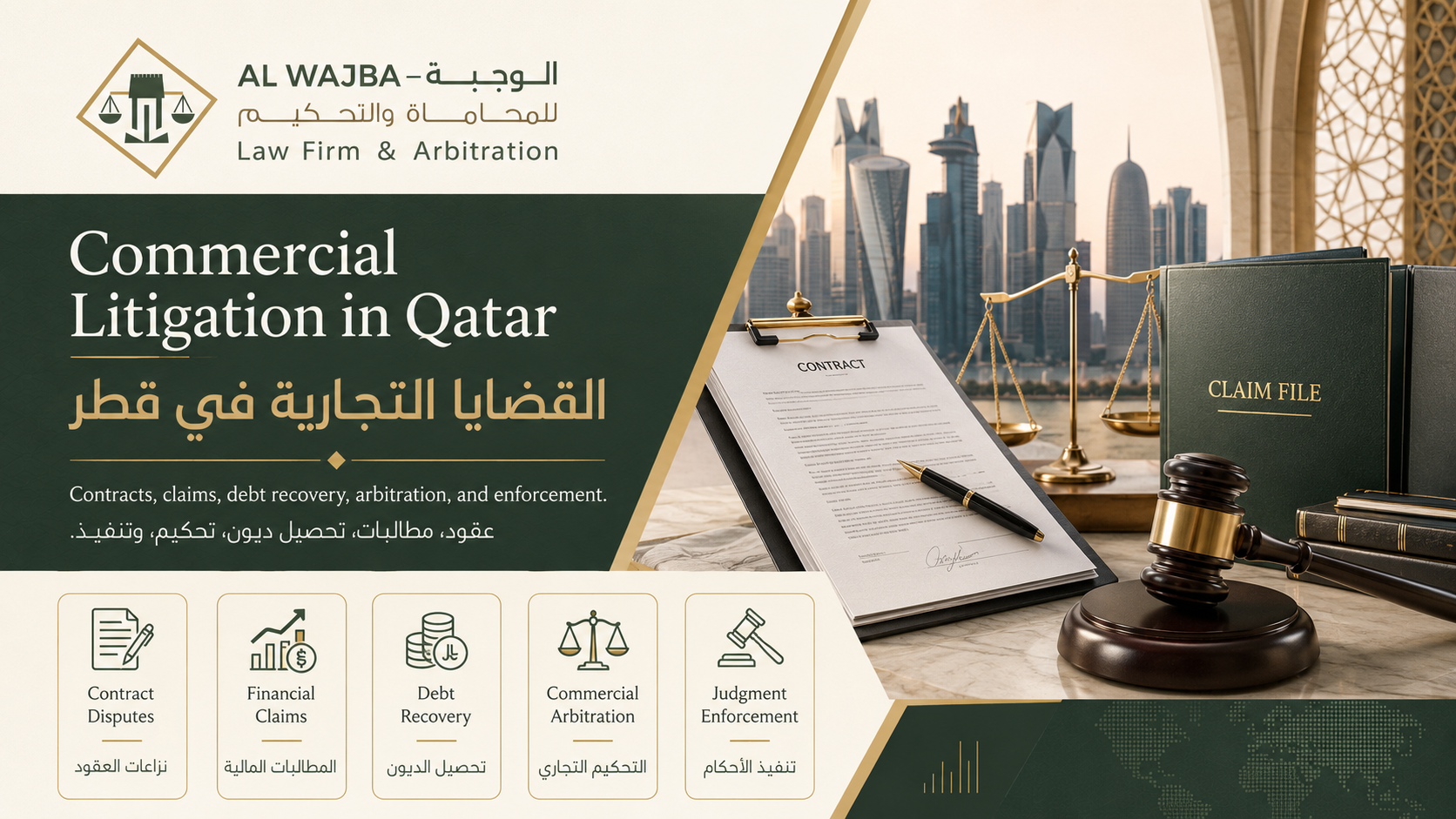
A commercial litigation lawyer in Qatar can help businesses, investors, partners, and shareholders assess contract disputes, unpaid invoices, financial claims, corporate conflicts, arbitration matters, court proceedings, and judgment enforcement.
Related Commercial Litigation Guides and Services
Explore related guides and legal services covering commercial claims, contract disputes, debt recovery, arbitration, court proceedings, and enforcement in Qatar.
The main guide covering commercial lawsuits, contract disputes, financial claims, debt recovery, business partner disputes, arbitration, court procedures, and judgment enforcement in Qatar.
Legal support for commercial lawsuits, contract disputes, financial claims, unpaid debts, business partner disputes, arbitration, and judgment enforcement in Qatar.
A practical guide to filing a commercial lawsuit in Qatar, including jurisdiction, legal notices, required documents, court hearings, judgments, and enforcement.
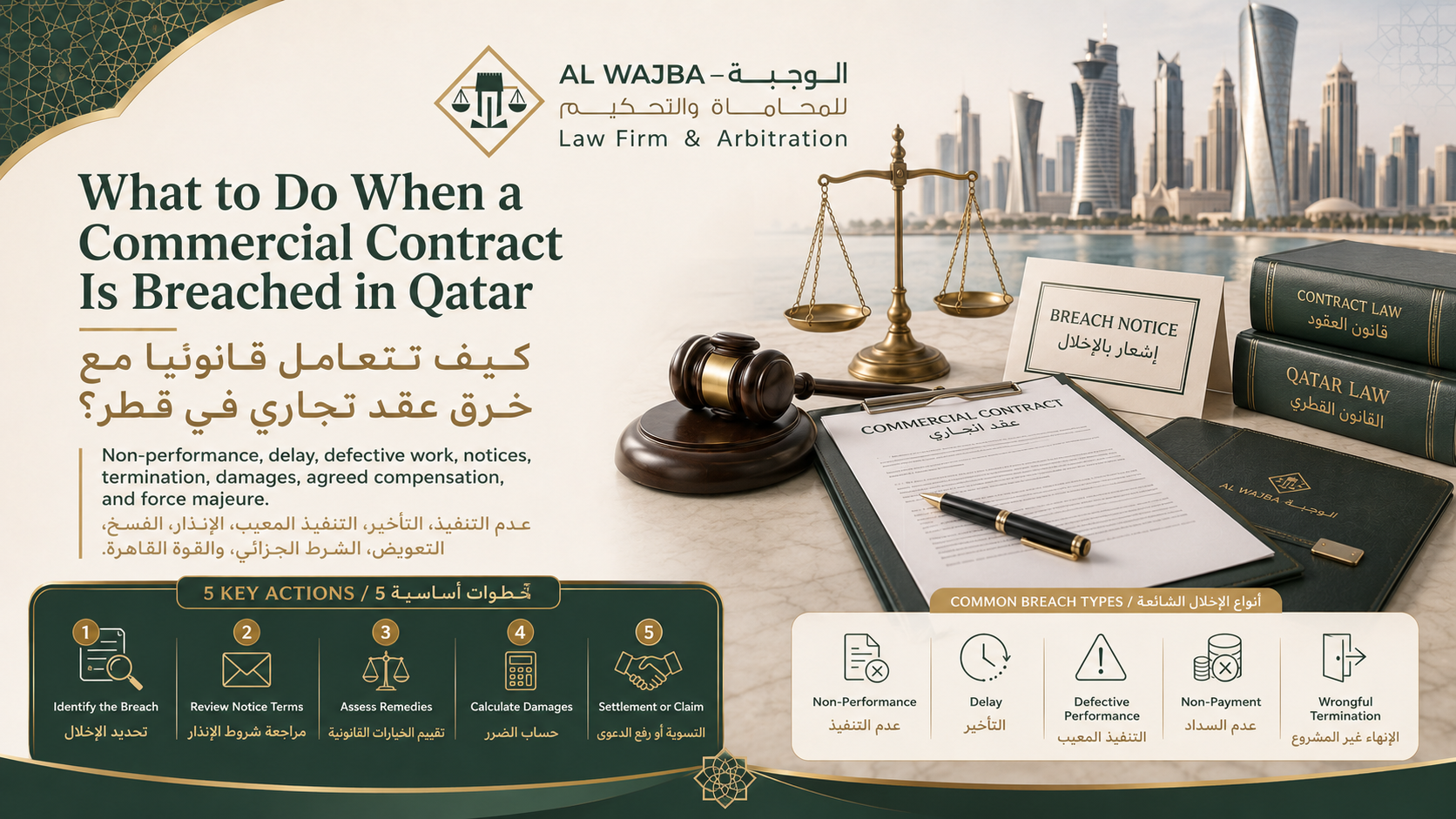
A practical guide to commercial contract breaches, delayed or defective performance, contract termination, compensation claims, and penalty clauses in Qatar.
A guide to commercial financial claims involving unpaid invoices, contractual payments, compensation, account statements, and supporting evidence in Qatar.
A practical guide to recovering commercial debts through payment demands, settlement negotiations, court claims, precautionary measures, and enforcement in Qatar.
Legal support for unpaid invoices, commercial debts, payment demands, settlement negotiations, financial claims, court proceedings, and enforcement in Qatar.
A practical guide to disputes between business partners involving company management, profit distribution, access to records, company shares, withdrawal, and partner agreements.
A guide to the jurisdiction, procedures, required documents, hearings, judgments, and case preparation before the Investment and Trade Court in Qatar.
A practical guide to arbitration agreements, arbitral procedures, interim measures, arbitral awards, challenges, and enforcement in Qatar.
A guide to enforcing commercial judgments, recovering awarded amounts, attachment procedures, debtor assets, and enforcement disputes in Qatar.
Legal services for commercial lawsuits, contract disputes, financial claims, debt recovery, business partner disputes, arbitration, and judgment enforcement.
Quick answer: when should you hire a commercial litigation lawyer?
Seek advice early when the claim is valuable, the contract is complex, arbitration may apply, assets are at risk, shareholders are in dispute, or evidence and enforcement are likely to be difficult.
- A customer or company has failed to pay invoices or other contractual amounts.
- The other party has delayed, refused, or defectively performed a commercial obligation.
- Partners or shareholders disagree about management, profits, records, or ownership interests.
- The contract contains an arbitration, jurisdiction, governing-law, or escalation clause.
- There is a risk that assets, documents, or electronic evidence may be moved or lost.
- A judgment or arbitral award has been obtained but payment has not been recovered.
Legal support from early dispute assessment to enforcement
Contract disputes, financial claims, shareholder conflicts, arbitration, and commercial court cases
Commercial dispute management does not begin only when a lawsuit is filed. It begins when a payment is missed, performance is delayed, work is rejected, a contract is threatened with termination, or partners begin disputing control of a company.
Early legal review can identify what should be done, what should not be communicated, how the evidence should be preserved, which party and forum are correct, and whether settlement, litigation, or arbitration offers the strongest practical route.
Claim and defense
Court and arbitration
Recover the result
Commercial dispute support may include
Claim or defense assessment
Reviewing the facts, contract, evidence, calculations, likely defenses, and risks.
Demands and settlement
Preparing a structured claim and negotiating enforceable settlement terms.
Litigation or arbitration
Preparing submissions and managing hearings, evidence, experts, and applications.
Appeals and enforcement
Reviewing the decision and pursuing payment, assets, or awarded performance.
Commercial litigation lawyer services in Qatar
The scope of work depends on the dispute and its current stage. Legal support may begin with a focused contract and evidence review or extend through settlement negotiations, court proceedings, arbitration, appeal, and enforcement.
Early Dispute Assessment
We review the contract, facts, communications, evidence, financial exposure, likely defenses, forum, and recoverability before recommending litigation, arbitration, settlement, or another response.
Commercial Contract Disputes
We assist with non-performance, delay, defective performance, termination, damages, contractual penalty clauses, payment disputes, and the financial consequences of ending a business contract.
Financial Claims and Debt Recovery
We support claims involving unpaid invoices, outstanding contractual payments, statements of account, payment demands, settlements, court claims, asset recovery, and judgment enforcement.
Partner and Shareholder Disputes
We advise on disputes involving management control, profit distributions, access to accounts and company records, ownership interests, manager authority, partner withdrawal, and company resolutions.
Investment and Trade Court Representation
We assist with preparing and filing claims, organizing exhibits, drafting submissions, responding to defenses, attending hearings, managing expert procedures, and pursuing appropriate applications.
Commercial Arbitration
We review arbitration clauses, tribunal jurisdiction, arbitrator appointment procedures, pleadings, evidence, interim relief, arbitral awards, annulment risks, recognition, and enforcement.
Interim and Precautionary Measures
We assess whether urgent protection may be available where assets, evidence, contractual rights, or the existing legal position may be at risk before the dispute is finally determined.
Appeals and Judgment Enforcement
We review judgments and available appeal routes, then assist with enforcement, recovery of awarded amounts, asset-related applications, and responses to enforcement objections.
When should you contact a business dispute lawyer?
Before proceedings begin
- A material contract breach or repeated delay has occurred.
- You are considering termination, suspension, or withholding payment.
- A significant legal demand or payment notice must be issued.
- The other party has formally rejected liability or payment.
- There is a risk of asset movement or evidence loss.
- A substantial settlement offer must be evaluated.
During or after proceedings
- You receive a court claim, defense, counterclaim, or arbitration request.
- A technical or accounting expert has been appointed.
- The opposing party introduces new documents or allegations.
- A judgment or award requires review or possible challenge.
- The awarded amount has not been paid.
- An enforcement objection or dispute has arisen.
How we approach a commercial dispute
These stages help turn scattered events, contracts, accounts, and communications into a clear claim or defense and a strategy designed around the client's commercial objective.
Initial consultation and commercial objective
We identify the parties, transaction, disputed obligation, amount at stake, current business risk, and the result you need, such as payment, performance, termination, damages, urgent protection, or settlement.
Contract and evidence review
We review the contract, amendments, invoices, account statements, correspondence, delivery or completion evidence, technical material, payment records, and any admissions or partial payments.
Forum and jurisdiction analysis
We assess the competent court, the legal identity and capacity of each party, governing-law provisions, arbitration clauses, and any notice, negotiation, or escalation steps required by the contract.
Claim, defense, and risk assessment
We identify the legal basis, remedies, claim value, evidential gaps, likely defenses, counterclaim exposure, procedural deadlines, expert issues, and practical enforcement risks.
Demand, negotiation, and settlement
Where appropriate, we prepare a structured legal demand and negotiate from an evidence-based position, with settlement terms addressing payment, security, releases, confidentiality, and default consequences.
Court filing or commencement of arbitration
We prepare the claim or arbitration request, submissions, supporting documents, translations, authority documents, calculations, and procedural applications required for the selected forum.
Hearings, pleadings, and expert procedures
We manage written submissions, hearings, document production, technical or accounting expert procedures, responses to reports, and the presentation of the client's factual and legal position.
Judgment, appeal, and enforcement
We review the result and reasoning, assess available challenge or appeal options, and develop an enforcement plan focused on actual payment, asset recovery, or performance of the awarded obligation.
What documents does a commercial litigation lawyer need?
You do not need to wait until the file is perfect before requesting advice. Begin with the records available and identify missing documents and the people or systems likely to hold them.
- The signed commercial contract and all schedules, amendments, purchase orders, and scope-of-work documents
- Commercial registration documents and records confirming the legal identity of each party
- Powers of attorney, board resolutions, shareholder resolutions, and evidence of signing authority where applicable
- Invoices, statements of account, payment certificates, bank transfers, and partial-payment records
- Delivery notes, completion certificates, service records, acceptance documents, and evidence of rejected performance
- Emails, letters, messages, meeting minutes, internal communications, and formal notices
- Payment demands, default notices, termination notices, objections, and responses exchanged before the dispute
- Technical, engineering, delay, quality-control, valuation, or accounting reports
- Articles of Association, shareholder agreements, partner agreements, company registers, and resolutions in corporate disputes
- The arbitration clause or separate arbitration agreement and any incorporated institutional rules
- A dated chronology of events and a separate claim schedule explaining how every amount was calculated
- The opposing party's correct legal name, registered address, notification details, and available asset information
- Certified, legalized, or translated foreign documents where required
- Previous court orders, judgments, arbitral awards, settlement agreements, or enforceable instruments connected to the dispute
Commercial disputes requiring careful legal review
High-value or multi-part financial claim
The principal debt, contractual payments, damages, deductions, costs, and other amounts should be separated and supported by a calculation that can be followed and tested.
Arbitration clause in the contract
The validity, scope, seat, rules, language, tribunal appointment process, and pre-arbitration steps should be reviewed before starting proceedings in any forum.
Partner or shareholder conflict
A dispute may involve rights belonging to the company, rights belonging personally to a partner, management authority, profit distribution, records, ownership, or director liability.
Risk of asset disposal or evidence loss
Urgent or precautionary relief may require consideration, but the requested protection must be supported by a proper legal basis and specific evidence of the relevant risk.
Technical or accounting complexity
The result may depend heavily on a court-appointed or party-appointed expert, making document organization, claim calculations, and technically precise submissions especially important.
Expected enforcement difficulty
Winning the claim may be easier than recovering the award, so the debtor's correct identity, solvency, guarantees, receivables, and reachable assets should be considered early.
Settlement, court litigation, or arbitration?
A commercial litigation lawyer should not assume that filing a lawsuit is always the best route. Each option should be compared against the evidence, urgency, confidentiality, relationship value, cost, required remedies, and location of the opposing party's assets.
Negotiation and settlement
Settlement can offer speed and flexibility, but the agreement should clearly address payment, security, releases, confidentiality, enforcement, and the consequences of default.
Court litigation
Court proceedings may be appropriate where a binding judgment, court-appointed expert, judicial interim measure, or formal enforcement mechanism is required.
Commercial arbitration
Arbitration may suit disputes covered by a valid arbitration agreement, particularly complex, technical, confidential, or cross-border commercial matters.
Representation before the Investment and Trade Court
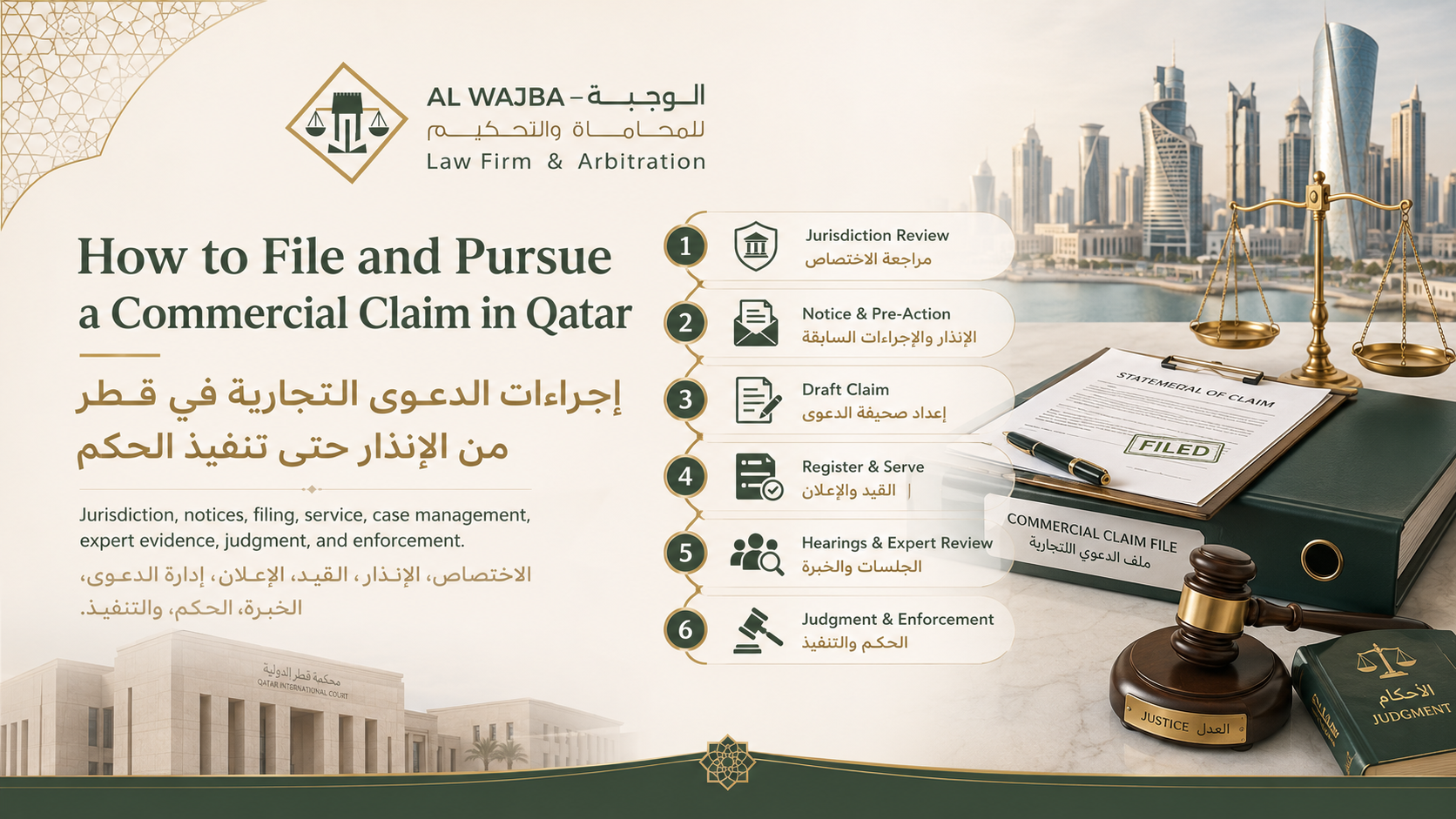
Court representation may involve reviewing jurisdiction, preparing party and authority details, drafting the claim or defense, organizing exhibits and translations, completing filing requirements, responding to the opposing case, and managing hearings and expert procedures.
- • Preparing the claim, defense, or counterclaim
- • Organizing evidence and claim calculations
- • Completing Case Management Office requirements
- • Preparing submissions on technical or accounting expert reports
- • Reviewing the judgment and appeal position
Judgment enforcement and recovery
The work does not necessarily end when judgment is obtained. The decision must be reviewed for enforceability, the proper enforcement procedure must be commenced, and available information about the debtor's accounts, receivables, assets, and legal status should be considered.
- • Reviewing the enforceable instrument and finality
- • Confirming the correct judgment debtor
- • Providing available asset information
- • Pursuing legally available attachment and recovery measures
- • Responding to enforcement objections and disputes
What affects the time and cost of commercial litigation?
Factors affecting duration
- • Completeness of party and notification details
- • Number of parties, contracts, claims, and defenses
- • Document volume and translation requirements
- • Technical or accounting expert procedures
- • Interim applications, counterclaims, and appeals
- • Complexity of the enforcement process
Factors affecting cost
- • Claim type, value, and applicable fees
- • Volume of contract and evidence review
- • Preparation of submissions and financial schedules
- • Translation, authentication, and expert work
- • Number of case, appeal, and enforcement stages
- • Institutional and tribunal fees in arbitration
Mistakes that can weaken a commercial dispute
- Starting proceedings without reviewing the jurisdiction or arbitration clause
- Relying on invoices without proving the contract, delivery, or completed service
- Submitting one unexplained claim total instead of a traceable calculation
- Sending emotional, inconsistent, or legally damaging communications after the dispute begins
- Failing to preserve original emails, electronic records, and complete communication chains
- Filing against a trade name or entity that is not the correct legal defendant
- Ignoring contractual notice, cure-period, negotiation, or escalation requirements
- Submitting foreign-language documents without the required Arabic translation or formal authentication
- Failing to prepare properly for a technical or accounting expert procedure
- Accepting a settlement without clear payment dates, security, releases, and default consequences
- Focusing on obtaining judgment without investigating the debtor's assets and recoverability
- Waiting until documents are lost or important contractual or procedural deadlines are close
Our approach to commercial dispute work
The objective is to build a clear, evidence-based position while considering the client's business outcome and prospects of enforcement—not simply to increase the volume of correspondence or prolong the dispute.
Legal and Commercial Assessment
We consider the legal position together with claim value, evidence strength, cost, business disruption, settlement leverage, and the practical prospects of enforcement.
Structured Case Preparation
We organize the chronology, contracts, correspondence, calculations, and exhibits so that each factual allegation and requested remedy has clear support.
Risk-Focused Strategy
We identify jurisdiction, evidence, arbitration, expert, limitation, counterclaim, and enforcement risks before they become late-stage problems.
Commercially Sensible Settlement
We do not assume that filing a lawsuit is always the best result. Settlement, litigation, and arbitration are compared against time, cost, evidence, and recoverability.
Support Through Each Case Stage
The work can cover pre-action advice, filing, submissions, hearings, expert procedures, settlement discussions, appeals, and enforcement.
Recovery and Enforcement Focus
Recoverability is considered from the beginning rather than being treated as an entirely separate issue after judgment has been obtained.
How commercial dispute advice is prepared
Evidence comes first
Advice should be based on the contract, communications, accounts, technical records, and actual chronology rather than unsupported assumptions.
Current legal sources are reviewed
The applicable jurisdiction, procedure, legislation, court guidance, and arbitration framework should be checked for the specific dispute and selected forum.
No outcome guarantees
The result, duration, cost, and recoverability of a commercial dispute depend on the evidence, opposing party, procedure, expert findings, and judicial or arbitral decisions.
Official court and legal sources
These official English resources provide information on the Investment and Trade Court, case-management procedures, commercial and civil legislation, electronic filing, published decisions, and arbitration. Current rules and procedures should be checked when handling a live matter.
Investment and Trade Court – Official Website
Investment and Trade Court – Court Overview and Jurisdiction
Supreme Judicial Council – Investment and Trade Court
Investment and Trade Court – Case Management Office
Investment and Trade Court – Filing Guidelines
Investment and Trade Court – Judicial Rulings
Al Meezan – Civil and Commercial Procedure Law
Al Meezan – Civil Code, Law No. 22 of 2004
Al Meezan – Trading Regulation Law, Law No. 27 of 2006
Al Meezan – Arbitration Law, Law No. 2 of 2017
Taqadi – Investment and Trade Court E-Services
Qatar International Center for Conciliation and Arbitration
Commercial litigation lawyer in Qatar FAQ
What does a commercial litigation lawyer in Qatar do?
A commercial litigation lawyer reviews contracts, facts, evidence, and financial records; assesses the strength of claims and defenses; identifies the correct court or arbitration forum; prepares demands and pleadings; negotiates settlements; manages hearings and expert procedures; and assists with appeals and enforcement.
When should a business contact a commercial dispute lawyer?
Legal advice is best sought when a significant breach, payment default, termination threat, shareholder conflict, or formal claim first arises. Early review can help preserve evidence, prevent damaging communications, identify deadlines, and protect the client's position before it becomes harder to change.
Does every commercial dispute go to the Investment and Trade Court?
The Investment and Trade Court has jurisdiction over broad categories of commercial and investment disputes, but jurisdiction must be assessed in each case. The parties, transaction, requested remedies, applicable laws, and any valid arbitration clause can affect the correct forum.
Is a legal notice required before filing a commercial claim?
The answer depends on the contract, the nature of the obligation, and the applicable legal rules. Notice may be contractually or legally important, and it can also clarify the default and create a settlement opportunity. A generic demand should not be used without checking its legal effect.
What documents should I give a commercial litigation lawyer?
Useful documents commonly include the contract and amendments, invoices, account statements, payment records, proof of delivery or service, emails and letters, notices, technical or accounting reports, corporate records, and documents confirming the parties' legal identities and signing authority.
Can a lawyer recover an unpaid business invoice in Qatar?
An unpaid invoice may support a commercial financial claim, but the file is usually stronger when it also proves the underlying order or contract, delivery of goods or performance of services, the payment due date, the outstanding balance, and any acknowledgment or objection made by the debtor.
How can a lawyer help with a shareholder or partner dispute?
The lawyer can review the Articles of Association, shareholder or partner agreements, resolutions, accounts, records, and management authority. The review should distinguish rights belonging to the company from personal rights of a shareholder or partner and identify the proper claimant, defendant, and remedy.
When is settlement better than commercial litigation?
Settlement may be preferable where it offers faster recovery, reduces legal and enforcement risk, preserves an important business relationship, or avoids disproportionate cost. The offer should be compared against evidence strength, likely duration, recoverability, and the security available for payment.
When is commercial arbitration used in Qatar?
Arbitration is generally used where the parties have a valid written arbitration agreement covering the dispute. The clause should be reviewed for scope, seat, rules, language, tribunal formation, costs, interim measures, award challenges, and later enforcement.
Can the court freeze or attach assets before final judgment?
Interim or precautionary relief may be available in appropriate circumstances, but it is not automatic. The applicant must establish the relevant legal conditions and provide evidence supporting the alleged risk and the specific measure requested.
How long does a commercial litigation case take in Qatar?
There is no fixed duration for every case. Timing can be affected by jurisdiction, notification, the number of parties, document volume, translations, written submissions, expert appointments, interim applications, appeals, and enforcement.
What happens after a commercial judgment is issued?
The judgment should be reviewed for finality, enforceability, and available appeal routes. Once enforceable, a separate enforcement process may be needed to notify the debtor, pursue payment or assets, and address any objections or disputes arising during enforcement.
Need a commercial litigation lawyer in Qatar?
We can review the contract, evidence, and financial claim; assess settlement, court, and arbitration options; and develop a practical strategy for protecting your business and pursuing enforcement.
About the Author
Written by Mr. Yasser Asaad — Egyptian Lawyer in Qatar. A legal director with 33+ years of experience in Egyptian and Qatari law, specializing in international civil and commercial arbitration.
Need Legal Consultation?
Our team of specialized lawyers is ready to assist you with all your legal matters.
Contact Us Now