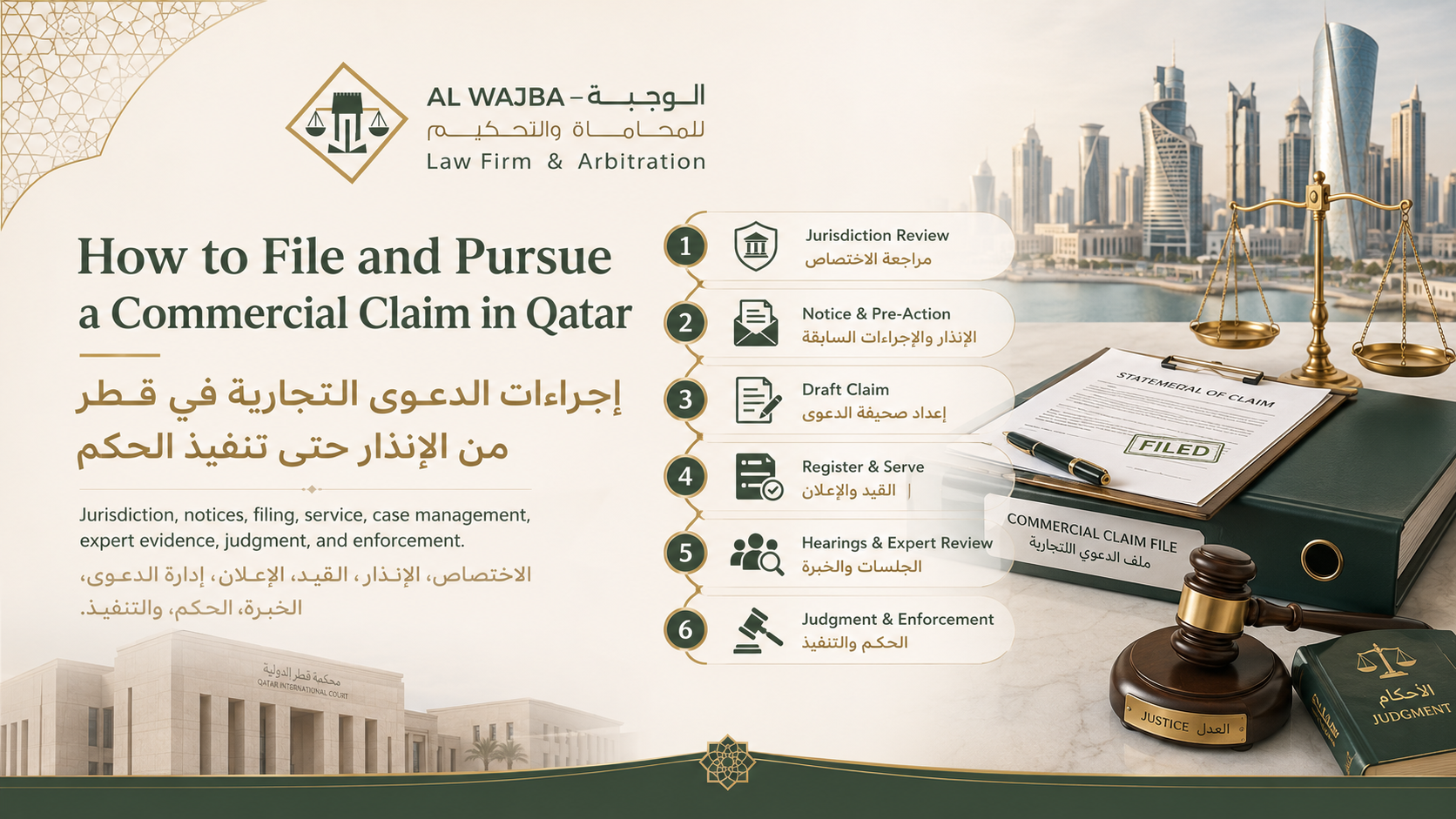
What to Do When a Commercial Contract Is Breached in Qatar
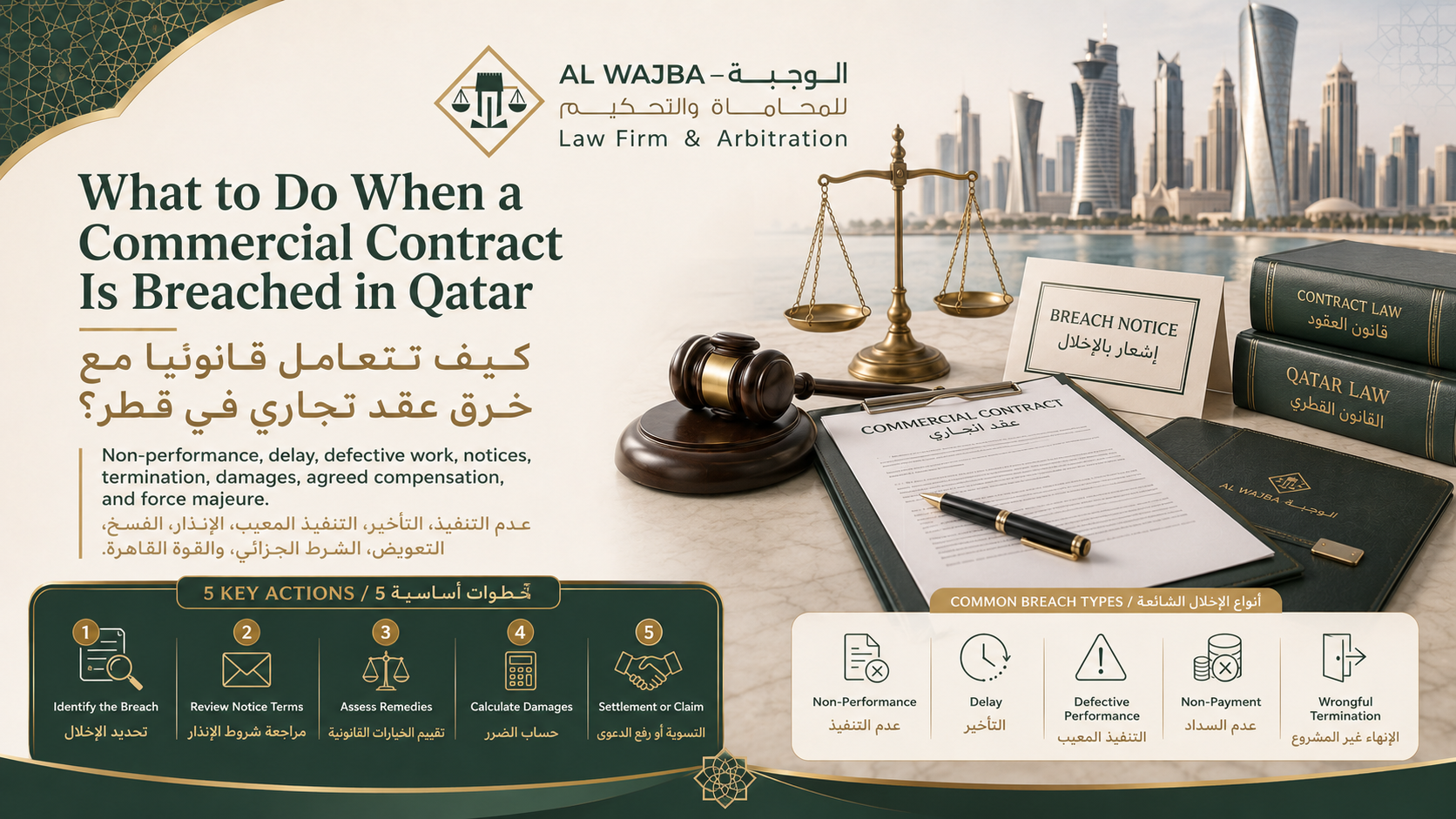
What to Do When a Commercial Contract Is Breached in Qatar
This guide explains breach of commercial contract claims in Qatar, including non-performance, delay, defective work, unpaid contractual amounts, default notices, termination, damages, agreed compensation, force majeure, and the evidence businesses should preserve.
Related Commercial Litigation Guides and Services
Explore related guides and legal services covering contract disputes, commercial court claims, financial recovery, arbitration, and judgment enforcement in Qatar.
The main guide covering commercial lawsuits, contract disputes, financial claims, debt recovery, business partner disputes, arbitration, court procedures, and judgment enforcement in Qatar.
Legal support for commercial lawsuits, contract disputes, financial claims, unpaid debts, business partner disputes, arbitration, and judgment enforcement in Qatar.
A practical guide to filing a commercial lawsuit in Qatar, including jurisdiction, legal notices, required documents, court hearings, judgments, and enforcement.
A practical guide to commercial contract breaches, delayed or defective performance, contract termination, compensation claims, and penalty clauses in Qatar.
A guide to commercial financial claims involving unpaid invoices, contractual payments, compensation, account statements, and supporting evidence in Qatar.
A practical guide to recovering commercial debts through payment demands, settlement negotiations, court claims, precautionary measures, and enforcement in Qatar.
Legal support for unpaid invoices, commercial debts, payment demands, settlement negotiations, financial claims, court proceedings, and enforcement in Qatar.
A practical guide to disputes between business partners involving company management, profit distribution, access to records, company shares, withdrawal, and partner agreements.
A guide to the jurisdiction, procedures, required documents, hearings, judgments, and case preparation before the Investment and Trade Court in Qatar.
A practical guide to arbitration agreements, arbitral procedures, interim measures, arbitral awards, challenges, and enforcement in Qatar.
A guide to enforcing commercial judgments, recovering awarded amounts, attachment procedures, debtor assets, and enforcement disputes in Qatar.
Legal services for commercial lawsuits, contract disputes, financial claims, debt recovery, business partner disputes, arbitration, and judgment enforcement.
Quick answer: what should you do after a commercial contract breach?
Preserve the evidence, identify the exact obligation and breach, review notice and cure requirements, calculate the loss, mitigate further damage, and choose the appropriate contractual or legal remedy.
- Identify the precise contractual clause, specification, deadline, or payment obligation that was breached.
- Confirm whether the obligation was due and whether any condition or reciprocal obligation remained outstanding.
- Document delay, defects, non-payment, or abandonment through original records and reliable communications.
- Review notice, cure, termination, agreed-damages, liability, force-majeure, and dispute-resolution provisions.
- Calculate the actual financial impact and take reasonable steps to prevent avoidable loss.
- Do not terminate, suspend performance, or admit liability before assessing the consequences.
From identifying the breach to selecting the remedy
Contract review, evidence, notices, cure, termination, damages, and dispute resolution
A contract dispute may begin with a missed deadline, an unpaid invoice, rejected goods, defective work, or a party suddenly refusing to continue. Establishing a legal breach requires comparing actual performance with the signed agreement, specifications, deadlines, amendments, notices, and conduct of both parties.
It is also important to distinguish dissatisfaction with a commercial result from breach of a specific contractual obligation, and to distinguish a serious breach affecting the purpose of the agreement from a limited breach that can be cured or compensated.
Common breach types
Potential remedies
Notice through recovery
Before taking action
What are the main types of commercial contract breach?
Identifying the breach category helps determine the relevant evidence and remedy. A single dispute may involve several forms of breach, such as delay combined with defective performance or non-payment following disputed completion.
| Type of breach | Examples | Questions to examine |
|---|---|---|
| Complete non-performance | A supplier does not deliver the goods, a contractor abandons the work, or a service provider does not provide the agreed service | Was the obligation due, and had the other party completed any prior or reciprocal obligations required from it? |
| Late performance | Delivery, completion, payment, mobilization, or service commencement occurs after the contractual deadline | Was time commercially essential, was an extension granted, and what direct consequences followed from the delay? |
| Defective performance | Goods, services, software, or completed work do not meet the agreed specifications, functionality, or quality | Which specification was breached, and was the defect inspected, reported, and preserved through reliable evidence? |
| Partial performance | Only part of the goods, work, service, or contractual payment has been provided | What portion was completed, can it still be used, and what value or obligation remains outstanding? |
| Failure to pay | A customer refuses or fails to pay an invoice, payment certificate, contractual instalment, or account balance | Is the amount due and adequately calculated, and are there credits, deductions, objections, or earlier payments? |
| Clear refusal or abandonment | A party states that it will not perform, stops supplying, leaves the project, or refuses to continue the contract | Is the refusal clear and final, and does the contract require a notice or cure period before further action? |
| Breach of non-payment obligations | Violation of confidentiality, exclusivity, cooperation, reporting, data, non-solicitation, or other operational obligations | What is the scope and duration of the obligation, and what actual harm arose from the alleged breach? |
| Wrongful termination | A party ends the contract without an agreed ground or without following the required notice and cure procedure | Did the contract permit termination, were the procedural steps followed, and how should the final account be calculated? |
Immediate steps after discovering a contract breach
Preserve the evidence
Secure the signed contract, amendments, invoices, correspondence, delivery records, photographs, reports, and original electronic files before they are lost or altered.
Review the entire contract
Check the scope, specifications, deadlines, payment terms, acceptance process, notices, cure rights, termination provisions, force-majeure clause, liability caps, and dispute mechanism.
Identify when the breach occurred
Determine when the obligation became due, when the delay, defect, refusal, or non-payment arose, and whether additional time was granted.
Control communications
Avoid emotional statements, inaccurate admissions, or inconsistent demands. Communications should preserve the position and match the contract.
Calculate the financial impact
Separate unpaid contractual amounts from repair costs, replacement costs, delay losses, agreed compensation, and other alleged damages.
Prevent avoidable loss
Consider reasonable mitigation measures such as appointing a replacement supplier, protecting goods, securing the site, or preventing further operational disruption.
Select the appropriate remedy
Compare continued performance, cure, payment, termination, damages, settlement, court litigation, and arbitration.
Assess recoverability
Confirm the breaching party's legal identity, financial position, guarantees, and reachable assets before committing to lengthy proceedings.
Core legal principles in commercial contract disputes
Each principle must be applied to the wording of the agreement and the actual facts. Together, they identify the issues to examine before issuing a demand, suspending performance, terminating, or claiming damages.
The contract is binding
A valid contract generally binds the parties according to its terms and cannot simply be changed or abandoned because performance later becomes commercially inconvenient.
Good-faith performance
Contractual obligations should be performed according to the agreement and consistently with good faith, together with requirements arising from law, custom, and the nature of the obligation.
Notice and default
A formal demand or notice may be relevant before certain remedies are pursued. The contract may prescribe the address, delivery method, content, and cure period.
Specific performance
Where legally and practically available, the affected party may seek performance of the contractual obligation itself rather than only financial compensation.
Termination or rescission
In reciprocal contracts, serious non-performance may support a request to terminate or rescind the contract, subject to notice, contractual terms, and the circumstances of the breach.
Contractual damages
A damages claim ordinarily requires proof of breach, recoverable loss, and causation, together with a clear calculation and supporting records.
Agreed compensation
The contract may state a predetermined amount or formula for certain breaches, often described in English-language contracts as liquidated damages or a penalty clause.
Force majeure and exceptional hardship
The legal effect depends on whether performance became impossible, merely more onerous, or only less profitable, as well as the contract's allocation of risk.
How do you assess whether there is an actionable breach?
- Is there a valid contract identifying the obligation in dispute?
- What exact obligation was not performed or was performed incorrectly?
- Had the obligation become due, or was it subject to an approval, condition, or earlier act?
- Did the affected party perform its own reciprocal obligations?
- Has an actual breach occurred, or is there only concern about possible future non-performance?
- Were defective goods, work, services, or invoices rejected within an appropriate period?
- Does the contract give the breaching party a cure or correction period?
- Was notice delivered to the address and through the method required by the contract?
- Is the breach material to the contract or limited in scope?
- Can the obligation still be performed effectively?
- What loss arose directly from the breach?
- What reasonable steps were taken to reduce further loss?
- Does the breaching party rely on force majeure, exceptional hardship, or conduct of the other party?
- Are there liability caps, exclusions, indemnities, guarantees, or agreed-damages clauses?
- Does the dispute belong before a court or an arbitral tribunal?
Default notices and demands to perform
A notice may do more than request payment or performance. It can establish the date of default, provide an agreed cure period, define the affected party's position, and support later termination or damages arguments.
What should be checked before sending the notice?
- The correct legal name and capacity of the party sending the notice
- The breaching party's legal name and contractual notice address
- Identification of the contract, date, amendments, and relevant purchase orders
- A precise description of the obligation that was breached
- The contractual deadline or event establishing the breach
- Reference to relevant earlier correspondence, objections, or demands
- The required action, such as payment, repair, completion, replacement, or delivery
- The contractually required or otherwise appropriate cure period
- An express reservation of other rights and remedies where appropriate
- A clear statement of the possible next step without inaccurate or excessive threats
- Use of the notice method required by the agreement and preservation of delivery evidence
- Removal of unverified figures, admissions, or language that could undermine the sender's position
Legal and contractual remedies for breach
Termination is not automatically the best response to every breach. Cure, continued performance, secured payment, or settlement may produce a stronger commercial result, depending on the evidence and recoverability.
| Remedy | When it may be suitable | What to review |
|---|---|---|
| Require performance | Where performance remains possible and receiving the agreed goods, services, work, or documentation remains commercially useful | Practical feasibility, delay, supervision, cost, continued cooperation, and whether court-ordered performance is appropriate |
| Allow a cure period | Where a defect, shortfall, delay, or payment failure can realistically be corrected within a defined period | The contractual cure clause, required standard, deadline, inspection, and consequences if the cure fails |
| Demand payment | Where a fixed or calculable amount is due for goods, services, work, or another completed contractual obligation | The contract, invoice, proof of performance, due date, previous payments, credits, and objections |
| Terminate or rescind | Where the breach is sufficiently serious, persistent, or inconsistent with continued performance of the agreement | Notice, cure rights, express termination language, materiality, final account, return of property, and accrued rights |
| Claim damages | Where measurable financial loss was caused by the breach and can be supported through records and calculations | Causation, foreseeability, mitigation, evidence, contractual exclusions, and liability limits |
| Apply agreed compensation | Where the contract contains a predetermined amount or formula covering the type of breach that occurred | Scope, calculation, damage, partial performance, maximum limits, and possible judicial adjustment |
| Recover payments or security | Where advance payments, deposits, retention amounts, or guarantees relate to work that was not completed | The payment basis, completed value, repayment clause, set-off, guarantee conditions, and final accounting |
| Renegotiate or settle | Where preserving the relationship or achieving faster secured recovery is more valuable than pursuing the entire dispute | Payment terms, security, releases, confidentiality, revised obligations, and consequences of settlement default |
Terminating or rescinding a commercial contract
Termination can affect accrued payments, completed work, guarantees, property, confidential information, and later damages. The legal and operational consequences should be mapped before the notice is sent.
Identify the termination ground
Connect the proposed termination to a specific contractual provision, legal basis, and documented breach.
Check notice and cure requirements
Review whether a notice must be sent, how it must be delivered, the cure period, and who is authorized to receive it.
Assess the seriousness of the breach
Consider the importance of the unperformed obligation, whether it can be corrected, and its impact on the commercial purpose of the agreement.
Map the consequences of termination
Determine what happens to completed work, goods, advance payments, retention, guarantees, equipment, data, records, and confidential information.
Preserve the physical and electronic record
Document the condition of work, goods, systems, or the site at termination and preserve records proving completion levels and defects.
Prepare the final account
Separate amounts earned from repair, replacement, completion, repayment, agreed compensation, and other alleged damages.
Issue a clear termination notice
Use the required address and delivery method and state the contractual basis, effective date, and consequences without contradictory wording.
Select the dispute route
Decide whether the resulting claim should be negotiated, litigated, arbitrated, or supported by an urgent protective application.
How should contractual damages be calculated?
A useful claim is traceable. Rather than presenting one unexplained total, separate each loss category, identify its cause, explain the calculation, and link it to supporting evidence.
| Claim category | Examples | Potential evidence |
|---|---|---|
| Outstanding contractual amount | Invoices, payment certificates, instalments, or account balances that became due | Contract, invoice, performance evidence, statement of account, and due date |
| Repair or completion cost | The cost of correcting defective work or completing unfinished obligations through another provider | Defect reports, quotations, invoices, scope comparisons, and proof that the cost was reasonable |
| Replacement cost | The higher cost of obtaining substitute goods, services, or materials following non-performance | Alternative quotations, substitute contract, invoice, necessity, and price comparison |
| Delay-related cost | Additional site, staffing, storage, financing, supervision, or extension expenses | Time records, invoices, payroll data, linked contracts, and proof connecting the expense to the delay |
| Loss of profit | Profit allegedly lost from business or transactions disrupted by the breach | Existing contracts, financial history, reliable forecasts, and a demonstrable causal link |
| Payments made for incomplete performance | Advance payments or amounts paid for work, goods, or services not fully provided | Payment proof, completed value, contract terms, and final-account calculations |
| Agreed compensation | A predetermined amount or rate for delay, failure to deliver, or another specified breach | Clause wording, breach category, duration, calculation, damage, and partial performance |
| Third-party exposure | Liabilities or costs incurred toward a customer or another party because of the breach | Third-party contract, claim, payment evidence, causation, and whether the consequence was reasonably foreseeable |
Liquidated damages, penalty clauses, and agreed compensation
A stated rate or amount is not necessarily applied mechanically in every case. The clause, breach, damage, partial performance, cap, and calculation should all be reviewed.
Scope of the clause
Confirm that the clause covers the type of breach that actually occurred, such as delay, non-delivery, or failure to complete.
Calculation method
Review the amount or percentage, maximum cap, commencement date, duration, exclusions, and any required certification.
Actual damage
The absence of proven damage may affect whether agreed compensation remains payable under the applicable Civil Code provisions.
Excessive calculation
The court may reduce the agreed amount where the calculation is proven to be substantially exaggerated.
Partial performance
Completion of part of the contractual obligation may affect the amount of agreed compensation.
Relationship to the main obligation
Review how the clause operates if the contract is terminated, rescinded, completed late, or only partly performed.
Force majeure, exceptional hardship, and commercial difficulty
Calling an event “force majeure” in correspondence does not determine its legal effect. The event, causation, foreseeability, notice, contractual risk allocation, and actual effect on performance should be examined.
| Situation | Practical meaning | Possible legal issue |
|---|---|---|
| Ordinary contractual breach | Non-performance, delay, or defective performance attributable to the obligated party or falling within risks it accepted | Performance, cure, termination, damages, agreed compensation, or another contractual remedy |
| Force majeure and impossibility | An external event makes the contractual obligation genuinely impossible, subject to causation and contractual risk allocation | The obligation and reciprocal obligation may be affected, but the precise result depends on the contract and applicable law |
| Exceptional unforeseen hardship | A general exceptional event does not make performance impossible but makes it excessively onerous and threatens severe loss | The issue may require judicial assessment and adjustment after balancing the parties' interests |
| Ordinary commercial difficulty | Higher cost, reduced profit, staffing difficulty, or supply inconvenience within normal business risk | It does not automatically excuse performance; price-adjustment and risk-allocation clauses should be reviewed |
| Prevention by the other party | Performance is affected because the other party failed to provide access, approvals, information, payment, or necessary cooperation | Responsibility, extensions, compensation, and the right to suspend or terminate may require reassessment |
How do you prove breach of commercial contract?
Contract wording
The contract defines the obligation, specification, deadline, payment terms, notice process, cure period, termination rights, agreed damages, and dispute forum.
Performance evidence
Delivery records, completion certificates, approvals, payment records, and service reports show what each party actually performed.
Delay evidence
Programmes, progress reports, extension requests, meeting minutes, and notices help establish when and why delay occurred.
Defect evidence
Inspection reports, photographs, tests, punch lists, repair quotations, and specialist opinions may establish defective performance.
Loss evidence
Replacement invoices, repair costs, additional operational expenses, and accounting schedules support the financial claim.
Correspondence and admissions
Communications may prove instructions, objections, acceptance, acknowledgment of delay, requests for additional time, or agreed corrective action.
Documents for a commercial contract breach claim
Contract and all schedules
The signed agreement, general and special conditions, specifications, scope of work, schedules, purchase orders, variations, and amendments.
Performance timetable
Commencement, delivery, completion, payment, and milestone dates, including agreed extensions and revised programmes.
Evidence of your own performance
Payments, approvals, access, information, instructions, permits, delivery, and other reciprocal obligations completed by the affected party.
Evidence of the breach
Non-delivery records, delay reports, defect notices, rejection documents, suspension notices, and evidence of unpaid amounts.
Correspondence and notices
Emails, letters, messages, meeting minutes, warnings, cure notices, objections, responses, and extension requests.
Invoices and accounts
Invoices, payment certificates, account statements, transfers, partial payments, credits, deductions, retention, and set-off records.
Technical material
Drawings, specifications, inspection records, photographs, testing results, quality reports, and engineering or specialist assessments.
Evidence of loss
Repair and replacement quotations, substitute contracts, additional costs, third-party claims, and relevant accounting records.
Mitigation records
Alternative quotations, repair attempts, protective measures, and internal decisions made to prevent the loss from increasing.
Corporate authority documents
Commercial registration, powers of attorney, corporate resolutions, signing authority, and details of the persons issuing or receiving notices.
Breaching-party information
The correct legal name, registration number, address, notification information, guarantees, and available asset information.
Chronology and financial schedule
A dated factual timeline and a separate table showing each claimed amount and its supporting document.
Investment and Trade Court proceedings
The Court's published jurisdiction includes broad categories of commercial-contract and business disputes. The case file should explain the agreement, breach, notices, remedies, calculations, and supporting technical and financial evidence.
- • Confirm jurisdiction and party capacity
- • Prepare the claim or defense
- • Organize exhibits, calculations, and translations
- • Manage hearings and expert procedures
- • Review judgment, appeal, and enforcement
Arbitration of contract disputes
Where the contract contains a valid arbitration agreement covering the dispute, the claim may belong before an arbitral tribunal rather than a court. The seat, rules, language, tribunal formation, interim relief, costs, and enforcement should be reviewed.
- • Review validity and scope of the arbitration clause
- • Identify the institution, rules, and seat
- • Prepare the arbitration request or response
- • Present documentary and expert evidence
- • Enforce or challenge the award where applicable
Common mistakes in commercial contract disputes
- Terminating immediately without reviewing the notice or cure clause
- Continuing to accept defective performance without a clear reservation or documented objection
- Suspending reciprocal obligations without assessing the contractual and legal consequences
- Describing the breach generally without identifying the violated clause or specification
- Failing to preserve the final signed contract, schedules, and later amendments
- Sending emotional or inconsistent communications that undermine the legal position
- Claiming the entire contract price despite usable partial performance
- Applying agreed damages without a clear and traceable calculation
- Failing to prove the loss and its causal connection to the breach
- Failing to take reasonable steps to reduce further loss
- Assuming that every cost increase or supply problem is force majeure
- Ignoring liability caps, exclusions, indemnities, or notice requirements
- Starting court proceedings without reviewing the arbitration clause
- Delaying inspection, defect documentation, or rejection of non-conforming goods
- Focusing on obtaining judgment without considering whether the defendant can pay
- Signing a settlement without security and defined consequences of non-payment
How can a commercial contract lawyer help?
Assess the breach
Compare the facts with the contract and identify the obligation, due date, defenses, and seriousness of the breach.
Prepare notices
Draft a demand or cure notice that identifies the breach, deadline, remedy, and reservation of rights.
Calculate the claim
Separate unpaid amounts, repair costs, replacement costs, agreed compensation, and other damages.
Negotiate settlement
Compare settlement with continued performance, termination, court proceedings, or arbitration.
Litigate or arbitrate
Prepare claims, defenses, evidence, submissions, expert materials, and procedural applications.
Enforce the result
Review judgments or awards and pursue payment, performance, or legally available enforcement measures.
How this guide was prepared
Official legislation and court sources
The general framework is based on Qatar's Civil Code, Trading Regulation Law, procedural legislation, and official Investment and Trade Court materials.
Practical evidence focus
The guide focuses on contracts, notices, correspondence, calculations, technical evidence, mitigation, and enforcement rather than abstract rules alone.
No guaranteed outcomes
The result depends on the agreement, type of breach, notices, damage, defenses, expert evidence, and the decision of the court or arbitral tribunal.
Official court and legal sources
These English-language sources provide the official framework on contractual performance, exceptional events, termination, damages, agreed compensation, force majeure, commercial-court jurisdiction, procedure, and arbitration. Current texts should be reviewed for a live dispute.
Investment and Trade Court – Official Website
Investment and Trade Court – Court Overview and Jurisdiction
Al Meezan – Civil Code, Law No. 22 of 2004
Civil Code – Binding Force of Contracts and Exceptional Events, Article 171
Civil Code – Good-Faith Performance, Article 172
Civil Code – Termination for Non-Performance, Article 183
Civil Code – Express Termination Clause, Article 184
Civil Code – Force Majeure and Contract Dissolution, Article 188
Civil Code – Contractual Damages, Article 263
Civil Code – Agreed Compensation, Article 265
Civil Code – Reduction of Agreed Compensation, Article 266
Civil Code – Contractual Allocation of Force-Majeure Risk, Article 258
Al Meezan – Trading Regulation Law, Law No. 27 of 2006
Al Meezan – Civil and Commercial Procedure Law
Al Meezan – Arbitration Law, Law No. 2 of 2017
Taqadi – Investment and Trade Court E-Services
Breach of commercial contract in Qatar FAQ
What is a breach of commercial contract in Qatar?
A breach may involve failure to perform a contractual obligation, late performance, partial performance, defective performance, non-payment, or termination without following the agreed requirements. The exact obligation, due date, evidence, and available defenses must be identified.
What can a business do when the other party breaches a contract?
Possible responses include requiring performance, allowing a cure period, demanding payment, terminating or rescinding the contract, claiming damages, applying agreed compensation, recovering advance payments, or negotiating a settlement. The appropriate response depends on the agreement and facts.
Must a default notice be sent before terminating a contract?
Notice may be required by the contract, the applicable legal rules, or the nature of the remedy being pursued. The agreement may specify the notice address, delivery method, content, and cure period. Those provisions should be reviewed before termination.
Does an express termination clause allow immediate termination?
An express termination clause may affect the procedure and legal effect of non-performance, but its wording, scope, notice requirements, and connection to the actual breach must be reviewed. A general clause does not necessarily justify immediate termination in every situation.
When can damages be claimed for breach of contract?
A damages claim normally requires evidence of breach, recoverable loss, and causation. The claimant should explain the type of damage, calculation method, supporting documents, mitigation measures, and any relevant liability cap or exclusion.
What types of contractual losses may be recoverable?
Depending on the contract and applicable legal requirements, a claim may include outstanding amounts, repair or completion costs, replacement costs, certain delay expenses, repayments, agreed compensation, and some loss-of-profit or third-party losses where adequately proved.
What is a liquidated-damages or penalty clause?
It is a contractual provision that predetermines compensation for a specified breach, such as delay or failure to deliver. The clause should identify the covered breach, formula, cap, commencement date, and relationship to actual performance and loss.
Can a Qatar court reduce agreed contractual damages?
Under the Civil Code, agreed compensation may be reduced where the obligor proves that the calculation is substantially exaggerated or that the obligation was partly performed. Proof that no damage occurred may also affect whether the agreed amount is payable.
Does a minor delay justify termination of a commercial contract?
Not every delay justifies termination. The importance of the deadline, duration and effect of the delay, cure rights, continued usefulness of performance, and the contract's express termination provisions should be reviewed.
How can a company prove breach of contract?
Evidence commonly includes the signed contract, specifications, programmes, delivery records, invoices, account statements, emails, notices, inspection reports, photographs, testing records, defect reports, payment records, and financial calculations.
Can emails and messages prove a contractual breach?
Electronic communications may prove instructions, objections, admissions, requests for time, agreed changes, rejection, or acknowledgment of delay. Complete message chains and original electronic files are generally more useful than isolated screenshots.
What is the difference between force majeure and exceptional hardship?
Force majeure may involve an external event making performance impossible, while exceptional unforeseen events may make performance excessively onerous without making it impossible. The legal characterization depends on the facts, contract, causation, and allocation of risk.
Does an increase in prices amount to force majeure?
An increase in cost or reduction in profitability does not automatically amount to force majeure. The event's severity, foreseeability, effect on actual performance, price-adjustment clause, and contractual allocation of risk should be examined.
Can I suspend my performance because the other party breached?
The relationship between reciprocal obligations may affect the right to continue, withhold, or suspend performance. Stopping work or payment without review may expose the suspending party to a counterclaim, so the contract and circumstances should be assessed first.
Which court handles commercial contract disputes in Qatar?
The Investment and Trade Court has jurisdiction over broad categories of disputes involving commercial contracts and business relationships. The parties, nature of the transaction, requested remedies, special legislation, and any arbitration clause must still be reviewed.
When should a business consult a commercial contract lawyer?
Legal review is particularly important before termination or suspension, where the claim is high value, the contract includes arbitration or agreed damages, technical defects or complex delay issues exist, assets may be at risk, or the financial loss is difficult to calculate.
Facing a breach of commercial contract in Qatar?
We can review the agreement, breach, notices, and evidence; assess performance, termination, damages, agreed compensation, and force majeure; and develop a strategy for negotiation, court proceedings, or arbitration.
About the Author
Written by Mr. Yasser Asaad — Egyptian Lawyer in Qatar. A legal director with 33+ years of experience in Egyptian and Qatari law, specializing in international civil and commercial arbitration.
Need Legal Consultation?
Our team of specialized lawyers is ready to assist you with all your legal matters.
Contact Us Now