Types of Companies in Qatar: Complete Guide for Investors and Founders
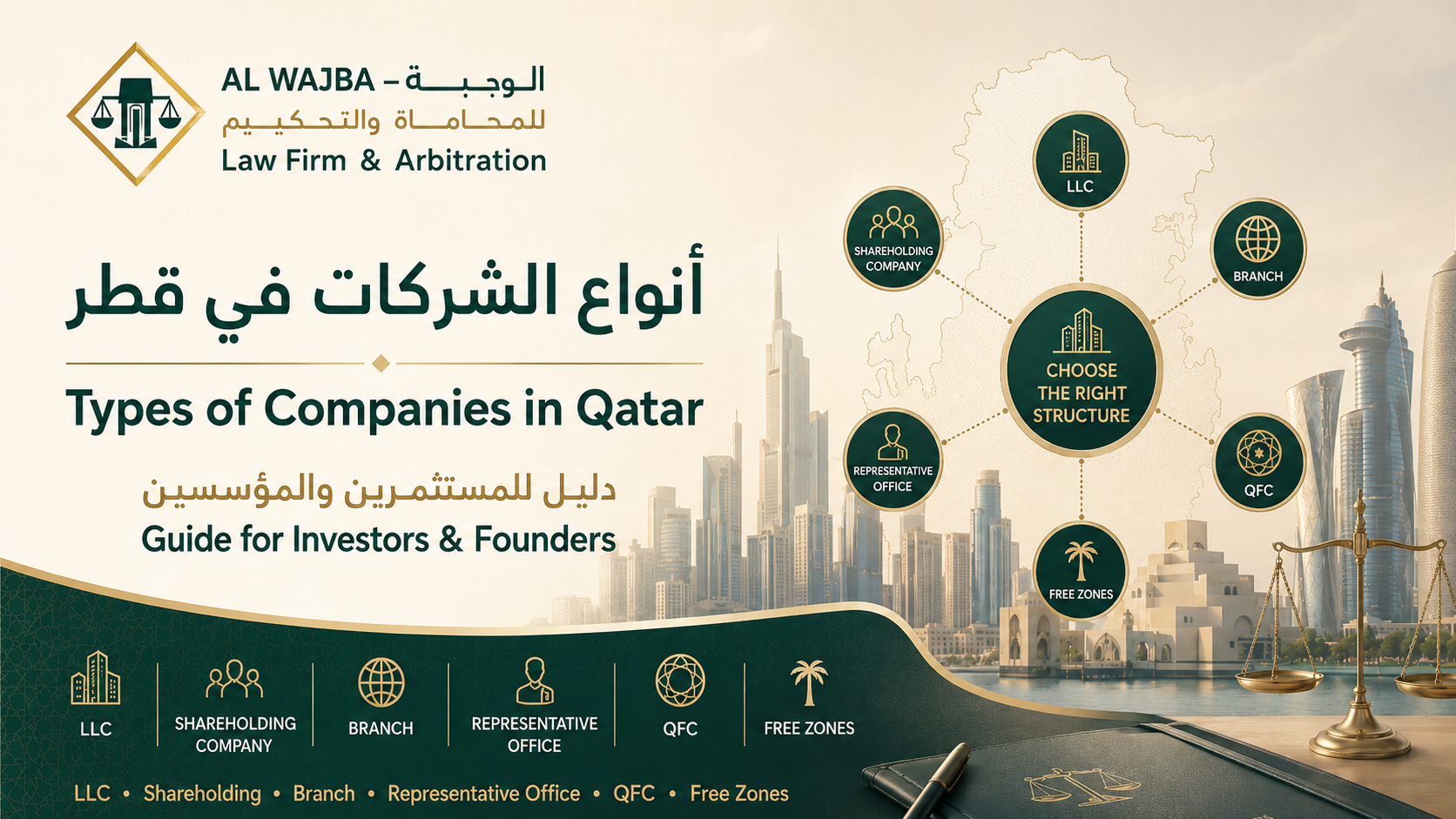
Choosing the right company type in Qatar is one of the most important decisions before registration. The structure affects ownership, liability, licensing, tax registration, management powers, documents, and the authority route. This guide compares LLCs, shareholding companies, branches, representative offices, QFC companies, Qatar Free Zone companies, and other structures so investors can understand which route may fit their business.
Related Company Formation Guides and Services
Explore related guides and legal services for company formation in Qatar.
The main guide covering company types, setup process, documents, costs, and Qatar formation routes.
End-to-end setup support for registration, documents, licensing, tax, and launch readiness.
Legal structuring, shareholder agreements, Articles of Association, risk review, and compliance.
A detailed comparison of LLCs, shareholding companies, branches, representative offices, and other structures.
A focused guide for limited liability company setup in Qatar.
A focused guide for eligible businesses setting up through Qatar Financial Centre.
A focused guide for businesses considering Qatar Free Zones.
A focused guide for foreign companies opening a branch in Qatar.
A focused guide for foreign companies opening a commercial representation office.
Corporate legal advice for contracts, governance, compliance, and business operations.
Quick answer: what is the best company type in Qatar?
The best company type depends on the activity, ownership plan, liability risk, operating model, and authority route. Many SMEs use an LLC, while larger ventures may use shareholding companies, foreign companies may consider branches or representative offices, and eligible businesses may consider QFC or Qatar Free Zones.
- Use an LLC / WLL when you need a flexible local company structure for many commercial or service activities.
- Use a shareholding company when the business needs a more formal share-based and governance-heavy structure.
- Use a branch only when a foreign company has an approved reason to operate through a branch in Qatar.
- Use a representative office only for limited representation, marketing, liaison, or promotional activity.
- Consider QFC or Qatar Free Zones when the business activity fits their eligibility and operating framework.
Company Type vs Setup Route
The right structure should match the activity, ownership, liability, and commercial plan
Company type
This is the legal or commercial form of the business, such as an LLC, shareholding company, branch, representative office, or partnership. It affects ownership, liability, governance, documents, and the legal relationship between owners.
Setup route
This is the authority or platform through which the business is registered or licensed, such as mainland registration, QFC, or Qatar Free Zones. It affects permitted activities, approvals, operational scope, and practical setup steps.
Quick Comparison of Company Types in Qatar
This table gives a practical overview. It should not replace a case-specific legal and setup review, especially where foreign ownership, regulated activities, branch liability, or shareholder rights are involved.
| Company type | Usually best for | Separate entity? | Key risk to review |
|---|---|---|---|
| LLC / WLL | SMEs, services, trading, local operations | Yes | Wrong activity, unclear ownership, weak manager or shareholder drafting |
| Private Shareholding Company | Larger private ventures and group ownership | Yes | More formal governance and capital planning |
| Public Shareholding Company | Large-scale and public shareholding projects | Yes | Higher regulatory, capital, and governance burden |
| Foreign Branch | Foreign company with an approved Qatar project or contract | Usually no | Parent-company exposure and limited activity scope |
| Representative Office | Promotion, liaison, marketing, market presence | Limited presence | Cannot be treated as a normal trading business |
| QFC Company | Eligible QFC activities and service businesses | Usually yes | Activity must fit QFC framework |
| Qatar Free Zone Company | Logistics, manufacturing, tech, export-oriented projects | Usually yes | May not fit every local-market business model |
Main Types of Companies and Business Structures in Qatar
The structures below are the most relevant options investors usually compare before company formation in Qatar. Some are legal forms, while others are practical setup routes or foreign-company presence options.
Limited Liability Company (LLC / WLL)
Most SMEs, service businesses, trading businesses, consultancies, and local market operations
This is often the starting point for investors comparing company types in Qatar, but activity approval, ownership, manager powers, and document requirements still need case-specific review.
Private Shareholding Company
Larger private ventures, family businesses, investment groups, and multi-founder projects
This structure may be more suitable where the founders want share-based ownership, board-level governance, and a more institutional corporate framework.
Public Shareholding Company
Large-scale projects, public offering structures, heavily capitalized ventures, and listed-company planning
This is not usually the first option for ordinary SMEs. It is more relevant for large projects, regulated sectors, or businesses planning a public shareholding model.
Branch of a Foreign Company
Foreign companies performing an approved project or contract in Qatar
A branch is useful in specific foreign-company scenarios, but it should not be treated as a general substitute for an LLC or other local company form.
Commercial Representative Office
Foreign companies that need a limited Qatar presence for promotion, marketing, liaison, or representation
A representative office is not a normal trading entity. It is generally not the right structure if the business needs to sell, invoice, or conduct direct commercial activity in Qatar.
QFC Company
Eligible professional services, consulting, financial services, holding, tech, advisory, and selected service activities
QFC is an onshore platform with its own registration and licensing framework. The business activity must fit the QFC permitted-activity framework.
Qatar Free Zone Company
Logistics, manufacturing, technology, trade, warehousing, industrial, and export-oriented projects
Qatar Free Zones can be attractive for businesses that fit the free-zone strategy, but they are not automatically the best choice for every business targeting the local Qatar market.
Sole Proprietorship or Single-Owner Structure
Simple owner-led businesses where a single owner structure is legally and commercially suitable
Single-owner structures should be reviewed carefully because the terms used in practice can differ from the legal effect of the registered entity.
Partnership and Other Company Forms
Special cases where the relationship between partners requires a partnership-based structure
Partnership structures are less common for many foreign-investor setups and should be reviewed carefully before use because liability can be very different from an LLC.
How to Choose the Right Company Type in Qatar
The right company type is not always the cheapest or fastest option. It should fit the legal, commercial, tax, ownership, and operational needs of the business.
Business Activity
The selected activity affects which structure is available, which authority handles the setup, and whether additional approvals are required.
Foreign Ownership
Foreign ownership rules can vary depending on activity, sector, route, and approval requirements. Do not assume the same rule applies to every company type.
Liability Exposure
An LLC, branch, partnership, representative office, and shareholding company can create very different liability consequences for owners and parent companies.
Number of Owners
A solo founder, two founders, a foreign parent company, a family group, and an investor-backed venture may each need a different structure.
Authority Route
Mainland, QFC, and Qatar Free Zones are not interchangeable. Each route has its own activity scope, registration process, documents, and practical use case.
Capital and Cost
Capital expectations, licensing fees, office requirements, professional fees, and post-registration costs can differ significantly by structure.
Which Structure Fits Which Business Scenario?
These examples are practical starting points. The final answer should always be checked against the business activity, ownership plan, documents, and approval route.
Scenario
A small service business wants to serve clients in Qatar
Likely structure
LLC / WLL or another suitable mainland structure
Why
An LLC is often practical for local-market operations, subject to activity approval and ownership requirements.
Scenario
A consulting or professional services business fits QFC activities
Likely structure
QFC company
Why
QFC may be suitable where the activity is permitted under the QFC framework and the business wants that route.
Scenario
A logistics, manufacturing, or export-focused project
Likely structure
Qatar Free Zone company
Why
Qatar Free Zones may be suitable where the project fits the free-zone strategy and approval criteria.
Scenario
A foreign company has an approved Qatar project or contract
Likely structure
Branch of a foreign company
Why
A branch may be possible where the foreign company has the right approval basis, but parent-company exposure should be reviewed.
Scenario
A foreign company only wants promotion and market presence
Likely structure
Commercial representative office
Why
A representative office can support promotion and liaison, but it should not be used for normal trading activity.
Scenario
A larger founder group needs formal governance
Likely structure
Private shareholding company
Why
A private shareholding company may suit larger ventures requiring more formal share-based ownership and governance.
Documents Needed by Company Type
Document requirements vary by route, activity, shareholder profile, and whether foreign-issued documents need certification, attestation, legalization, or Arabic translation.
| Structure | Common document categories |
|---|---|
| LLC / WLL | Founder IDs, trade name, activity details, Articles of Association, manager and authorized signatory details, beneficial ownership information, powers of attorney where applicable. |
| Shareholding Company | Founder documents, constitutional documents, board and shareholder planning documents, capital and governance records, approvals depending on the activity and structure. |
| Foreign Branch | Foreign parent company documents, commercial register, constitutional documents, board resolution, contract or approval basis, power of attorney, director or signatory documents, certified foreign documents. |
| Representative Office | Foreign company registration documents, decision to open the office, power of attorney for the office director, office-related application documents, and certified foreign documents. |
| QFC Company | QFC application materials, permitted activity details, ownership and controller information, beneficial ownership information, governance documents, and any regulated-activity materials where applicable. |
| Qatar Free Zone Company | Investor application, project profile, activity details, shareholder documents, business plan or project information, and documents requested by the free-zone authority. |
Common Mistakes When Choosing a Company Type in Qatar
Many company formation delays happen because the wrong structure is chosen before the activity, ownership, liability, and authority route are properly reviewed.
- Choosing an LLC simply because it is common, without checking whether the activity or ownership plan fits
- Treating QFC, Qatar Free Zones, and mainland formation as if they are the same route
- Using a representative office when the business actually needs to sell, invoice, or contract in Qatar
- Opening a branch without reviewing parent-company liability and the approved scope of activity
- Ignoring shareholder rights, exit rules, manager powers, and signing authority before incorporation
- Using old capital information for LLCs instead of checking the current official position
- Assuming 100% foreign ownership is automatic for every activity and structure
- Starting the registration process before foreign corporate documents are attested, translated, or legally reviewed
When Should You Get Legal Advice?
Some structure decisions create long-term legal consequences.
Legal advice is especially important where there are multiple shareholders, foreign corporate shareholders, regulated activities, investor agreements, broad manager powers, branch-office liability, representative-office limits, or uncertainty about foreign ownership. The company type should be selected before documents are drafted and before authority submissions begin.
Review before choosing:
- Business activity and licensing route
- Foreign ownership and shareholder structure
- Liability exposure for owners or parent company
- Manager and authorized signatory powers
- Tax, premises, banking, and post-registration needs
- Shareholder agreements and exit protections
Practical Process for Selecting a Company Type
Before starting registration, work through the structure decision in the right order.
Confirm the exact business activity
The activity drives the structure, authority route, additional approvals, and documents.
Compare authority routes
Decide whether the business is better suited to mainland, QFC, Qatar Free Zones, branch, or representative-office registration.
Review ownership and liability
Check who will own the company, who will manage it, who can sign, and who carries liability risk.
Check document readiness
Foreign corporate documents, powers of attorney, translations, attestations, and beneficial ownership details can affect timing.
Prepare incorporation documents
Draft or review Articles of Association, shareholder agreements, resolutions, manager powers, and internal authority documents.
Proceed with registration and launch steps
After choosing the structure, continue with trade name, registration, licensing, tax, address, banking readiness, and compliance steps.
Official Sources and Useful References
These sources are useful starting points for checking company types, foreign investment rules, branch and representative-office rules, QFC registration, Qatar Free Zones, and tax-related portals.
FAQs About Types of Companies in Qatar
Practical answers for investors comparing company structures before registration.
What are the main types of companies in Qatar?
The main company and setup options in Qatar include Limited Liability Companies, shareholding companies, branches of foreign companies, commercial representative offices, QFC companies, Qatar Free Zone companies, single-owner structures, partnerships, and other specialized forms. The right option depends on the business activity, ownership plan, liability concerns, and authority route.
What is the most common company type in Qatar?
The Limited Liability Company, often called an LLC or WLL, is one of the most common structures for many commercial, trading, consulting, and service businesses in Qatar. It is still important to confirm whether the activity, ownership plan, and licensing route fit the LLC model.
What is the difference between an LLC and a branch in Qatar?
An LLC is generally a separate Qatari company with partners or shareholders. A branch of a foreign company is usually an extension of the foreign parent company and may be available only in specific approved circumstances. The branch can create different liability and activity-scope issues for the foreign parent company.
What is the difference between a branch and a representative office in Qatar?
A branch is used where a foreign company has an approved basis to carry out work in Qatar, often linked to a specific contract or approval route. A representative office is more limited and is generally used for promotion, liaison, marketing, and representation rather than direct trading or invoicing.
Is QFC the same as a mainland company in Qatar?
No. QFC is an onshore business and financial centre with its own registration, licensing, and permitted activity framework. Mainland companies are generally formed through the standard commercial registration and licensing route. The right route depends on the business activity and operating model.
Is a Qatar Free Zone company right for every business?
No. Qatar Free Zones can be attractive for eligible logistics, manufacturing, technology, trade, industrial, and export-oriented projects. A free-zone company may not be the best fit for every business that mainly wants unrestricted local-market operations in Qatar.
Can foreigners own 100% of a company in Qatar?
Qatar's foreign investment framework allows full foreign ownership in many sectors, subject to the applicable law, executive regulations, activity restrictions, and approval requirements. The exact position should be checked based on the activity, route, and company structure.
Which company type is best for foreign investors in Qatar?
There is no single best company type for every foreign investor. An LLC may suit many local-market businesses, QFC may suit eligible professional or financial services, Qatar Free Zones may suit eligible logistics or export-oriented projects, and a branch may suit a foreign company with an approved Qatar contract. The best option depends on activity, ownership, tax, liability, and operational needs.
Do I need legal advice before choosing a company type in Qatar?
Legal advice is recommended when there are multiple shareholders, foreign corporate shareholders, regulated activities, branch-office questions, representative-office limits, investor agreements, or concerns about liability, control, manager powers, and signing authority.
Need Help Choosing the Right Company Type?
Choosing the wrong structure can create licensing delays, ownership problems, liability exposure, or unnecessary restructuring later. We can help you compare LLC, branch, representative office, QFC, Qatar Free Zone, and shareholding options based on your activity and ownership plan.
About the Author
Written by Mr. Arqam Abdelqader — Sudanese Lawyer in Qatar. A Sudanese lawyer registered with the Sudanese Bar Association and the Qatari Ministry of Justice, with legal experience in Sudan, Kuwait, and Qatar. He specializes in family, criminal, corporate, and labor law.
Need Legal Consultation?
Our team of specialized lawyers is ready to assist you with all your legal matters.
Contact Us Now