Documents Needed for Family Court in Qatar: Practical Checklist by Case Type
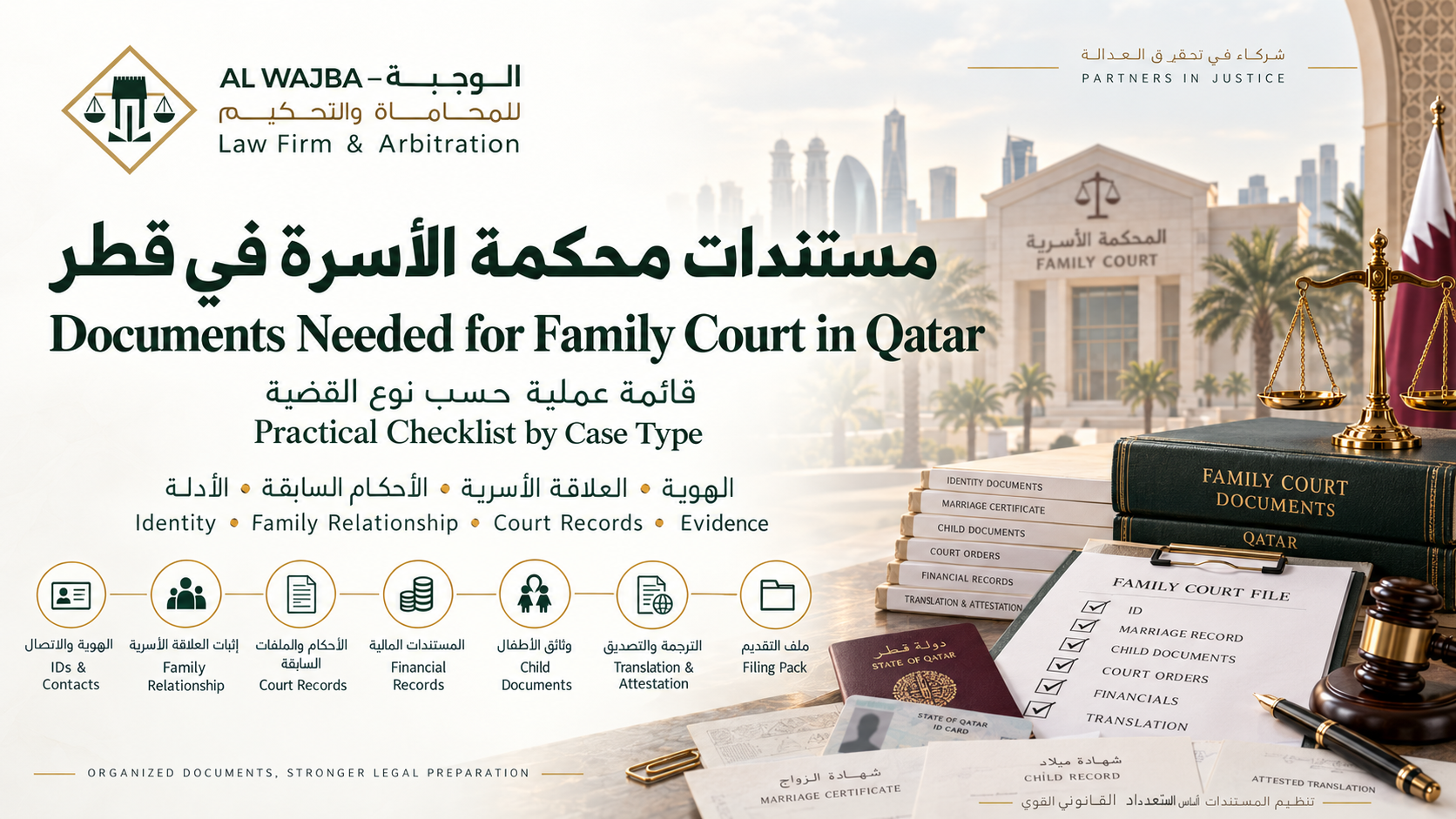
Documents Needed for Family Court in Qatar: Practical Checklist by Case Type
The right Family Court document file is not the biggest file. It is the file that proves who the parties are, establishes the family relationship, shows the existing court history, and connects reliable evidence to each order you are asking the court to make.
This guide explains how to prepare documents for common family cases in Qatar. For the wider court structure and hearing overview, see Family Court in Qatar. For marriage certificates, divorce proof, attestation and related civil-status records, see Marriage and Family Documents in Qatar.
Family Court Guides in Qatar
Continue with the main Family Court guide and practical resources on procedure, documents, hearings, legal support, and related family disputes.
The broad Family Law guide covering divorce, custody, support, marriage documents, inheritance, and Family Court matters in Qatar.
The main guide to Family Court procedures, documents, hearings, case preparation, and family dispute pathways in Qatar.
Legal support for divorce, custody, alimony, child support, inheritance, marriage documents, and family disputes in Qatar.
A guide to how family cases move through court, from documents and filing to hearings, judgment, and enforcement.
A focused guide to documents commonly needed for divorce, custody, maintenance, inheritance, and Family Court cases.
Start with status
IDs, marriage records, children’s documents and prior judgments establish who is involved and the legal relationship behind the request.
Match proof to the request
A support claim needs financial proof; a custody dispute needs child-focused evidence; enforcement needs the order and proof of non-compliance.
Check foreign records early
Translation, attestation and legalization questions can take time, so foreign civil-status and court records should be reviewed before the filing deadline.
The core document file to prepare first
Most family matters become easier to review when the file is divided into four basic groups before case-specific evidence is added.
Identity and contact details
Keep clear copies of the relevant Qatar IDs and passports, current contact information, and the best available address details for the other party. The statement of claim itself must identify the parties and their contact details under the procedural framework.
Proof of family relationship
Marriage contracts or certificates, divorce records, children’s birth certificates, and other civil-status documents establish the relationship on which many Family Court requests depend.
Existing court records
Bring previous judgments, interim orders, settlement agreements, court notices, hearing records, and any execution file details. A new request can be misunderstood if the earlier procedural history is missing.
Evidence tied to each request
Organize the documents that prove the facts behind the exact order you want: income and expenses for support, child-related records for custody, communications where relevant, or proof of non-compliance for enforcement.
Family Court documents by case type
Use this table as a working checklist. It is designed to help you identify the likely evidence categories, not to replace the requirements of a particular court service or judicial direction.
| Type of matter | Start with | Evidence often added |
|---|---|---|
| Divorce or judicial separation | Marriage contract/certificate, IDs, any earlier family judgment or agreement, and a short chronology of the relationship and dispute. | Evidence relevant to the legal ground relied on, financial records, child-related documents, communications or other records where legally relevant. |
| Custody or visitation | Children’s birth certificates and IDs/passports, existing custody or visitation orders, school and medical information, and current care arrangements. | Evidence of day-to-day care, residence, schooling, health needs, contact history, travel concerns and a practical proposed schedule. |
| Child support or spousal maintenance | Marriage/divorce records where relevant, children’s records, existing support orders, salary information and a clear schedule of the amounts claimed. | Bank statements, salary records, rent or housing costs, school fees, medical expenses, receipts, payment history and evidence of arrears. |
| Enforcement of an existing family judgment | The judgment or enforceable order, case details, identification documents and a clear statement of what has not been performed. | Payment records, bank transfers, visitation logs, delivery records, messages, notices and evidence of partial or repeated non-compliance. |
| Inheritance or estate dispute | Death certificate, identity and relationship documents, available inheritance or estate records, prior judgments and any relevant will or family arrangement. | Asset records, ownership documents, bank or company records, powers of attorney and documents showing the disputed entitlement or transaction. |
| Responding to a case already filed | Court notice, full claim or application received, hearing details, IDs, previous orders and a concise chronology. | Documents answering each disputed allegation, evidence supporting any counter-request, and records showing compliance with earlier orders or agreements. |
If you are preparing the filing itself rather than only the supporting documents, the planned How Family Cases Work in Qatar explains how the file connects with registration, notices, hearings, judgment and enforcement once that guide is available.
What does Qatar’s filing law require from the claim itself?
Supporting evidence is only one part of the file. Article 31 of the Civil and Commercial Procedures Law requires the statement of claim to identify the parties and their contact information, state the filing information and court, and explain the subject, requests and supporting grounds. That makes document organization a legal communication task, not just an administrative one.
A document should answer a question in the case
Before adding a document, ask what it proves: identity, marriage, parentage, income, an expense, a child’s circumstances, an agreement, payment, non-compliance, or another disputed fact. If you cannot explain its purpose, it may belong in your background file rather than the first court bundle.
Divorce documents: prove status first, then the disputed facts
A divorce or separation file commonly starts with the marriage record and identity documents. From there, the additional evidence depends on the legal route and the consequences being requested. If children, maintenance, housing, dowry, prior agreements or earlier judgments are involved, those issues need their own supporting records rather than being treated as automatic attachments to the divorce claim.
Custody and visitation documents should show the child’s real circumstances
Qatar Family Law defines custody around the child’s keeping, maintenance, upbringing and education. A useful custody file therefore goes beyond identity records. Depending on the dispute, school attendance, medical needs, housing, day-to-day care, communication, travel records, existing visitation arrangements and a realistic proposed schedule can be more informative than general allegations between the parents.
See Child Custody in Qatar for the wider legal context around custody and child-focused disputes.
Support and alimony documents need numbers that can be verified
Financial claims are stronger when every important number has a source. Separate income evidence from expense evidence, and separate ordinary current expenses from arrears or unusual costs. Qatar Family Law addresses marital support and child support, but the amount and proof questions depend on the claim and circumstances.
Income and ability to pay
- Salary certificate or employment information where available
- Relevant bank records and regular transfers
- Evidence of other income or financial resources where legally relevant
- Existing support obligations or judgments that affect the financial picture
Needs, expenses and payment history
- Housing or rental records
- School fees and education expenses
- Medical costs and recurring child expenses
- Receipts, bank transfers and a schedule of paid or unpaid amounts
The Child Support and Alimony in Qatar guide explains these financial issues in more detail.
For enforcement, the judgment is only the starting document
If the case is about enforcing an existing family judgment, organize the operative order and then prove the implementation problem. For money, that may mean a payment schedule and bank records. For visitation or handover, it may mean dated logs, notices and communications. The objective is to show clearly what the judgment required and what happened afterward.
Foreign marriage, birth, divorce and court records: check translation and attestation before filing
International families often hold core records issued outside Qatar. Those documents may need additional formal preparation before they can be used for the intended purpose. Qatar’s Ministry of Foreign Affairs provides attestation services for personal-status documents, while the exact chain can depend on the issuing authority and country.
Check where the document was issued
A Qatari-issued document and a foreign-issued document do not necessarily follow the same authentication route. Identify the issuing authority and the country of origin before arranging attestation.
Check the purpose for which it will be used
The steps can differ depending on whether the document is being used before a Qatar court, another government body, an embassy, or outside Qatar. Do not assume an attestation obtained for one purpose answers every later use.
Prepare Arabic translation when required
If the working court record requires Arabic, arrange an appropriate legal translation and keep the source document attached to or clearly matched with the translated version.
Check names, seals and dates before submission
Transliteration differences, missing pages, expired identity records, unclear seals or mismatched dates can create avoidable delays. Compare the final set before filing.
For document-focused guidance outside the litigation bundle, see Marriage and Family Documents in Qatar.
How to make each document easier for the court to use
Good evidence can lose practical value when it is incomplete, unreadable or disconnected from the point it is supposed to prove.
Electronic filing does not remove the need for a clean source file
The Supreme Judiciary Council directs users to its electronic portal for court and family-document services. Even where a service accepts digital submissions, keep the underlying originals or formally usable records organized. Name files clearly, scan complete pages, keep each final submission together, and save the receipt or confirmation produced by the service.
A simple digital folder structure
Use folders such as 01 Identity and Status, 02 Court Orders, 03 Children, 04 Financial, 05 Communications, 06 Foreign Documents, and 07 Filed Versions. Keep the version actually submitted separate from later drafts so you can always reconstruct what the court received.
Final Family Court document-pack checklist
Before filing, responding, or attending a document-heavy hearing, run through this final preparation list.
Common document mistakes in Family Court cases
The most damaging document problems are often avoidable preparation errors rather than a complete absence of evidence.
Need a document review before filing in Family Court?
A focused legal review can help separate essential records from background material, identify missing evidence, check foreign-document issues, and connect each document to the request you need the court to decide.
Official sources and document references
These official materials support the Family Court framework, claim-content requirements, current e-service environment, Family Law context, and foreign personal-status document guidance discussed above.
Frequently asked questions about Family Court documents in Qatar
These answers are general. The exact document requirement can change with the claim, court direction, issuing country, procedural stage and the evidence disputed between the parties.
What documents do I need for Family Court in Qatar?
There is no single universal checklist. Most files begin with identity documents, proof of the family relationship, relevant existing court records, and evidence supporting the exact request. Divorce, custody, support, inheritance and enforcement matters then require different additional documents.
Do I need my marriage certificate for a family case?
For many disputes involving spouses, the marriage contract or certificate is a key status document. Whether an original, certified copy, translated version or attested foreign document is needed depends on where it was issued and the procedure in which it will be used.
What financial documents should I prepare for child support or alimony?
Useful records can include salary information, bank statements, housing costs, school fees, medical expenses, recurring child costs, receipts, prior support orders and proof of payments or arrears. The evidence should correspond to the amounts actually claimed or disputed.
What documents are useful in a child custody or visitation case?
Commonly useful records include children’s identity and birth documents, existing orders, school and medical records, evidence of current care arrangements, relevant communication, travel information and a practical proposed schedule. The court’s focus is not simply document volume but the facts relevant to the child and the legal issue.
Can I submit WhatsApp messages or screenshots to Family Court?
Electronic communications may be relevant, but relevance and evidential treatment depend on the dispute and the way the material is presented. Preserve the full source and context rather than relying only on selected or cropped screenshots, and obtain legal advice if authenticity or admissibility may be contested.
Do foreign documents need Arabic translation or attestation in Qatar?
Often they require additional preparation, but the exact route depends on the issuing country, document type and intended use. Check translation and attestation requirements before a deadline; Qatar’s Ministry of Foreign Affairs provides attestation services for personal-status documents.
Should I bring original documents to a Family Court hearing?
Keep originals or the formally acceptable version available when required, even if electronic copies were used for an earlier step. The correct format can depend on the service, document and stage of the case, so check the specific filing or hearing instruction.
What if I do not have an important document?
Identify the gap early. Determine who issued or controls the document, whether another official record proves the same fact, and whether a court request or other procedural step may be available. Do not fabricate a substitute or leave the missing point unexplained.
Build the file around the decision you need
Bring your IDs, family-status documents, existing court records, a short chronology and the strongest evidence for each request. If a key record is foreign, missing, untranslated or not yet attested, identify that issue before the court deadline rather than at the hearing.
Office hours: Saturday–Thursday: 9:00 AM – 5:00 PM. This article is general legal information, not a substitute for advice based on your case, filing route, deadlines and documents.
About the Author
Written by Mr. Arqam Abdelqader — Sudanese Lawyer in Qatar. A Sudanese lawyer registered with the Sudanese Bar Association and the Qatari Ministry of Justice, with legal experience in Sudan, Kuwait, and Qatar. He specializes in family, criminal, corporate, and labor law.
Need Legal Consultation?
Our team of specialized lawyers is ready to assist you with all your legal matters.
Contact Us Now